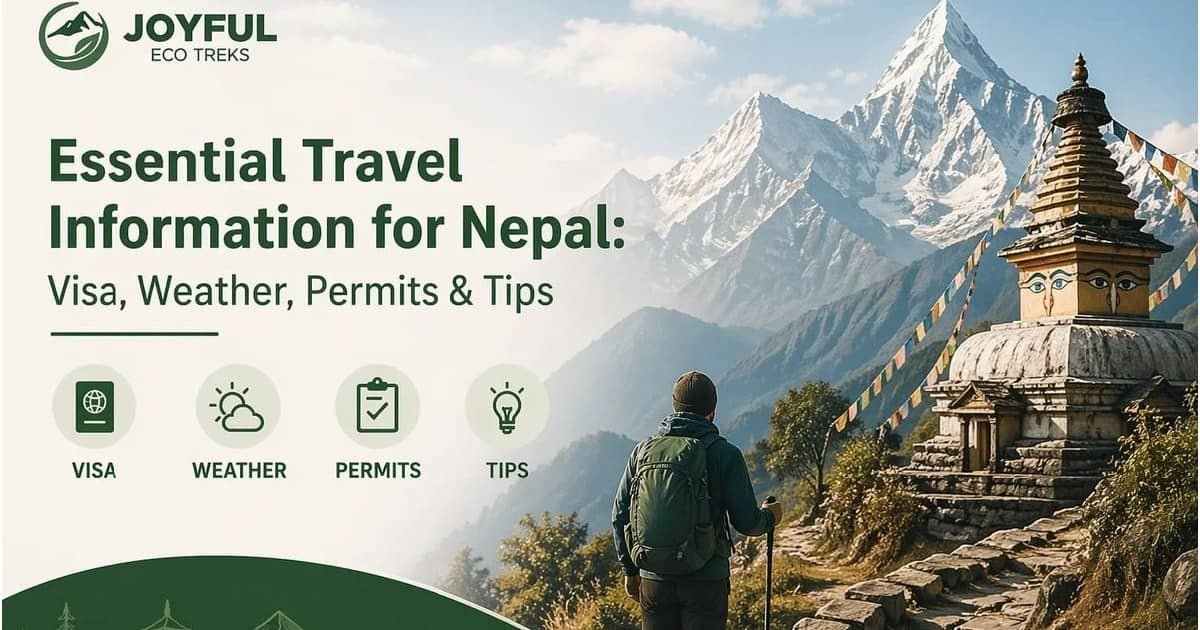
Essential Travel Information for Nepal: Visa, Weather, Permits & Tips
Nepal is one of the world’s top destinations for adventure, culture, and mountain trekking. Before traveling, it is important to understand weather conditions, safety updates, trekking opportunities, and visa requirements, including the cost of tourist visa.
This guide provides all this essential information, along with details on currency, power plugs,and health tips.
Table of Contents
ToggleNepal Visa Information (Visit Visa for Nepal)
150+ countries can obtain a visit visa for Nepal on arrival at Tribhuvan International Airport in Kathmandu or at major land border crossings. To avoid queues, you can also apply online before arrival.
For most nationalities, a 30-day visa on arrival costs USD 50. Official requirements include a passport, an application form, and the visa fee. You can find more information on the official Nepal Immigration Visa on Arrival page.
Nepal Current Situation & Travel Safety
Before your trip, it is helpful to check the latest safety advisories and weather conditions. Nepal is generally safe for travelers, particularly in tourist hubs and popular trekking regions.
Safety Tips
- Follow the guidance of licensed trekking guides.
- Avoid traveling alone in remote areas.
- Respect local customs and regulations.
- Keep emergency contact numbers saved.
Health & Insurance
- Obtain travel insurance that covers high-altitude trekking.
- Ensure coverage includes emergency helicopter evacuation.
- Pack a basic medical kit for common ailments.
- Maintain proper hydration during your trek.
Natural Disaster Risks
- Monsoon Landslides: Be aware of increased risks during the rainy season (June–August).
- Extreme Cold: Prepare for sub-zero temperatures at high altitudes.
- Flight Disruptions: Plan for potential delays in mountain regions due to unpredictable weather.
Weather & Best Time to Visit Nepal
Nepal’s climate varies dramatically by altitude, ranging from subtropical heat in the lowlands to arctic conditions in the high Himalayas. Here are the best time to visit:
- Best Seasons for Trekking and Travel Spring (March – May): Offers clear skies, mild temperatures, and blooming rhododendrons. It is the second-best time for high-altitude trekking.
- Autumn (September – November): Provides the best trekking conditions with post-monsoon clarity and stable weather. This is the peak tourist season.
- Winter (December – February): Ideal for lower-altitude treks and cultural tours. While the skies are clear, high-altitude passes may be closed due to snow.
- Monsoon (June – August): Characterized by heavy rainfall and potential landslide risks. While trekking is difficult, it is a great time for lush greenery and city-based cultural tours.
Electricity & Power Plugs in Nepal
Nepal uses a variety of plug types, and power outages, while less frequent than in the past, can still occur.
- Plug Types: Types C, D, and M are standard.
- Voltage: The standard voltage is 230V with a frequency of 50Hz.
- Recommendations: Bring a universal adapter and a power bank for remote trekking areas.
Currency & Payment Tips
The official currency is the Nepalese Rupee (NPR). While digital payments are growing, cash remains king in the mountains.
- Local Currency: Carry Nepalese Rupees (NPR) for all daily transactions.
- ATM Access: Use ATMs in major cities like Kathmandu and Pokhara before heading into the wild.
- Cash Preference: Carry enough physical cash in small denominations for remote regions.
- Exchange: Convert your currency at official exchange counters or banks for the best rates.
Required Trekking Permits in Nepal
Depending on your chosen trekking region, you may require one or more of the following documents:
- Trekkers’ Information Management System (TIMS) Card: A mandatory registration card for most trekking routes in Nepal.
- National Park Entry Permits: Required for treks passing through protected areas, such as Sagarmatha (Everest) National Park.
- Conservation Area Permits: Necessary for regions like Annapurna or Manaslu to support local environmental efforts.
- Restricted Area Permits: Mandatory for designated sensitive regions, such as Upper Mustang or Upper Dolpo.
Nepal Trekking & Hiking Regions
Nepal is globally renowned for its diverse mountain adventures. The most popular trekking regions include:
Everest Region
- Everest Base Camp Trek: The most iconic journey to the foot of the world’s highest peak.
- Gokyo Lakes Trek: A scenic alternative featuring high-altitude turquoise lakes.
- Three Passes Trek: A challenging circuit for experienced trekkers.
Annapurna Region
- Annapurna Base Camp Trek: A classic route into a spectacular mountain amphitheater.
- Annapurna Circuit Trek: A diverse journey crossing the Thorong La Pass.
- Mardi Himal Trek: A shorter, “off-the-beaten-path” ridge trek.
- Nar Phu Valley Trek: A remote cultural experience in a hidden valley.
Langtang Region
- Langtang Valley Trek: A beautiful trek known for its unique culture and scenery.
- Gosaikunda Trek: A spiritual journey to sacred alpine lakes.
Manaslu & Remote Regions
- Manaslu Circuit Trek: A stunning circuit around the world’s eighth-highest mountain.
- Kanchenjunga Base Camp Trek: A deep wilderness adventure in eastern Nepal.
- Makalu Base Camp Trek: A rugged trek to the base of the “Great Black” mountain.
Why Choose Joyful Eco Treks
At Joyful Eco Treks, we provide professionally guided trekking and tour experiences across Nepal. Our services include:
- Provide Licensed Guides: Every trek is led by an experienced, government-licensed professional.
- Handle All Documentation: We manage all necessary permits and paperwork on your behalf.
- Create Custom Itineraries: Every journey is tailored to your specific preferences and fitness level.
- Provide Full Logistics Support: We offer seamless airport pickups and hotel assistance.
- Ensure Safety Management: We provide 24/7 emergency support and comprehensive safety protocols.
- Organize Diverse Group Sizes: We facilitate both small group tours and private expeditions.
We specialize in trekking across the Everest, Annapurna, Langtang, and Manaslu regions, as well as other remote Himalayan destinations.
Conclusion
Nepal offers an unparalleled blend of adventure, culture, and natural beauty. By understanding the essential requirements, including visa costs, seasonal weather patterns, and trekking permits, you can ensure a seamless and well-prepared journey.
Joyful Eco Treks provides expert guidance and curated itineraries across the Himalayas. By managing all logistical details and safety protocols, we allow you to focus entirely on the experience of your trek.
For a personalized itinerary or the latest travel updates, feel free to reach out to the Joyful Eco Treks team as you plan your journey.
Frequently Asked Questions
Is Nepal visa on arrival available?
Yes, Nepal visa on arrival is available for most nationalities at Tribhuvan International Airport (KTM) and major land border crossings, allowing stays of 15, 30, or 90 days. It is a simple process, with fees applicable for each duration respectively. Citizens from 13 countries (including Nigeria, Ghana, Cameroon, Syria, Iraq, etc.) are required to apply prior to arrival.
How much does a Nepal tourist visa cost?
Nepal tourist visa fees are based on the duration of stay, with on-arrival (multiple-entry) options available at Tribhuvan International Airport and land borders: 15 days for USD 30, 30 days for USD 50, and 90 days for USD 125. Fees must be paid in USD or equivalent foreign currency; credit cards are also accepted.
What currency is used in Nepal?
The official currency of Nepal is the Nepalese Rupee (NPR), symbolized as ₨ or रु. It is pegged to the Indian Rupee at a fixed rate of ₹1 = रु1.60. Regulated by the Nepal Rastra Bank, it is divided into 100 paisa and is available in both coins and banknotes (1, 2, 5, 10, 20, 50, 100, 500, and 1000 denominations).
What type of power plugs are used in Nepal?
Nepal primarily uses three types of power plugs: Type C, Type D, and Type M. The standard voltage is 230V with a frequency of 50Hz. A universal travel adapter is highly recommended, as older buildings often use Type D sockets, while newer accommodations may feature compatible Type C or Type M sockets.

All Categories