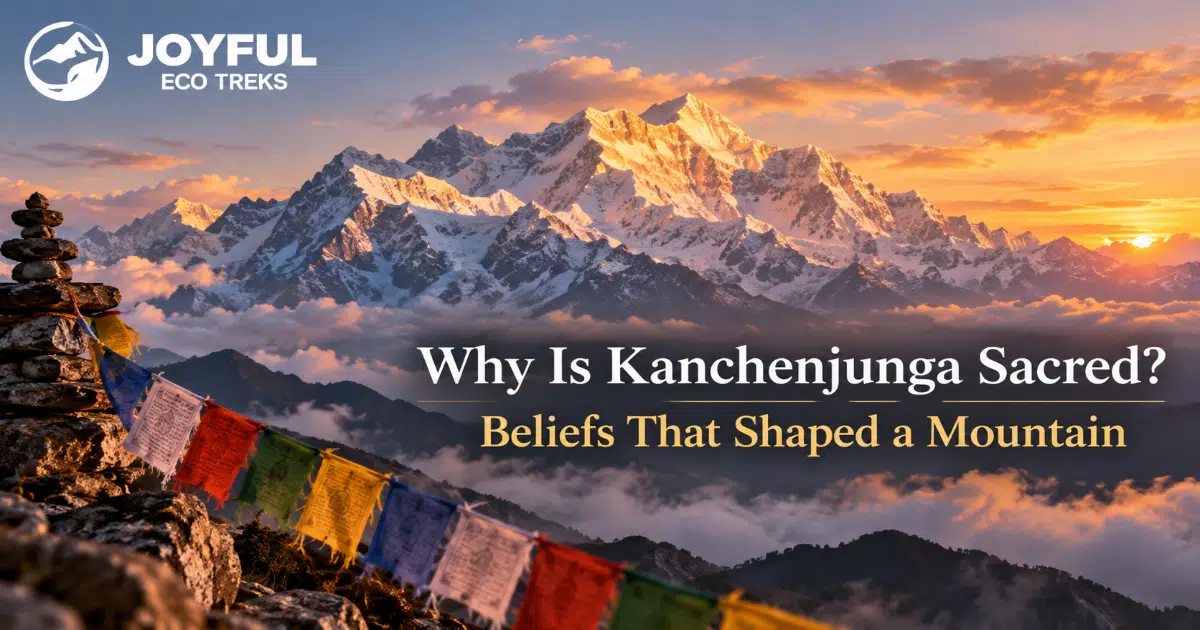
Why Is Kanchenjunga Sacred? Beliefs That Shaped a Mountain
In May 1955, Joe Brown and George Band climbed to within about twenty feet of Kanchenjunga’s true summit, then stopped. They had the weather, the strength, and the daylight to finish. They stopped anyway, and every expedition in the seventy years since has done the same. So why is Kanchenjunga sacred, and to whom, if even the climbers who first reached it agreed to leave the last few metres untouched? The answer is not one belief but four, held by four distinct peoples, and it reaches into present-day Indian law.
Table of Contents
ToggleWhat the Name ‘Five Treasures of Snow’ Encodes
The Tibetan name for the mountain, Khangchendzonga, translates as ‘Five Treasures of the High Snow.’ The five summits of the massif are believed to guard five divine gifts held in reserve for humanity. In the Lhopo tradition of Sikkim, the treasures are usually listed as salt, gold and turquoise, sacred scriptures and wealth, invincible armour or ammunition, and grain and medicine.
The list matters less as an inventory than as a claim: the mountain is a storehouse the gods will open in a time of need, which makes its summit a threshold rather than a trophy.
You will sometimes see each treasure assigned to a specific named peak. Treat that with caution. No reliable indigenous-language or academic source maps a single treasure to a single summit, and the tidy one-to-one tables that circulate online are later inventions. The tradition attaches the five treasures to the five summits collectively, and that is as far as the evidence honestly goes.
Dzö-nga and Mayel Lyang: the Lepcha Mountain
For the Lepcha, the indigenous people of Sikkim and the Darjeeling hills, the massif sits at the centre of both cosmology and origin. Two terms are often collapsed into one, and keeping them apart is what gives the Lepcha view its real texture.
Dzö-nga (also written Dzoe-nga) is the mountain deity: a fierce protective spirit described in some accounts as a rakshasa or yeti-like being, who guards the peak and punishes those who defile it. Mayel Lyang is something else entirely, the hidden paradise, or ancestral homeland, where Lepcha tradition holds the first people lived and where the immortal Mayel ancestors still tend their fields. Some Lepcha sources give the name of the peak itself as Kingtsoom Zaongboo Choo.
Lepcha oral tradition also speaks of sacred objects held within the mountain, a belief that rhymes with the Tibetan idea of the five treasures without being identical to it. The consequence is direct. Because the summit is where the guardian deity and the people’s origin meet, disturbing it violates an ancestor’s house rather than merely scuffing rock.
The Limbu Greeting to Sewalungma
Cross the watershed into eastern Nepal, and the mountain keeps its sanctity but changes its name and its keepers. The Limbu, a Kirat people of the Kanchenjunga foothills, call the peak Sewalungma: ‘the mountain we offer greeting to.’ The name itself carries a ritual instruction.
Limbu spirituality centres on the Kirat faith and its supreme mother goddess, Yuma Sammang, revered across the eastern Himalaya as a protector of high places. English-language sources tie the Limbu to Kanchenjunga most clearly through language and living ritual rather than through a single named summit deity, so it is more accurate to say the Limbu greet the mountain than to assign it one guardian figure. That greeting is still performed. Foothills communities in Taplejung mark the peak in seasonal observance, and their most visible site of devotion sits a short way down the range at Pathibhara, which the Limbu know as Mukkumlung.
Why Every Climbing Party Has Stopped Short Since 1955
George Band’s own diary is the cleanest record of how the tradition began. On 25 May 1955, he and Joe Brown reached, in his words, ‘a little rocky promontory on the South side about 20 feet away from the summit,’ and there they halted. ‘We had come as far as we were allowed,’ Band wrote. The restraint was not improvised on the ridge. Before the expedition, its leader Charles Evans had promised Tashi Namgyal, the Chogyal (king) of Sikkim, that the top of the mountain would remain inviolate. Brown and Band were keeping a diplomatic promise made at ground level.
That promise later hardened into policy. A Sikkim government notification (No. 70/HOME/2000) was issued in 2000 and became widely cited for its 2001 effect, prohibiting expeditions to Kanchenjunga and several other peaks held sacred by the state’s Buddhist communities. A second legal layer sits behind it: community leaders also invoke the Places of Worship (Special Provisions) Act of 1991 as national protection for the summit’s sacred character.
Both layers were tested in 2025. In May, an Indian Army team from NIMAS, climbing under the ‘Har Shikhar Tiranga’ banner, reported summiting Kanchenjunga on 18 May. The reaction was immediate and official. Sikkim’s chief minister Prem Singh Tamang wrote to Union Home Minister Amit Shah in protest, calling the ascent a violation of both legal provision and religious belief. The Sikkim Bhutia-Lepcha Apex Committee had already petitioned the Ministry of Defence in early April to stop it, and community leader S.D. Tshering Lepcha named both the 1991 Act and the state notification. The episode is the strongest available proof that Kanchenjunga’s sanctity is not heritage-brochure language. It generates ministerial correspondence and legal argument in the present tense.
Pang Lhabsol: Kanchenjunga Cast as a Warrior Deity
Once a year, Sikkim does not describe the mountain’s sacredness. It performs it.
Pang Lhabsol falls on the fifteenth day of the seventh month of the Tibetan lunar calendar, usually in late August or September, and its centrepiece is a masked dance in which Kanchenjunga takes bodily form. A dancer wearing a red mask mounted with five human skulls becomes Dzonga, the mountain as guardian deity. Another performer in a black mask plays Yabdu, Dzonga’s supreme field commander, who leads warriors in Sikkimese battle dress carrying helmets, swords, and shields in the Pangtoed dance.
The festival encodes a political founding story as much as a religious one. Its origin lies in the blood-brotherhood pact sworn between the Lepcha Bonthing (priest) ThekungTek and Khye-Bumsa, ancestor of the Bhutia Namgyal royal line, a treaty between two peoples witnessed by the mountain itself. Chakdor Namgyal, the third Chogyal of Sikkim, gave the festival its present form in the early eighteenth century, dedicating the dance to Kanchenjunga as a war god, with the protector Mahakala commanding the deity and his retinue to defend the land. When Sikkim invokes Kanchenjunga as guardian, it is invoking a deity it has crowned in ritual for three centuries.
Buddhist reverence also runs underground, quite literally. Tibetan tradition places Beyul Demoshong, a hidden valley blessed by Guru Padmasambhava, within the mountain’s slopes. That belief has a real biography: in 1962 the lama Tulshuk Lingpa led more than 300 followers on a quest to open the concealed valley, a literal attempt to reach a sanctuary the faithful believed was there.
Pathibhara Devi and Where Hindu and Limbu Devotion Meet
At 3,794 metres in Nepal’s Taplejung district stands the temple of Pathibhara Devi, and it is where the mountain’s Hindu dimension becomes concrete. Hindu pilgrims climb to the shrine to petition the goddess Pathibhara, believed to grant wishes and reward the devout. The pilgrimage season runs primarily from March through May and again in October and November, coinciding with the pre- and post-monsoon windows when the high trail is passable. The site draws tens of thousands of visitors each year, making it one of eastern Nepal’s most significant pilgrimages.
The same ground is sacred to the Limbu, who know it as Mukkumlung. That overlap is the whole argument in a single location: two traditions, Hindu and Kirat, worshipping at one site on the mountain’s approaches without merging into each other. Hindu devotion frames the peak through the goddess; Limbu devotion frames it through Sewalungma and ancestral geography. They share the ground, not the theology.
One Mountain, Four Traditions, No Agreement Between Them
Ask why Kanchenjunga is sacred, and you get four answers, not one, and no two of them were written together. Set the beliefs side by side, and one fact stands out: they never coordinated.
The Lepcha guard an ancestral origin and a fierce deity. Tibetan Buddhists honour a crowned warrior god and a hidden valley. The Limbu greet a mountain whose correct address is salutation. Hindus petition a goddess at its base. Four cosmologies, developed separately, arrive independently at the same rule: the true summit must not be disturbed. Convergence that no council ever negotiated is far harder to dismiss than a single tradition’s taboo.
That convergence is also what makes Kanchenjunga stand apart when measured against the full roster of the world’s highest mountains. The table below is drawn from publicly available climbing records and government policies compiled by this site’s research team.
|
Peak |
Height (m) |
Legal ban on true summit? |
Basis |
|---|---|---|---|
|
Kanchenjunga |
8,586 |
Yes (Sikkim side) |
State notification No. 70/HOME/2000; religious protection |
|
Gangkhar Puensum |
7,570 |
Yes |
Bhutanese national law (all peaks above 6,000 m banned since 1994) |
|
Machapuchare |
6,993 |
Yes |
Nepal government ban; held sacred |
|
All other 8,000 m peaks |
Various |
No |
Restrictions are safety, permit, or seasonal only, not summit prohibition |
Among the fourteen eight-thousanders, Kanchenjunga is the only one whose true summit is subject to a state-level legal prohibition grounded explicitly in religious belief. Other peaks carry restrictions on who may attempt them, when, and how many, but none of those rules prohibit setting foot on the summit itself. Nepal’s Kanchenjunga side still allows expeditions; the protection is the Sikkim-side statute and the voluntary promise every party has honoured since 1955. On this mountain, tradition and law point at the same few square metres of rock and agree they should stay untrodden.
Questions About Why Kanchenjunga Is Sacred
Is it actually illegal to climb to the true summit of Kanchenjunga?
On the Sikkim (Indian) side, yes. A Sikkim government notification (No. 70/HOME/2000), issued in 2000 and widely cited for its 2001 effect, prohibits expeditions to Kanchenjunga as a sacred peak, and community leaders also invoke the Places of Worship (Special Provisions) Act of 1991. The 2025 Indian Army ascent from the Sikkim side triggered formal protest on exactly those legal grounds. Expeditions are still permitted from the Nepal side, where climbers reach a high point and, by long tradition, stop short of the true top.
What are the five treasures of snow, and which peak holds each?
The name Khangchendzonga means ‘Five Treasures of the High Snow,’ and the treasures are usually given as salt, gold and turquoise, sacred scriptures and wealth, invincible armour or ammunition, and grain and medicine. No reliable source maps each treasure to a specific named summit. The tradition links the five treasures to the five peaks collectively, so any table assigning one gift to one peak should be treated as invention rather than record.
Do Lepcha and Limbu communities still perform Kanchenjunga rituals?
Yes. Lepcha and Bhutia communities take part in Pang Lhabsol each year in Sikkim, where a masked dancer embodies the mountain as a warrior deity. In eastern Nepal, Limbu communities continue to greet the peak they call Sewalungma and worship at Pathibhara, which they know as Mukkumlung. These are living observances, not historical curiosities.
Why did George Band and Joe Brown stop short of the summit in 1955?
Because they had promised to. Before the climb, expedition leader Charles Evans assured Tashi Namgyal, the Chogyal of Sikkim, that the summit would remain inviolate. Band’s diary records the pair halting about twenty feet below the top, where he wrote, ‘We had come as far as we were allowed.’ Every expedition since has kept the same restraint.
What is Pang Lhabsol and how does it relate to Kanchenjunga?
Pang Lhabsol is a Sikkimese festival, held on the fifteenth day of the seventh Tibetan lunar month, that honours Kanchenjunga as the land’s guardian deity. A dancer in a red mask crowned with five skulls embodies the mountain god Dzonga, while warriors perform the Pangtoed dance. The festival also commemorates the blood-brotherhood pact between the Lepcha and Bhutia peoples, tying the mountain’s sanctity to Sikkim’s political founding.
Kanchenjunga rewards the reader who looks past the altitude figures to the people who named it. Explore more articles on Himalayan indigenous cultures and the communities who call these ranges home.

All Categories