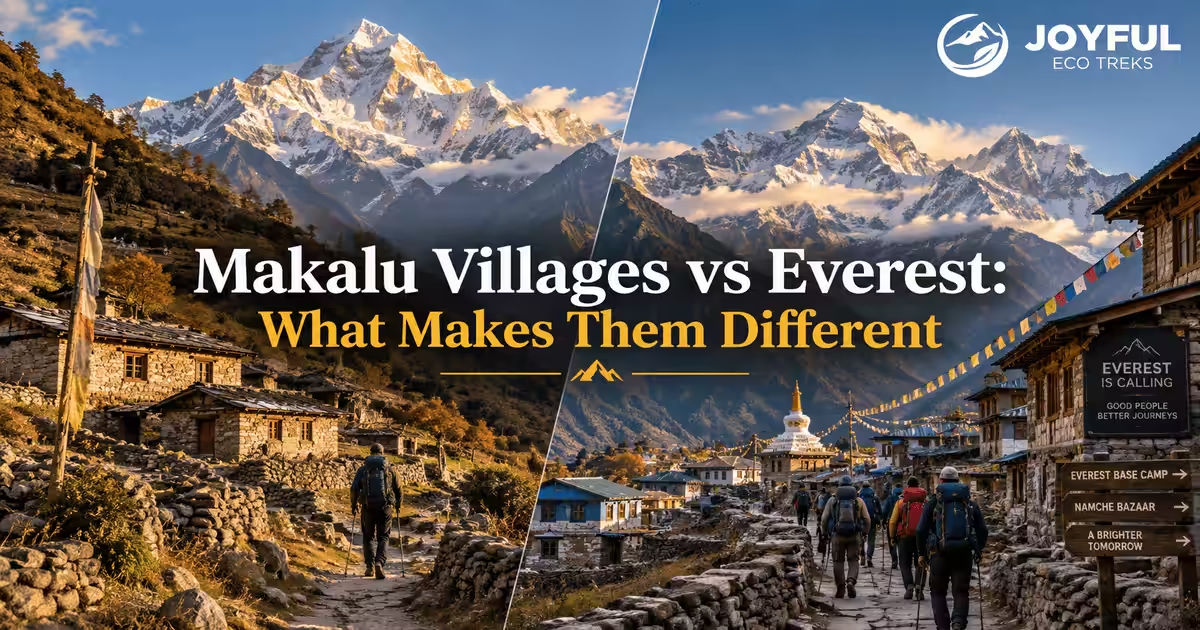
Makalu Villages vs Everest: What Makes Them Different
Stand in Tashigaon at roughly 2,100 metres, and you are looking at the last major permanent village on the Makalu Base Camp route. Walk the Everest trail to Gorak Shep at about 5,164 metres, and seasonal lodges still provide a kitchen and a bed. That difference in the altitude reached by permanent villages and trekking accommodation is central to the makalu villages vs everest question, and it quietly shapes almost everything a culturally curious trekker notices between the two routes.
Table of Contents
ToggleWho This Comparison Is Actually For
You have probably read that Makalu is unspoiled, off the beaten path, one of Nepal’s last quiet corners. Every route page says it. None of them tell you what that quiet actually contains at the village level, which is the only thing that matters in the makalu villages vs everest comparison if you care about the human experience rather than the ridgelines.
This piece is for the traveller who has already weighed the Everest Base Camp route and wants to know whether the Makalu region offers a meaningfully different cultural encounter, not just an emptier trail.
The Everest region receives tens of thousands of visitors annually, while the Makalu Base Camp route receives only a small fraction of that traffic. This difference helps explain why Makalu’s lodges remain fewer and simpler and why agriculture continues to shape daily life in its lower villages. That is part of the difference you are choosing between.
How Seven Decades of Tourism Shaped Each Region
Khumbu After 1953: What the Hillary Route Built
Namche Bazaar was a seasonal Sherpa trading post before 1953. After Edmund Hillary and Tenzing Norgay summited Everest that year, sustained trekking traffic turned it into the economic and cultural hub of the Khumbu. Namche now holds banks, the Sagarmatha National Park headquarters, three museums including a dedicated Sherpa Culture Museum, and the broadest range of accommodation in the Everest region. Seventy years of trekking money built all of it.
Why Makalu’s Permanent Villages End at Tashigaon
Makalu never had a 1953. On the Everest side, Sherpa communities had settled high valleys for centuries before tourism, giving the trekking economy established villages from which to grow. On the Makalu side, permanent village settlement largely ends at Tashigaon. Basic seasonal accommodation continues through the upper Barun Valley, but it never developed at the density or scale found in Khumbu.
Village by Village, Namche to Tashigaon
Namche Bazaar, Khumjung, and Phortse Today
Namche is the loud one, and it earns the reputation: a natural amphitheatre of guesthouses and gear shops, plus a weekend Haat Bazaar that remains a genuine living market. Khumjung, just above, is quieter and more residential. Phortse, at 3,840 metres and off the main circuit, still reads as an authentic Sherpa village rather than a trekking strip. That contrast matters. Khumbu cultural depth is not uniformly paved over, even at altitude; step one valley off the highway and the old village is still there.
Num, Seduwa, and Tashigaon: The Last Inhabited Clusters
The Makalu corridor’s inhabited stops are few. Num sits near 1,500 metres as the trailhead settlement, Seduwa at roughly 1,500 metres across the valley, and Tashigaon at about 2,100 metres, the last major permanent village on the trail. Between Seduwa and Tashigaon, accommodation remains limited compared with the much denser lodge network around Namche.
Then the permanent villages largely end. Above Tashigaon, the map fills with kharkas: Yangle Kharka, Langmale Kharka, and several others. A kharka is traditionally a seasonal grazing station rather than a permanent village. Herders, lodge operators and trekking staff may occupy these places seasonally, and basic lodges operate at several stops. For a culturally curious trekker, the structural fact remains important: above roughly 2,100 metres, the Makalu route offers spectacular wilderness and seasonal human activity rather than the daily life of established villages.
Sherpa Heartland and the Rai-Sherpa Borderland
Khumbu Sherpa Identity and Trekking Income
The upper Khumbu is Sherpa-majority and Tibetan Buddhist, and seven decades of trekking income are woven into that identity now. Monasteries, mani walls, and prayer flags are the visible culture, and the trekking economy funds much of what keeps them standing. We go deeper into Sherpa belief and practice in our piece on Rai and Sherpa traditions.
Yamphu Rai Households Below Makalu’s Treeline
The census is far more specific than the standard ‘Rai in the lower villages, Sherpa higher up’ summary most route descriptions offer.In Makalu Rural Municipality, the 2011 count puts Yamphu as the single largest group at 25.4 percent, ahead of Sherpa at 19.1 percent, with Tamang at 10.9 percent and Kulung at 8.3 percent. These municipality-wide figures do not represent the exact composition of every village on the trekking route. More telling than the ethnic split is the religious one: 43.8 percent of residents identified with Kirat traditions, compared with 40.3 percent Buddhist. That contrasts with the Khumbu’s predominantly Tibetan Buddhist character and points to a different mix of cosmologies, rituals, and relationships with the land in the wider lower Makalu region.
Cultural Access: What Each Region Lets You Witness
Tengboche, Mani Rimdu, and the Khumbu’s Year-Round Circuit
The Khumbu’s cultural calendar is reliable, and that reliability is the whole point. Namche’s market runs every weekend. Tengboche Monastery holds services you can attend on almost any itinerary. Once a year, the region stages Mani Rimdu, its biggest festival: masked Chham dances, a Wong blessing ceremony, and a closing fire ritual at Tengboche. The public Mani Rimdu celebrations are currently expected to fall from October 26 to 28 in 2026, squarely inside the autumn trekking season. Because the festival follows the Tibetan lunar calendar, visitors should reconfirm the dates with the monastery or their operator before arranging an itinerary around it.
Makalu’s Sakela Observances and the Reality of Seasonal Timing
Makalu’s signature Rai festival is Sakela, and its timing requires more careful planning. Sakela is celebrated twice a year: Ubhauli around the April-May full moon, at the start of the farming year, and Udhauli around Mangsir Purnima, the November-December full moon, at harvest. Celebrations centre on worship and the Sakela Shili circle dance, although their duration and local programme can vary.
The timing is the entire story. Udhauli’s window may overlap the tail of the autumn trekking season, so a trekker descending through the lower Rai villages in late November or December may encounter local celebrations. Come in October and you are unlikely to encounter Sakela. In Makalu, festival access requires advance confirmation and careful timing.
Five Criteria: Makalu Villages vs Everest, Scored
Joyful Eco Treks scored both regions on the five criteria that actually shape a village experience. Each region is rated 1 to 5 on how strongly it expresses that trait; the scoring input for each row is the sourced fact beside it. A high score is not automatically better. It depends entirely on what you want from the trail.
|
Criterion |
Makalu (score) |
Khumbu (score) |
Scoring input |
|---|---|---|---|
|
Habitation and accommodation altitude |
2 |
5 |
Makalu permanent villages largely end at Tashigaon (~2,100m), although seasonal lodges continue higher; Khumbu seasonal lodging reaches Gorak Shep (~5,164m) |
|
Lodge density |
1 |
5 |
Makalu has sparse, basic seasonal accommodation; Namche and the wider Khumbu have a dense lodge network |
|
Ethnic diversity of permanent settlements |
4 |
2 |
Makalu municipality, 2011 Census: Yamphu 25.4%, Sherpa 19.1%, Tamang 10.9%, Kulung 8.3%; Khumbu is predominantly Sherpa |
|
Festival access reliability |
2 |
5 |
Makalu: Sakela requires local date confirmation; Khumbu: weekly Namche market and Mani Rimdu each autumn |
|
Degree of cultural curation |
1 |
5 |
Makalu: limited formal interpretation; Khumbu: museums, market and monastery circuit |
The Khumbu scores high on altitude reach, lodge density, festival reliability, and curation because seven decades of infrastructure developed those strengths. Makalu scores highly for the ethnic diversity of its permanent settlements but lower for accommodation density and predictable cultural access. Whether that makes it the better trip is the next question.
Makalu Villages for Unfiltered Cultural Immersion
If your ideal is a farmhouse kitchen where the family is cooking their own dinner rather than a lodge menu shaped primarily around trekking demand, Makalu offers that possibility below Tashigaon. Encounters in the lower villages often remain closely connected to the agricultural year. The cost is real. Beds are limited, guesthouses are basic, and the route above Tashigaon consists mainly of seasonal kharkas and sparse lodges rather than permanent village life. You trade comfort and reliability for a quieter experience, and you accept that the main cultural stretch of your trek is the lower valley, not the high route.
Khumbu Villages for Depth With Reliable Infrastructure
The Khumbu answers a different priority. You can arrive on almost any date and still find a working market, an open monastery, museums, and, in late October, one of the Himalaya’s great masked festivals. The depth is genuine: Phortse alone proves the region still holds authentic Sherpa villages once you step off the main line. What you give up is exclusivity. You are one of many thousands, the lodges are commercial, and the culture, real as it is, has been meeting trekkers for seventy years and knows how to present itself to them.
Which Region Fits First-Time Himalayan Trekkers
For a first Himalayan trek, the honest makalu villages vs everest answer is that neither region wins outright, because they are built for opposite travellers. If you want more predictable access to monasteries, markets and scheduled cultural events, together with an extensive lodge network from bottom to top, the Khumbu offers a first-timer more reliable cultural contact. If your priority is meeting communities that have not rearranged themselves for you, and you will accept the logistics, the altitude ceiling, and the calendar risk that come with it, lower Makalu offers the Kirati Rai world the Everest trail simply does not contain. Match the region to what you value, not to which one sounds more remote on a listicle.
Common Questions About Makalu and Khumbu Village Trekking
Are there teahouses or lodges above Tashigaon on the Makalu Base Camp route?
Yes, but they are basic and seasonal. Tashigaon, at about 2,100 metres, is the last major permanent village on the route. Above it, simple teahouses or trekking lodges operate at several stops, including kharkas, but availability and standards vary by season. Some organised groups therefore continue to carry camping support.
Why does permanent habitation on the Makalu trail end so much lower than on the Everest route?
Because the Khumbu’s Sherpa communities established permanent villages at higher elevations, giving its trekking economy a broader settlement network from which to grow. Gorak Shep, near 5,164 metres, is itself a seasonal trekking outpost rather than a year-round village. In Makalu, permanent village settlement largely ends at Tashigaon, while the higher route relies on seasonal kharkas and sparse lodges.
Do Rai communities in lower Makalu interact with trekkers differently than Khumbu Sherpas do?
The experience can differ, but it should not be treated as a rule about every household. Trekking infrastructure is much less developed in lower Makalu, where agriculture remains highly visible in village life. Khumbu has a mature tourism economy, so visitor services and interactions are usually more organised and commercial.
Can you attend a Sakela festival if your Makalu trek timing doesn’t align with the calendar?
Not easily. Sakela is associated with two principal seasonal observances: Ubhauli around the April-May full moon and Udhauli around Mangsir Purnima in November or December. Trekkers should confirm the local programme and dates in advance because celebrations vary by place and calendar.
Is the Makalu village experience accessible without camping gear?
The village experience from Num to Tashigaon works with basic guesthouses. Seasonal teahouses also operate at several stops above Tashigaon, so the route is not strictly camping-only. However, services remain basic and can be inconsistent; carrying camping support may still be advisable depending on the season and operator.
Ready to see exactly which villages you pass and when? Read the full Makalu Base Camp Trek itinerary to walk the corridor from Num to Tashigaon stop by stop.

All Categories