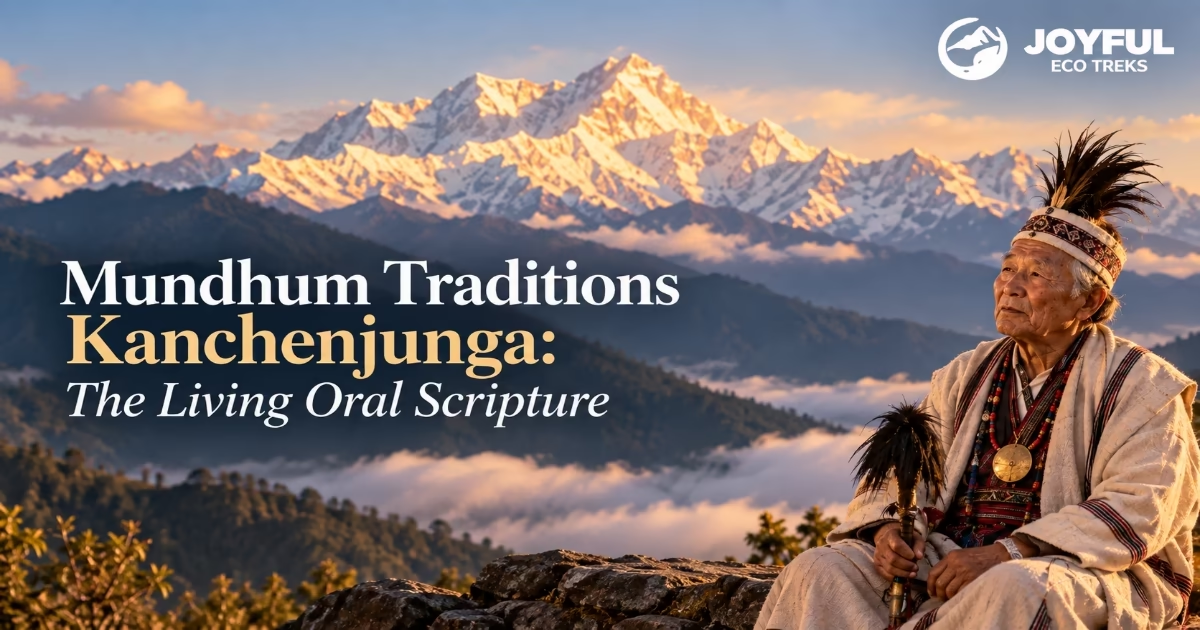
Mundhum Traditions of Kanchenjunga: The Living Oral Scripture
In a farmhouse above the Tamor River, a part-time priest may sit before a family and begin to recite from memory. No book needs to lie open in front of him. The genealogy he delivers can reach back through the household’s clan to ancestral beginnings, carried through trained recall and generations of oral transmission. This is Mundhum at work, not Mundhum on display, and it is the reality behind the mundhum traditions Kanchenjunga trekkers walk through.
These traditions are not adequately understood as folklore alone, and they are not leftover superstition draped over a photogenic valley. Mundhum is a sacred oral tradition of the Kirat-Limbu, or Yakthung, people, functioning at once as creation narrative, ritual knowledge, genealogy, social guidance, and a source of customary norms. Grasping that changes what you are walking through. You are not crossing empty sacred scenery. You are crossing a lived cultural landscape with its own calendar, cosmology, ritual specialists, and inherited rules. What follows maps that landscape onto the standard trekking corridor, so you know what you are actually moving past.
Table of Contents
ToggleWhy Mundhum Still Governs Daily Life Around Kanchenjunga
Ask a Limbu household when Mundhum matters and the honest answer is: at every threshold. One oral tradition covers the entire life cycle. Birth rites, naming ceremonies, marriage negotiations, harvest timing, death rituals: Mundhum supplies procedures, narratives, and ritual authority for each. Families do not attend it only on feast days. The tradition runs the other way, starting inside the house and radiating out to the fields and the peaks, which is what separates it from a religion encountered only at a temple edge.
One canon from the birthing room to the harvest field
For the Limbu, there is no clean line between spiritual observance and ordinary governance. The same inherited body of knowledge informs both. When a field is planted, when the first grain is offered back, when a child is named: all of it can draw from the same oral tradition. That reach is what makes Mundhum a governing cultural and ritual system rather than a ceremonial supplement to everyday life.
Where the practice concentrates: Taplejung and Panchthar
Limbu Mundhum practice remains especially significant in the eastern districts a Kanchenjunga trek crosses or borders, including Taplejung, which contains the Kanchenjunga Conservation Area, and Panchthar just to its south. The Conservation Area covers roughly 2,035 square kilometres of Taplejung District and was established in 1997. In 2006, the Government of Nepal handed management responsibility for the area to the Kanchenjunga Conservation Area Management Council.
Kirat was recorded as the religion of 924,204 people in Nepal’s 2021 national census, about 3.17 percent of the population and the fourth-largest religious category recorded in the census.
This is not a fringe belief system thinning toward the edge of the record.
What Mundhum Actually Is: Oral Epic, Ritual Manual, and Clan Law
Mundhum has no single original manuscript or one universally authoritative authored book. Think of it instead as a living body of inherited knowledge held, interpreted, performed, and transmitted across generations, with versions and emphases that can vary among communities and ritual specialists.
The oral register and the canonical branches
A widely cited classification associated with Limbu scholar Iman Singh Chemjong divides Mundhum into two major forms. Thungsap Mundhum refers to the older oral form transmitted and recited through performance. Peysap Mundhum refers to written or textually recorded forms and is commonly divided into four branches: Soksok Mundhum, dealing largely with creation and human beginnings; Yehang Mundhum, concerning leadership, conduct, social rules, and spiritual teaching; Sapji Mundhum, dealing with spiritual forces and related teachings; and Sap Mundhum, associated with historical or inherited knowledge.
Map those onto the plainer categories a newcomer needs and several working bodies emerge: a cosmogonic one explaining where the world and humans came from, a ceremonial one guiding ritual practice, a social and ethical one governing conduct, and genealogical or historical traditions threading through them.
A script also exists. Te-ongsi Sirijunga Sing Thebe is remembered as one of the most important figures in the development and revival of Limbu literary culture in the eighteenth century. Historical scholarship credits him with promoting the Sirijunga script, while Limbu traditions also preserve accounts of an older origin for the script and describe him as its reviver. Writing helped preserve and transmit Limbu knowledge, but it did not replace the authority of oral ritual performance. The voice remains central.
How a Phedangma carries the text
One important keeper of that voice is the Phedangma, also written Phedangba. Limbu ritual traditions also recognize specialists such as Samba, Yeba, and Yema, whose roles can differ according to ritual and community.
A Phedangma memorises and performs Mundhum at the appropriate ritual moment, drawing on knowledge transmitted through practice, apprenticeship, and community recognition. The transmission is oral, located, and slow. Written texts can preserve portions of the tradition, but ritual competence still depends heavily on performance and inherited knowledge.
Kanchenjunga and Faktanglung in Mundhum Cosmology
Most visitors arrive knowing Kanchenjunga is sacred and assume it is therefore the centre of the local cosmology. In Mundhum the picture is more layered, and several mountains and sacred sites carry different meanings.
Yuma Sammang, Tagera Ningwaphuma, and the sacred mountain
In the Limbu language, Kanchenjunga is commonly known as Sewalungma, meaning roughly “the mountain to which we offer greetings.” The mountain is sacred within Limbu and wider Kirati traditions.
To understand how Limbu beliefs fit alongside the mountain’s other religious traditions, explore why Kanchenjunga is sacred.
Yuma Sammang, the ancestral grandmother or mother divinity, holds an especially important place in Limbu domestic, agricultural, and ritual life. Tagera Ningwaphuma is associated with supreme creative power in Limbu cosmology.
The relationship between Yuma Sammang and Tagera Ningwaphuma should not be reduced to one universal formula. Interpretations vary across Limbu religious traditions, communities, and scholarship. Some accounts distinguish Yuma Sammang from Tagera Ningwaphuma, while others understand Yuma as an earthly manifestation or personification of the supreme creative divinity. That variation is part of the living tradition rather than an error to be resolved by an outsider.
The peak that does the work: Faktanglung
If Sewalungma is the great sacred mountain on the horizon, Phoktanglungma, also rendered Faktanglung and known outside Limbu tradition as Kumbhakarna or Jannu, carries major narrative weight in Mundhum traditions. The mountain rises to about 7,710 metres and is regarded as sacred by Limbu communities.
Mundhum-related accounts connect the mountain with major ancestral and cosmological events. Mundhum accounts connect Porokmi Yamphami with episodes of drought and the restoration of water or rainfall, although the details and locations of these narratives can vary between oral traditions.
Kanchenjunga is a presence; Phoktanglungma is also a landscape of narrative action. Drawing that distinction changes what you understand yourself to be walking beneath.
Sacred sites you pass close to
The cosmology is anchored in named, findable places, several near the trekking approach. Sodhung Worok, also written Sodungwarak, at Tokpegola appears in Limbu accounts as an important sacred location. Singsaden and Tiptala are among places associated in some Mundhum traditions with Yuma Sammang, ancestral journeys, early cultivation, and the transmission of knowledge.
Pathibhara is another major sacred site. In Limbu it is known as Mukkumlung, a name still used by Yakthung/Limbu communities and recognized in descriptions of the site itself.
The Tamor is no exception. Rivers, lakes, mountains, forests, and cultivated land are woven into Mundhum narratives rather than treated simply as physical features of an approach route.
Mundhum Traditions Along the Kanchenjunga Trekking Corridor
Not every rite is open to an outsider, and some should not be sought out at all. The ceremonies Kanchenjunga trekkers can realistically encounter are limited, but seasonal festivals and public cultural gatherings can offer a respectful glimpse into the living traditions of eastern Nepal.
Yokwa Tongnam, a Limbu spring observance
One important Limbu agricultural observance is Yokwa Tongnam, associated with the period before cultivation and with worship of ancestors, agricultural divinities, land, water, and the forces on which a successful crop depends.
Yokwa is commonly associated with the spring or Ubhauli season and is observed in different forms by Limbu communities. Practices and exact timing can vary locally.
A useful distinction matters here. Sakela and Sakela Sili are especially associated with Rai or Khambu Kirati traditions. Although Limbu, Rai, Yakkha, Sunuwar, and other Kirati peoples share some seasonal ideas and regional cultural connections, their festivals should not be treated as interchangeable. For Limbu communities, Yokwa and Chasok are more precise names to carry into this discussion.
Birth and death rites: the Limbu names to know
The life-cycle rites are more private, and their Limbu names are worth carrying even if you never witness one. Sappok Chomen is a pre-natal rite associated with the womb and the protection of pregnancy. Yangdang Phongma is the naming ceremony. Accounts of Limbu ritual practice describe the Phedangma chanting protective Mundhum and using sacred water during the rite.
Mangenna is performed to ward off harmful influences and strengthen well-being.
Nahangma is different from a funeral rite. It is associated with restoring vitality, dignity, strength, and the life force of the household or its head, particularly during periods of difficulty or transition.
Death and post-death rituals form their own complex body of practice. Khauma is one documented Limbu death rite, performed with Mundhum recitation by ritual specialists, although names, sequences, and ritual details can vary among clans and local traditions.
That variation is important. Mundhum is living oral heritage, so a single English label should never be assumed to describe every Limbu household in exactly the same way.
A trekker’s seasonal ceremony calendar
Three useful Limbu seasonal windows to know are:
|
Ceremony |
Approximate window |
Where along the broader region |
What a trekker may notice |
|---|---|---|---|
|
Yokwa Tongnam |
Spring, often associated with the Baisakh cultivation season |
Limbu communities of eastern Nepal, including parts of Taplejung and Panchthar |
Agricultural and community observances connected with land, ancestors, water, and hopes for a successful growing season |
|
Chasok Tangnam |
Mangsir period, generally November to December |
Taplejung, Panchthar, Ilam, and other Limbu areas |
Newly harvested grain and food offered in thanksgiving, with household and community celebrations |
|
Kokphekwa Tongnam |
Around mid-January |
Across Limbu communities |
A seasonal and New Year period associated with family gatherings, food, nature, and the beginning of a new annual cycle |
Chasok Tangnam is one of the best-known Limbu harvest observances. Newly harvested foods are offered before being consumed, linking household agriculture with gratitude toward Yuma and other divinities recognized within local tradition.
Kokphekwa Tongnam falls around the mid-January seasonal transition and is widely treated as an important Limbu New Year observance. Names, ritual emphasis, and calendrical interpretation can vary between communities, which is why it is better to describe the living festival than force every tradition into one fixed historical epoch.
How Oral Transmission Works, and Where It Frays
The apprenticeship that carries Mundhum knowledge is long, located, and difficult to compress. An apprentice learns through repeated exposure to practising ritual specialists, ritual language, performance, and the social setting in which ceremonies occur.
Written texts, recordings, language teaching, and cultural archives now help preserve portions of Mundhum. They do not, however, reproduce every element of ritual performance, local knowledge, pronunciation, sequencing, or community authority. Migration away from the villages can therefore weaken the conditions in which traditional apprenticeship has historically taken place.
Why you cannot simply study your way in
Phedangma authority is not equivalent to earning a formal religious qualification from a school. Ethnographic descriptions of Limbu ritual practice emphasize apprenticeship, ritual calling, spiritual capacity, and community recognition alongside knowledge of Mundhum.
Some traditional accounts hold that a person does not become a Phedangma through study alone and that ritual capacity involves a spiritual calling or force beyond memorisation. The precise explanation can vary according to community and religious tradition.
That is very different from a seminary model in which completion of a standardized curriculum is enough to confer the role.
The pressures narrowing the pool
Several forces can pull at different links in the transmission chain. Nepali-dominant schooling can reduce everyday fluency in Limbu ritual language. School and work calendars make years-long participation in village traditions more difficult. Urban and overseas migration can separate younger generations from ritual specialists and the locations where ceremonies are normally performed.
At the same time, Limbu communities are actively documenting, teaching, publishing, recording, and reviving language and ritual traditions. The picture is therefore not simply one of disappearance. It is a struggle over how an oral, place-based tradition continues when the social conditions around it change.
Three Things Trekkers Misread About Mundhum Traditions
First, Mundhum should not be treated as simply a Limbu version of Hinduism or Buddhism, nor reduced to a generic label such as hill animism. It is an Indigenous religious and cultural tradition with its own cosmology, ritual specialists, oral narratives, ancestral knowledge, and customary norms. Centuries of interaction with neighbouring traditions have produced overlaps and changes, but that does not erase its distinct identity.
Second, the Phedangma is not simply a monk or scholar in robes. Traditional authority involves ritual knowledge, apprenticeship, performance, spiritual calling, and community recognition rather than a standardized clerical curriculum.
Third, Kanchenjunga is not the only mountain that matters in Mundhum sacred geography. Phoktanglungma carries major narrative importance, and places such as Mukkumlung, Sodhung Worok, Singsaden, and Tiptala belong to a much broader sacred landscape.
The relationship between Yuma Sammang and Tagera Ningwaphuma also varies across Limbu traditions, so flattening either figure into a single universal definition misses the complexity of the religion.
Get those distinctions straight and you are already asking better questions than most visitors, the kind a knowledgeable guide or local host may actually enjoy answering.
Walking Through Mundhum Sacred Territory: Notes for Trekkers
Respecting the mundhum traditions Kanchenjunga communities maintain is not simply a matter of travel etiquette. Sacred places can carry community rules and customary religious restrictions that existed long before modern trekking routes or protected-area administration.
Prohibitions attached to sites can differ from place to place, so do not assume that access to one shrine, lake, grove, rock, or mountain site means the same behaviour is acceptable at another.
What the prohibitions mean in practice
Depending on the site and community, there may be rules around entering certain areas, touching sacred objects, fishing, taking plants, photographing rituals, or disturbing offerings. Restrictions can be specific to a clan, ceremony, season, or location.
Offerings and cairns are not props for a portrait. Ask your guide or local host before you approach a named sacred site, photograph a ceremony, or interact with ritual objects, then follow the answer without negotiating it.
If you want to walk this landscape with its Indigenous cosmology in view rather than as scenery, plan the route through the living communities themselves. Read our Kanchenjunga region guide to build a trek that moves through the villages where these traditions are still practised, and consider our Kanchenjunga North Base Camp Trek or the Kangchenjunga Circuit Trek for routes that pass directly through Limbu Mundhum territory.
Pair either with our overview of Limbu culture around Kanchenjunga and the wider sacred traditions of the region.
Mundhum FAQs for Kanchenjunga Trekkers
Is Mundhum written down anywhere, or is it exclusively oral?
Mundhum remains fundamentally rooted in oral transmission, but substantial portions have also been recorded, transcribed, studied, and published.
Te-ongsi Sirijunga Sing Thebe became a major figure in the eighteenth-century development and revival of Limbu writing. Historical scholarship credits him with promoting the script now commonly called Sirijunga, while Limbu traditions also preserve accounts of the script having an older origin that he rediscovered or revived.
Written preservation has become increasingly important, but ritual authority still depends heavily on oral performance and the knowledge of practitioners.
Which communities near the trekking route still practise Mundhum?
Limbu communities across Taplejung and Panchthar continue to maintain Mundhum-related ritual and cultural traditions, although practices differ between villages, clans, households, and religious movements.
The lower valleys and settlements around the broader Kanchenjunga approach are where trekkers are most likely to encounter Limbu cultural life directly. Public festivals may be visible to visitors, while household rituals are generally private unless an invitation is clearly extended.
How does Mundhum read Kanchenjunga differently from Buddhism?
Within Limbu tradition, Kanchenjunga is known as Sewalungma and belongs to a sacred landscape understood through Yakthung/Kirat cosmology, ancestral narratives, ritual relationships with nature, and places such as Phoktanglungma and Mukkumlung.
Yuma Sammang and Tagera Ningwaphuma are important within that wider religious world, although different Limbu traditions explain their relationship differently.
This framework is distinct from Tibetan and Sikkimese Buddhist interpretations of Kanchenjunga. The same mountain can therefore occupy several sacred worlds at once without one tradition simply being a variation of another.
Can a trekker attend a Mundhum recitation or Limbu ceremony?
Sometimes, but access depends entirely on the event.
Public cultural and seasonal gatherings associated with festivals such as Chasok Tangnam or Yokwa Tongnam may be accessible to visitors when communities are celebrating openly.
Private birth, healing, household, and death rituals are another matter. They should never be treated as tourist performances. Attend only when a household, community member, ritual specialist, or trusted local guide clearly indicates that visitors are welcome.
What is the Phedangma, and how is one trained?
The Phedangma, also written Phedangba, is one of the principal Limbu ritual specialists who recites and performs Mundhum during important ceremonies. Limbu traditions also recognize specialists such as Samba, Yeba, and Yema, whose responsibilities can differ.
Training traditionally depends heavily on oral transmission, observation, repeated ritual participation, apprenticeship, and community recognition. In some traditional interpretations, knowledge alone is not enough and the practitioner must also possess a spiritual calling or ritual capacity.
That combination of memory, performance, apprenticeship, and religious authority is why a living ritual tradition cannot simply be reproduced by reading a written version of Mundhum.

All Categories