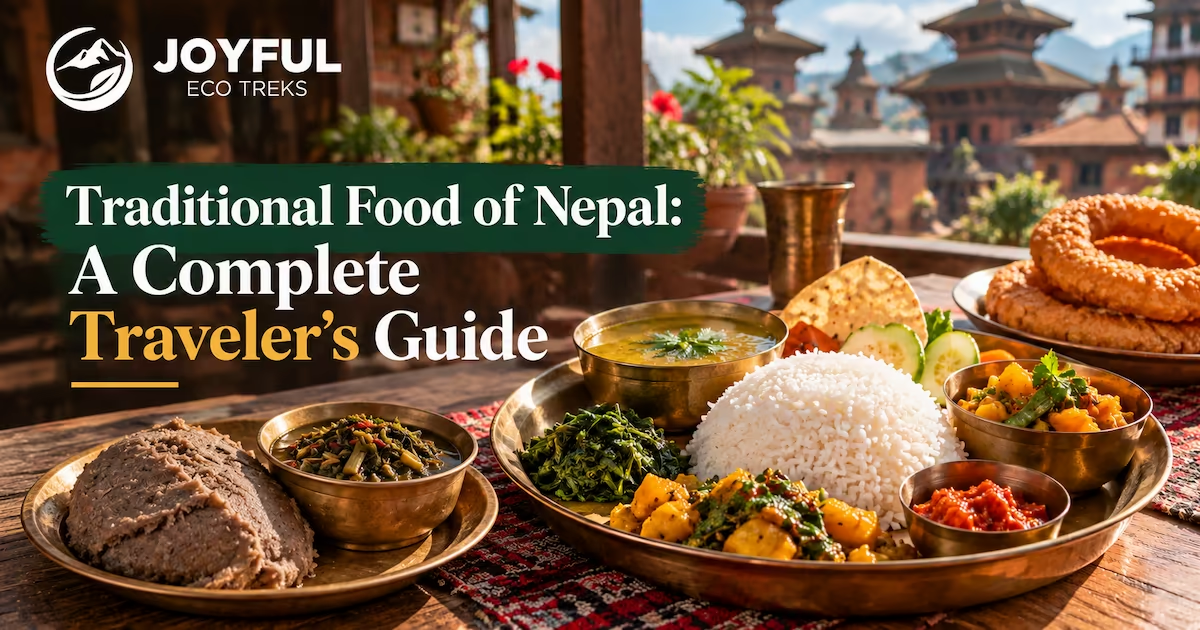
Traditional Food of Nepal: A Complete Traveler’s Guide
Order dal bhat at a Terai roadside stall and again at a lodge below the Everest icefall, and you are paying for two different meals that happen to share one name. That gap is what most food guides skip. The traditional food of Nepal gets sold to travelers as a flat checklist of dishes to photograph, when the more useful question is what actually reaches your plate at a given altitude, in a given valley, cooked by a given community. This guide maps the food to those variables, because that is how you will meet it on the trail rather than in a magazine.
Table of Contents
ToggleDal Bhat: The Dish That Runs Nepal
Every serious conversation about Nepali eating starts here, and for a practical reason: dal bhat is the one meal you can order at almost any elevation on almost any route, morning or evening, refilled until you are full. It is fuel first and a dish second. Treating it as a single recipe, though, is the mistake competitor lists consistently make.
What a standard thali actually contains
A standard thali is built around four core parts, each with a job. Dal, made from lentils that vary by household and region, is the protein and the thing you pour over everything. Steamed rice is the calorie base. Tarkari, a seasonal vegetable curry, changes with whatever is being harvested. Achar, the pickle, brings the acid and heat that cut through the starch, and it can be fresh or fermented. Papadum may appear alongside for texture, but it is an accompaniment rather than a defining part of the meal. Eat it the local way, mixing with your right hand, and the balance of soft, sharp, and crunchy makes sense immediately.
How dal bhat changes from the Terai to Khumbu
The plate shifts as you climb, but not according to a single fixed recipe. In the Terai lowlands, rahar (toor) and moong dal are common examples, often alongside vegetables such as okra or eggplant. In the mid-hills, musuro dal and seasonal greens are common, while Khumbu lodges may serve darker lentils and add local dishes such as Sherpa stew, a heavy potato and vegetable broth, alongside the meal. Same name, three kitchens, but with plenty of household and lodge-to-lodge variation. The Everest Holiday’s 2026 trekking-food guide puts a plate on the Everest Base Camp route at roughly NPR 400 to 900 (about USD 3 to 7), a figure that climbs steeply at high lodges where supplies arrive by porters and pack animals.
Momo, Sel Roti, and Nepal’s Street Food
Street food in Nepal is where Tibetan trade routes, Hindu festivals, and everyday snacking overlap. Two items anchor it, and both carry more history than the menu suggests.
How to read a momo menu and what each variety signals
When a menu just says “momo,” buff, water buffalo, is a common default, and that tells you a story. Momo has Tibetan roots; one widely repeated account is that Newar merchants trading in Lhasa carried the dumpling home to the Kathmandu Valley, where it evolved with local fillings and spiced tomato chutney, although the exact origin is not documented conclusively. Chicken and vegetable fillings are common across Nepal today. Jhol momo arrives sitting in a thin spiced broth; kothey momo is pan-fried on one side. Above Namche Bazaar, think twice about any meat filling, for reasons the altitude section explains.
Sel roti and the sweets tied to Dashain and Tihar
Sel roti is strongly tied to Nepal’s festival calendar, but it is also eaten outside festival periods. A ring-shaped bread of rice flour, water, sugar, and ghee, deep-fried into a crisp golden loop, it is prepared especially during Dashain and Tihar. The tradition stretches across the eastern Himalayan belt into Darjeeling, Sikkim, and the Kumaon hills, and is centuries old. Festival periods are when it becomes especially visible in homes and markets.
Fermented and Preserved Foods: Eating Without Refrigeration
Before roads reached the hills, winter meant months without fresh vegetables or reliable protein. Fermentation solved that, and the solutions were chemically different depending on what was being preserved.
Gundruk: fermented greens that outlast the harvest
Gundruk is what you do with a glut of leafy greens before they rot. Mustard, radish, and cauliflower leaves are wilted for a day or two, shredded, packed tight into an earthenware pot, submerged in warm water around 30°C, and sealed. Lactic acid bacteria, mostly Pediococcus and Lactobacillus species, drive the ferment, dropping the pH to roughly 4.0 over about a week before the mass is sun-dried for storage. No salt goes in, making it one of the few genuinely salt-free vegetable ferments in the world. In highland winters before road access, that sour, dried green was often the only vegetable a family had, and its vitamin content was not a luxury.
Kinema, sinki, and the logic of highland fermentation
Kinema looks like a cousin of gundruk but works on entirely different chemistry. A fermented soybean food of the Kirat community, the Limbu and Rai of the eastern hills, its ferment is powered by Bacillus subtilis rather than lactic acid bacteria. That bacterium breaks soy protein down into glutamic acid, which is where kinema’s deep umami comes from. The name is Limbu, where “ki” points to fermentation and “nambaa” to flavour, and the tradition is centuries old. Sinki, a radish-root ferment, sits closer to gundruk on the lactic-acid side. The practical takeaway for a traveler: a protein ferment and a vegetable ferment are two distinct preservation technologies that grew from what each community farmed, not the same food in different jars. The Kanchenjunga region carries this eastern tradition strongly, and our Kanchenjunga food and festivals guide goes deeper on the household side of it.
What Trekkers Actually Eat Above 3,000 Meters
Below is a map of what you can reliably order by elevation band, built by Joyful Eco Treks from documented teahouse menus and trekking reports across the Everest, Annapurna, and eastern routes. It is a general pattern, not a promise, but it holds well on the popular trails.
|
Elevation band |
Reliably on the menu |
Thins out or vanishes |
|---|---|---|
|
Below 1,500m (Kathmandu, Pokhara) |
Full Newari and Thakali thalis, every momo variety, fresh vegetables and fruit, meat dishes, espresso |
Nothing; this is peak variety |
|
1,500 to 3,500m (mid-hill teahouses) |
Dal bhat with refills, momo, thukpa, fried potatoes, eggs, fresh bread near hubs like Namche |
Upscale restaurant variety, most imported produce |
|
Above 3,500m (high lodges) |
Dal bhat with unlimited refills, tsampa, Sherpa stew, garlic soup, butter tea, boiled and fried eggs |
Reliable meat, fresh fruit, most baked goods |
Two practical notes sit inside that table. At Namche Bazaar (3,440m), you can still buy apple pie, cinnamon rolls, and espresso; a day higher, past Tengboche, the menu narrows fast to dal bhat, noodle soups, eggs, and potatoes. Meat is best avoided above Namche on the Khumbu route because without dependable refrigeration, whatever protein reaches a high lodge has usually been carried and stored for days. Garlic soup, believed locally to help with acclimatisation, becomes near-universal above 4,000m.
Why dal bhat dominates teahouse menus at altitude
Dal bhat dominates high teahouse menus because it is genuinely the most practical high-altitude meal, not because variety is unavailable. Rice and lentils store and transport well, cook on a single stove, deliver the carbohydrate load a trekker actually burns, and come with free refills almost everywhere. A lodge can feed twenty hungry walkers from one pot. The famous trekker line, “dal bhat power, 24 hour,” is a joke that happens to be sound nutrition advice.
Tsampa and dhido: the staples that fill the gap
When rice runs thin, older grains take over. Tsampa, roasted barley flour, is the Himalayan trail food that needs no fire: because the barley is pre-roasted, you mix it with butter tea or plain water into a quick paste and eat it, which is exactly why it stays practical above the treeline in Humla, Mustang, and Dolpo. Dhido belongs to the mid-hills, a thick porridge of buckwheat or millet flour stirred with hot water, still eaten daily in many Tamang and Gurung households. For generations it carried a stigma as a poor family’s substitute for rice, which makes its recent arrival on Kathmandu restaurant menus a small cultural reversal worth noticing rather than a tourist invention.
Three Regional Kitchens Behind the Traditional Food of Nepal
Ask what defines the traditional food of Nepal and the honest answer is that three distinct kitchens do most of the defining, each tied to a people and a place a trekker can actually walk through.
Newari food in Kathmandu Valley: chatamari, bara, and juju dhau
Newari cooking is the valley’s own, and it is more layered than a single momo stall suggests. Chatamari is a thin rice-flour crepe, sometimes called Nepali pizza, topped with minced buffalo, a cracked egg, or just onion, tomato, and coriander. Bara (also called Wo) is a savoury pancake of ground black lentils. Yomari is the showpiece: a steamed rice-flour dumpling shaped like a fig and filled with chaku, a molasses-like jaggery sweetener, made at the Yomari Punhi festival that marks the end of the rice harvest. Juju dhau, the “king curd” of Bhaktapur, is set from rich buffalo milk in unglazed clay pots that wick away moisture; local tradition says a Malla-era king crowned it the best yogurt in a competition, and the name stuck.
Thakali cooking from the Mustang corridor
The Thakali thali is what a standard dal bhat becomes when a trading people refine it over centuries. Two flavours mark it out, and competitors almost never name them: jimbu, a dried Himalayan herb in the chive and garlic family, and timur (also written timmur), the dried pod of a prickly-ash tree that gives a citrusy, numbing heat. Buckwheat is the other signature. Phaper ko dhido, a thick buckwheat porridge, is a staple of Thak Khola teahouses, and buckwheat pancakes appear regularly alongside it, filling the role that rice plays lower in the valley. The meal is usually served with several accompaniments, while the exact mix of fats and side dishes varies by household and restaurant. None of this is decoration. The Thakali come from the Thak Khola valley on the Kali Gandaki, the old trade artery between the Tibetan plateau and the Indian plains, and that traffic in ingredients helps explain the layered character of their cuisine. You cross straight through it on the Annapurna Circuit.
Eastern hills: Limbu kinema, tongba, and Rai staples
In the far eastern hills, kinema is the daily food and tongba is the evening ritual, and getting that order right matters. Rai and Limbu kitchens run on preserved and foraged ingredients shaped by short growing seasons: wachipa (a Rai dish of rice and chicken traditionally flavoured with powder from burnt chicken feathers), yangben-faksa (a curry of wild lichen and pork), and dried meats like sukuti and smoked masikra. These are not novelty items; they are what a highland larder produces when winter is long and the fields are small.
Drinks From the Lowlands to the High Passes
Nepal’s drinks sort by community and altitude as cleanly as its food does, and knowing which is which keeps you from ordering the wrong thing at the wrong elevation.
Tongba: how hot millet beer is served in the eastern hills
Tongba is a hot, mild millet beer and a piece of Limbu culture in a single wooden vessel. Fermented finger millet, started with a culture called khesung, is packed into the wooden pot (the pot itself is the tongba), topped with boiling water, and sipped through a bamboo straw fitted with a filter so you draw the liquid and leave the grain. Refill it with hot water several times, and each pour comes lighter than the last, making it a slow, sociable drink rather than a fast one. The alcohol sits low, around 2 to 5% depending on the ferment. Trekkers most reliably encounter it in the eastern districts, Taplejung and Ilam, along the lower Kanchenjunga route, where it functions as a communal cold-weather ritual.
Chhaang, raksi, and when locals drink what
Around tongba sit three other drinks with clear roles. Chhaang is the broader Himalayan grain beer, milky and mild, found well beyond the Limbu hills. Raksi is the distilled spirit, clear and strong, comfortably north of 20% and closer to a home-made whisky in effect. Po cha, salted butter tea, carries no alcohol at all and is a traditional high-altitude drink, delivering fat, salt, and warmth in cold conditions. The exact social role of each drink varies by community, season, and occasion.
Where and What to Order: A Practical Eating Guide
Kathmandu: eating beyond the tourist restaurant strip
The honest advice for Kathmandu is to leave the Thamel tourist strip for at least a few meals. The reheated pizzas and “Nepali set” menus there are calibrated for nervous first-timers, not for the food this guide describes. A Newari eatery in the old city, a Thakali bhojanalaya near Jhamsikhel, a busy momo counter where the buff filling is cooked to order in front of you: that is where the traditional food of Nepal stops being a performance. Forget advice that names specific restaurants as permanent fixtures, since kitchens change hands; follow the crowds of local office workers at lunch instead.
What to eat before, during, and after a long trek
Before a big climb, eat carbohydrate-forward and familiar, which usually means dal bhat the night before rather than an experimental meal that might disagree with you at 4 a.m. During the trek, default to dal bhat for its refills and familiarity, lean on eggs, potatoes, and garlic soup, and be cautious with meat above Namche, where refrigeration and transport can be less dependable. Afterward, back in Kathmandu or Pokhara, is the time to work through the range you could not get at altitude: the full Newari platter, fresh momo in every filling, the sweets you missed. Your route decides much of your menu, so it is worth choosing the trek partly for the kitchens it passes. Our best treks in Nepal guide maps the routes, and the Everest Base Camp route shows how the food changes step by step as you climb.
Questions Travelers Ask About Traditional Food in Nepal
Does dal bhat taste the same across every region of Nepal?
No. Dal bhat changes noticeably by region and altitude. Lentils, spicing, vegetables, and tempering vary by household and location: rahar or moong are common examples in the Terai, musuro is common in the hills, and Khumbu lodges may use darker lentils and add local dishes such as Sherpa stew. The logic stays constant (rice, lentils, vegetable, pickle) while the ingredients follow what grows and what can be carried.
What food will I eat trekking above 3,000 meters?
Mostly dal bhat, often with refills, plus tsampa, Sherpa stew, garlic soup, butter tea, eggs, and potato dishes. Fresh fruit and dependable meat options become less common as you climb, and many trekkers choose to avoid meat above Namche Bazaar (3,440m) because refrigeration and transport can be less dependable. Menus narrow with altitude, but the core carbohydrate meals stay available the whole way.
Is street food like momo safe to eat in Nepal?
Generally yes, if you choose places where dumplings are cooked thoroughly and served steaming hot, food handling looks clean, and safe water and ingredients are used. High turnover can be a useful clue, but it is not a guarantee of food safety. Meat and vegetable fillings can both pose risks if handling, storage, or cooking is poor, so do not assume vegetable or jhol momo is automatically safer.
What makes Newari cuisine different from everyday food?
Newari cooking is the distinct cuisine of the Kathmandu Valley’s Newar people, built around dishes you rarely see in a generic thali: chatamari crepes, black-lentil bara, festival yomari filled with chaku, and Bhaktapur’s clay-pot juju dhau. More festival-driven, more fermented, and more buffalo-centric than standard hill cooking, it reflects a settled urban food culture rather than a trekking-route one.
What is tongba and where can trekkers find it?
Tongba is a hot fermented finger-millet beer of the Limbu people, served in a wooden vessel and sipped through a filtered bamboo straw, with a low 2 to 5% alcohol content and repeated hot-water refills. Trekkers most reliably encounter it in the eastern hills, especially the Taplejung and Ilam districts along the lower Kanchenjunga route, where it functions as a communal evening drink.
Can vegetarians and vegans eat well on a Nepal trek?
Yes, usually. Much of the core menu is already plant-based: dal bhat (ask for it without ghee for a fully vegan version), gundruk, dhido, vegetable momo, and tsampa mixed with water rather than butter tea. Vegetarians usually have plenty of options on established trekking routes; vegans should ask specifically about ghee or butter, milk, egg, and any animal-based broth or stock.
The most reliable way to eat the traditional food of Nepal as this guide describes it is to walk into the valleys where these dishes are daily life rather than menu items. Our best treks in Nepal guide is the practical starting point, and if you already know which region calls to you, start planning your own trip around the kitchens you most want to reach.

All Categories