Dashain Food Nepal: Dishes Every Family Cooks 2026
By the ninth evening of the festival, many Kathmandu kitchens smell of mustard oil, popping cumin, and goat cooking on the bone. This is the Dashain food Nepal reserves for its single biggest week, and most travel guides compress it into a three-item list before moving on. What follows maps each dish to the day it appears, explains why goat is central to many traditional tables, and walks through what you may be handed if a family invites you in.
Table of Contents
ToggleWhat Makes Dashain Food Different From Everyday Nepali Cooking
A common everyday Nepali plate is dal bhat, a vegetable, and a spoon of pickle. Dashain often shifts that routine for a festival week. The menu starts following a ritual calendar, although what families cook, and when, varies from household to household.
The ritual calendar that decides what gets cooked when
The festival runs fifteen days, and food tracks its arc. For some families the opening days are comparatively plain. Feasting often builds around Maha Ashtami, Maha Navami, and the main tika day, while other households prepare vegetarian food or follow different traditions. Where animal sacrifice is observed, it can shape the cooking schedule, but it is not a requirement for celebrating Dashain.
Why the meat feasting concentrates in October
Dashain begins in the Nepali month of Ashwin and can extend into Kartik, landing in late September or October. The timing follows the lunar festival calendar, not seasonal convenience: for meat-eating households, feasts often cluster around Ashtami, Navami, and the tika days. Demand for goat meat can rise during the festival, although prices and buying habits vary by place and year.
Khasi Ko Masu: Why Goat Curry Anchors the Dashain Table in Nepal
Goat curry is a familiar centrepiece at many meat-eating Dashain tables. Nepal Tourism Board documents official animal sacrifices at Hanuman Dhoka during Navami, and some households observe their own sacrificial ritual. Others buy meat from the market or keep the festival vegetarian. Khasi ko masu, goat curry, remains a widely enjoyed dish, but no single meat or ritual is compulsory for every family.
From the Navami sacrifice to the Vijaya Dashami plate
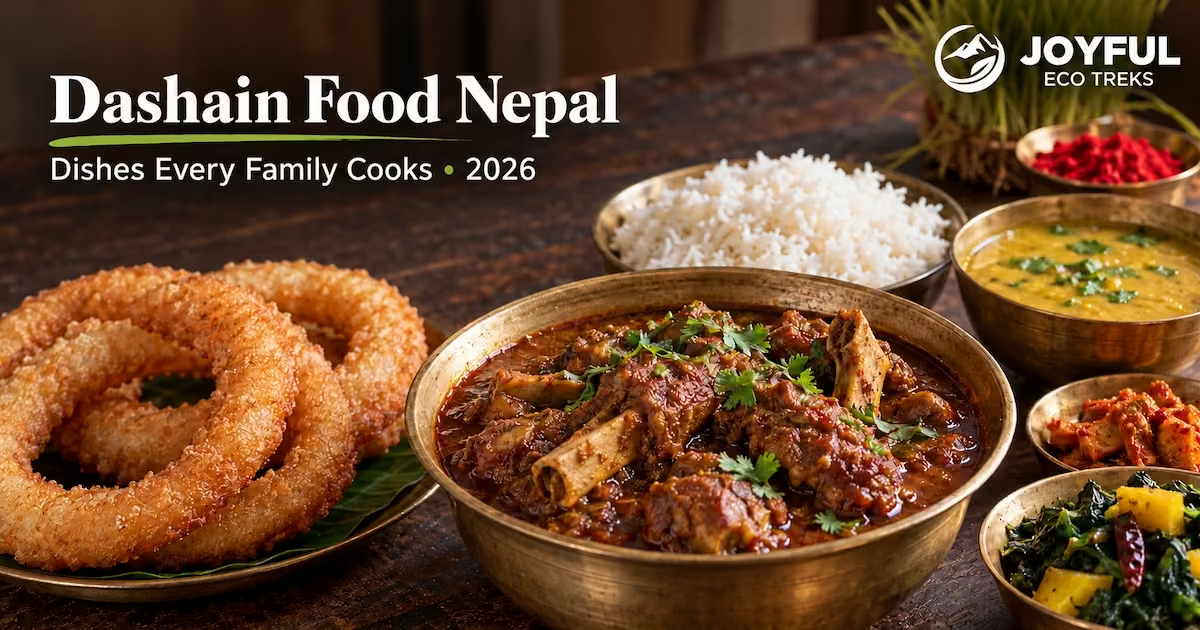
The cut is usually bone-in: shoulder and ribs, left that way because the marrow and connective tissue carry flavor through a long simmer. Browned in mustard oil with whole spices, then cooked down slowly until the gravy clings to each piece. Goat curry is especially familiar on many Pahadi Dashain tables, but chicken, buffalo, other dishes, or vegetarian meals also appear according to household preference and community tradition.
How Pahadi kitchens and Newari households treat the same goat
Here the cooking traditions often differ. A Pahadi family may turn goat into that wet, spice-dark curry and ladle it over rice or chiura. Many Newa households celebrate Mohani with buffalo preparations, lentil dishes, samay baji, and other foods, as a later section shows. The plates differ, but their ingredients and customs can also overlap.
Sel Roti: The Ring-Shaped Bread Made for Festivals
Sel roti is the sweet, ring-shaped bread that surfaces only when something is being celebrated. The batter is roughly ground rice flour loosened with water, sugar, and a little ghee, sometimes scented with cardamom; a practiced hand pours it in a thin circle straight into hot oil, where it puffs into a crisp golden ring. Researchers put the tradition at over 800 years old, which tells you how settled a fixture it is.
The festival-week window when families fry it
Families often fry sel roti in batches around the main festival days, though the exact day and quantity vary. The reason is practical. A food-science study describes a shelf life of about two weeks at room temperature, but actual keeping time depends on ingredients, hygiene, and storage conditions, so it should not be treated as a guarantee.
What a plate of sel roti at the door really signals
When a neighbor opens the door and a plate of sel roti appears before you have even sat down, that is the signal: this house is deep into Dashain and you are being folded into it. The rings travel well. They are a common treat offered to visitors and sometimes sent home in a bag, which is one reason families prepare them in batches.
Chiura and Masu: The Pairing Many Guests Are Offered
At many meat-eating Dashain homes, you may be handed chiura and masu: a mound of cold beaten rice with hot goat curry spooned over it. The logic is physical. Chiura is parched, flattened rice that needs no cooking and no reheating, so it soaks up the oily gravy instantly and can be served to a stream of drop-in guests without a stove running all day. It is the festival’s paper plate, if a paper plate could be delicious.
In some Newa households, beaten rice also carries a ritual meaning. OnlineKhabar documents a Newa custom in which two vessels, one of rice and one of chiura, are set aside during Dashain; on Vijaya Dashami, the eldest woman gives them to younger women in age order as a blessing and a symbol of household responsibility. This is a particular community tradition, not a ritual followed in every Nepali home.
Maas Ko Daal, Tarkari, and the Dishes That Round Out the Plate
Around the goat sit the supporting dishes. Maas ko daal, a thick black-lentil curry, is a festive staple widely used in Newari cooking and common on hill tables too, richer and darker than the everyday yellow lentils. Alongside it comes a seasonal tarkari, often potato with the first of the season’s cauliflower or beans, a sharp fermented green like gundruk, and at least one fierce achar to cut the fat. None of this is the star. Its job is to give the goat somewhere to sit and the palate somewhere to rest.
Taas: The Pan-Fried Goat Slices You Can Actually Buy in Kathmandu
Here is the dish for travelers with no home to be invited to. Taas is goat sliced thin, marinated overnight, and shallow-fried on a thick iron griddle until the edges crisp, a world away from the slow wet curry. The dish is closely associated with Chitwan in the Terai, and is also found in Kathmandu eateries. It may arrive with chiura, beaten rice, or with bhuja, puffed rice, plus pickles and chilies. Because it is sold in shops and small restaurants, taas is an accessible festival-season meat dish a visitor can walk in and order. No invitation required.
Newari Dashain Food: Kachilaa, Bara, Sapu Mhichaa, and Haku Choila
Newa communities of the Kathmandu Valley have distinctive festival food traditions that frequently feature buffalo alongside grains, lentils, and other dishes. Kachilaa is spiced raw minced water buffalo, closer to a tartare than a curry. Thick patties of ground black lentils, pan-fried crisp outside and soft within, are bara. For haku choila, buffalo is grilled and then tossed hot in mustard oil and garlic. The showpiece, sapu mhichaa, is buffalo leaf tripe tied into a small pouch, stuffed with bone marrow, then boiled and deep-fried so the marrow turns molten inside. Guides that call it a stuffed trotter have it wrong.
Why these dishes feature in Newa festival tables
The distinction is about recipes and local customs as well as the animal. Many Pahadi households favor goat curry, while Newa Mohani feasts may place buffalo preparations alongside goat, duck, lentil cakes, and beaten rice. These are recognizable Newa specialties, but dishes and ingredients travel between communities, and no single festival menu represents everyone.
Where to find Newari Dashain food in Kathmandu
No family connection required. Samay baji sets and these buffalo preparations turn up year-round in the Newari eating houses clustered through the old quarters of Kathmandu, Patan, and Bhaktapur, and they are at their most elaborate during Mohani. For a traveler who wants the Valley’s festival food without a home invitation, the old city is the place to start, and a cultural tour of the Valley is the easy way to time it.
How Terai Households Eat Dashain Differently From Hill Families
Drop down to the plains and the chiura-and-masu template is not the only picture. The Kathmandu Post reported in 2025 that some Tharu families enjoy ghonghi (freshwater snails), andik bhaat (sticky rice), and bhakka (a soft steamed rice cake) during the Dashain–Tihar festive season. Terai food varies across districts and communities; rice dishes, meat, vegetables, and regional specialties can share the same table. It is a reminder that traditional Dashain food is really several cuisines wearing the same festival name.
Dashain Food Nepal: Which Dish Appears on Which Day
No single menu maps every household’s food to the calendar, so here is a practical guide. The table below is Joyful Eco Treks’ synthesis of the main 2026 festival observances and dishes that may appear, rather than a fixed menu for every family.
|
Festival day |
What tends to be on the table |
|---|---|
|
Ghatasthapana (Oct 11, 2026) |
Jamara is sown; meals vary, and some families keep the opening days simple |
|
Fulpati / Saptami (Oct 17, 2026) |
Festival preparations and offerings; some households begin making sel roti and other foods |
|
Maha Ashtami (Oct 18, 2026) |
Ritual offerings and feasts in some communities; Newa households may prepare samay baji or kuchi bhwey |
|
Maha Navami (Oct 20, 2026) |
Meat dishes in households that observe sacrifice or buy meat; vegetarian meals in others |
|
Vijaya Dashami (Oct 21, 2026) |
Tika visits and shared meals; goat curry with chiura is common in some homes, while menus vary |
|
Kojagrat Purnima observance (Oct 25, 2026) |
The festival closes with full-moon observances; food customs depend on the household |
Ghatasthapana through Fulpati: the preparation stretch
These opening days can stay close to ordinary eating in some homes, while others begin their feasting earlier. Ritual attention goes to the barley seedbed, shrines, and family preparations, and some kitchens begin frying sel roti before the main tika day.
Saptami to Vijaya Dashami: the peak feasting days
This is the engine room of the festival for many households. Some families observe animal sacrifice or prepare meat dishes around Ashtami and Navami, while others serve vegetarian food. Vijaya Dashami brings tika visits and shared meals; the rice-and-chiura blessing vessels belong to a specific Newa custom, rather than every household.
Kojagrat Purnima: the full-moon close
The festival closes with Kojagrat Purnima observances. Some families prepare sweets or shared meals, but there is no single food that replaces meat dishes in every household on this day.
What a Traveler Is Actually Served at a Dashain Table
The sequence of the meal and how long it runs
A Dashain visit rarely follows a clear sit-down structure with a defined start and end. You may arrive, receive tika and blessings from the elders, and find food coming in waves: perhaps sel roti with tea, then chiura and masu or vegetarian dishes, with curry and sides if you stay for the full spread. It can stretch across a whole afternoon, and refusing every round is harder than it sounds.
How to handle the meat question if you do not eat it
If you do not eat meat, mention it before you arrive where possible. That gives the host time to offer a lentil-and-vegetable plate, and it avoids confusion at the table. You can also decline an offered dish politely; there is no universal rule requiring guests to refuse the first serving and accept the second or third. Bring something when you come, fruit, a box of sweets, or mithai for the household, and you will have read the room correctly.
Questions Travelers Ask About Dashain Festival Food
Is it rude for a vegetarian to decline meat at a Dashain meal?
No. Mention your preference in advance when possible, so your host can plan a vegetarian plate of daal, rice, and vegetables. If you need to decline meat at the table, do so politely; Dashain does not require every guest to eat goat.
What is sel roti and on which Dashain days is it made?
Sel roti is a sweet, ring-shaped bread of fried rice-flour batter, often made around Fulpati, Ashtami, Navami, and other festive days. There is no single peak frying day for every family. Published research describes a shelf life of about two weeks, but safe storage depends on the recipe and conditions.
Why do Newari families eat different dishes than Pahadi families?
Newa families celebrating Mohani often serve dishes such as kachilaa, sapu mhichaa, and haku choila made with water buffalo, alongside other festive foods. Many Pahadi households favor goat curry. These are common patterns, not strict boundaries, and menus vary between families.
What food is served on Vijaya Dashami, the main tika day?
In many meat-eating households, khasi ko masu, goat curry with chiura, is a familiar Vijaya Dashami meal, often with daal, seasonal vegetables, and pickles. Some families use meat from a sacrifice or market purchase, while others prepare vegetarian dishes.
Can you buy Dashain food at restaurants, or is it home-only?
Much of the festival food is home-cooked, but restaurants also sell dishes such as taas. This Chitwan-associated dish of pan-fried goat slices may be served with beaten rice or puffed rice in eateries, making it an accessible option for travelers without a home invitation.
Traveling through Nepal in October? See how Dashain slots into the full festival season in our month-by-month cultural calendar, and plan your table time around the peak feasting days.

All Categories