Five Days of Tihar: Nepal’s Ritual Sequence Decoded
The five days of Tihar are not five separate celebrations strung together by the calendar. They form one connected argument about death, protection, wealth, and human love, often read as a symbolic progression. Most visitors arrive having already read the dates and logistics, see lamps in every window and marigolds on every door, and leave calling it the festival of lights. Watch the sequence closely and a stricter structure appears: the festival first makes peace with the agents of death, then honors death’s gatekeepers, then invites prosperity into a home that has settled its account with mortality, then turns inward to the living soul that prosperity is meant to serve, and only at the very end seals the sibling bond that gives a protected, prosperous life its reason to exist.
Table of Contents
ToggleWhy Tihar runs for five days instead of one night
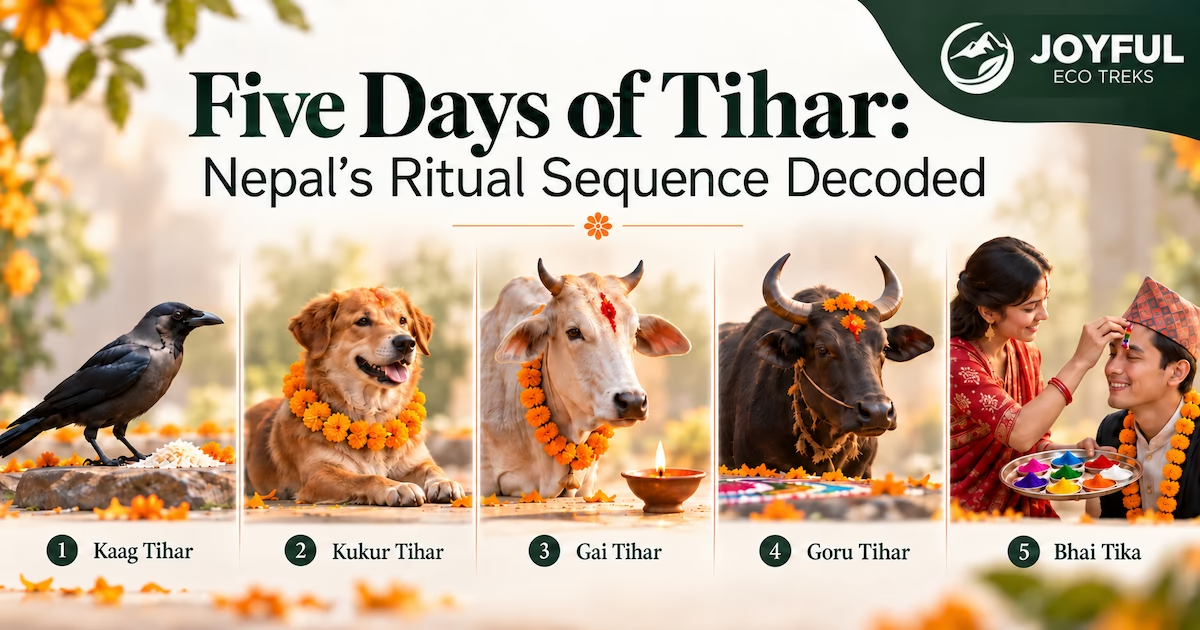
Read in order, the honorees form a deliberate progression. The crow comes first because it carries messages to Yama, the lord of death. The dog follows because it guards the threshold between this world and the next. In this interpretation, Laxmi, the goddess of wealth, enters a house that has already made its peace with death’s messengers. The fourth day also turns to the self, the one soul in whose service all that wealth exists. The fifth closes on the tie between sister and brother, the human bond that is supposed to outlast a single lifetime.
The movement runs outward to inward: from the farthest and most frightening power toward the nearest and most intimate one. A household that lit lamps for Laxmi before it had fed the crows would, in this logic, be inviting wealth into an unguarded house. Because Tihar follows the lunar calendar, the dates shift each year against the Gregorian one, and observances do not always fall on separate days.
In 2026, Kukur Tihar and Laxmi Puja are together on November 8, followed by Gai Puja on November 9, Goru Puja and Mha Puja on November 10, and Bhai Tika on November 11. The five sections below explain the rituals and their symbolic connections, not a fixed Gregorian-date schedule.
The weight is not evenly spread. For most families, Laxmi Puja on Day 3 and Bhai Tika on Day 5 carry the heaviest ritual load; the first two mornings are quieter, almost preparatory. Knowing that keeps a visitor from expecting the same intensity on a sleepy first dawn that they will feel on the final afternoon.
Day 1: Kaag Tihar and the crow as Yama’s messenger
The first ritual happens while the household is still dark, and the timing is the point.
Before sunrise: what goes on the roof and why
Before the sun is up, a plate of rice, curd, and curry goes out onto the roof, into the courtyard, or into any open space where crows gather, according to Tourism Info Nepal. The food is left for the crows specifically because the crow is Yama’s messenger in Hindu tradition, the bird whose cawing is associated with grief and whose flight crosses between the mortal and spiritual worlds. This is closer to diplomacy with death than to a celebration of wildlife. The household sends a good message up the line, hoping the crow carries word of the family to Yamaraj and returns with nothing worse than news.
Reading the crow: the Shuva bol omen tradition
The communication runs both ways. In Nepali tradition, when a crow caws, people answer it aloud with “Shuva bol, shuva bol,” meaning “speak good news,” as Tourism Info Nepal records. On Kaag Tihar, the morning’s calls are read as omens of what is coming, often the arrival of a guest. The household does not just set out food and walk away. It listens, answers, and interprets, treating the crow as a correspondent rather than a pest. The day’s first act is a short conversation with death’s postman.
Kaag Tihar across Nepal: Valley and hill communities
Much of the documented ceremony, the temple observances at sites like Kageshwari Mahadev and the elaborate rooftop offerings, concentrates in the Kathmandu Valley, where Kaag Tihar in Nepal is most visibly staged. In many hill and mountain communities, the morning passes more simply: food left out, a few words spoken, little ceremony. A visitor should not assume the Valley’s version is the national norm, nor read a quiet hill dawn as neglect. The gesture is the same even where the staging is minimal.
Day 2: Kukur Tihar and the dog as afterlife guardian
On the second day, the honoree you can actually pet arrives. Dogs across the country, pets and strays alike, are garlanded and fed, and the warmth of it is genuine. The theology underneath is older and darker than the photographs suggest.
Why dogs: the Vedic guardian and Bhairava’s companion
The dog’s role comes straight from the oldest layer of the tradition. Yama keeps two four-eyed dogs who guard the path of the dead; the fierce god Bhairava rides a dog as his vahana; and in the Mahabharata, the loyal dog that follows Yudhishthira to the gates of heaven turns out to be Yama himself in disguise. Put those together and the logic of Day 2 is plain: having addressed death’s messenger on Day 1, the household now honors death’s gatekeeper. Keeping the guardian of the threshold on your side before you ask wealth to cross it is the point.
Garland, tika, and sel roti: the three offerings explained
The dog receives three things, and each means something distinct. The marigold garland marks the animal as sanctified for the day, lifted out of its ordinary stray status. The sindoor tika pressed onto its forehead is the same red mark of blessing a person receives, placing the dog briefly on human ritual footing. The sel roti, the ring-shaped rice bread fried for every Tihar, is the good food of the festival shared with a creature that is, for one day, family. A stray that is kicked the other 364 days is fed from the same kitchen as the children. That reversal is the ritual’s quiet argument about who, in the end, guards you.
Day 3: Gai Tihar and its traditional link to Laxmi Puja
Gai Tihar and Laxmi Puja are traditionally linked through two rituals with two timings, though their dates can differ. The cow is worshipped in the morning; the goddess of wealth is welcomed after dark. Understanding why requires reading the two as a theological sequence rather than assuming they always share a date.
Gai Tihar across Nepal: the cow as a living Laxmi
At dawn the cow is garlanded, marked with tika, and draped in colored cloth, honored as a figure of nourishment, patience, and abundance. Gai Tihar in Nepal is usually explained as reverence for a sacred animal, which undersells it. The cow is treated as Laxmi’s living earthly form. Consider what each provides: the goddess grants material plenty; the cow gives milk, curd, and ghee, the daily substance of that plenty. In the traditional telling, worshipping the cow is therefore the symbolic preface to Laxmi Puja, not an unrelated custom. Wealth in its tangible, breathing form is honored through the cow, while its divine form is welcomed through the evening lamps, even when the dates differ.
Why Laxmi Puja waits until evening
Laxmi Puja is performed in the evening around Kartik’s new-moon period, one of the darkest times of the lunar month, as MeroNepal notes. The darkness is the premise, not an inconvenience. Oil lamps set in every window and strung along every path to the door exist so the goddess can find her way in; the diyos are navigational, not decorative. A dark gap anywhere in that line is a break in the invitation. Many families also lay rangoli at the threshold, sometimes with small painted footprints leading inward, marking the route for Laxmi to follow. Gambling with kauda cowrie shells and langur burja dice boards, ordinarily frowned upon, is culturally sanctioned this one night, a licensed flirtation with fortune on the evening on which fortune is said to visit.
Deusi and bhailo move house to house
After dark, roving singers go door to door. Bhailo groups, traditionally of women and girls, and deusi groups, traditionally of men and boys, perform set songs at each house and collect small gifts and blessings in return. This is not busking; it is a structured exchange of good wishes for tokens, a village-scale circulation of the prosperity the evening celebrates. For a sense of where Tihar sits within Nepal’s wider ritual year, our month-by-month festival guide maps it against the country’s other major observances.
Day 4: Goru Puja, Govardhan Puja, and Mha Puja for Newars
The fourth day brings worship of working oxen alongside Govardhan Puja and the Newar observance of Mha Puja, and the rituals could hardly look less alike.
Goru Puja: honoring the work of the fields
Goru Puja honors the ox for its labor in the fields, often with tika, garlands, and food. Farming households may also worship plows and other agricultural tools during Hali Tihar, recognizing the animals and implements that sustain the harvest.
Mha Puja: worshipping your own living soul
Among the Newars, the same day is Mha Puja, literally the worship of one’s own self. Each family member sits before a mandala drawn for them on the floor. The construction is exact: a powdered limestone base, then concentric rings of red rice, black lentil, black soybean, unhusked rice, and puffed rice around a center circle of mustard oil, with an eight-petalled lotus set inside a circle marked with water, according to Wikipedia’s account of the ritual. The lady of the household applies tika to each person and hands out sacred threads called kwakha. At the feast’s close, bronze plates set on the mandalas stand for the impermanence of the worldly.
One detail closes the festival’s whole circle. In one documented Newar practice, two extra mandalas are prepared for Janmaraj and Yamaraj, associated with life and death; arrangements vary among communities On Day 1, the household feeds death’s messenger on the roof; on Day 4, at the very moment it honors its own living souls, it marks death a place on the floor too. The self is worshipped in full view of mortality, never apart from it. That echo between the first day and the fourth is the thread that most Tihar guides leave untraced.
Nepal Sambat, the Newar new year
Mha Puja falls on New Year’s Day of Nepal Sambat, the Newar lunar calendar. This is not a folk relic. Nepal Sambat dates from 20 October 879 CE, its founding attributed by legend to Sankhadhar Sakhwa, who is said to have found sand that turned to gold and used it to clear the debts of the Nepali people, though historians still debate whether he existed. More to the point for a visitor, the calendar carries formal status: the government of Nepal has included Nepal Sambat in official documents alongside Vikram Sambat, effective 11 November 2023, as Wikipedia records. Nepal Sambat is a recognized civil calendar, not a community curiosity.
Day 5: Bhai Tika and the ritual that closes the five days of Tihar
The last of the five days of Tihar brings the sequence home to the most human bond of all, between sister and brother.
Why the tika travels from sister to brother
Traditionally, the sister applies the tika to her brother, though some Nepali communities exchange tika in both directions. One explanation sits in the founding story. Yamuna, sister of Yama himself, is said to have welcomed him with tika and flowers, and the day re-enacts that wish for a brother’s long and protected life. Having moved through death’s messenger, death’s guardian, wealth, and the self, the festival ends by asking the oldest question a person asks of death: let my brother live. The sister stands in Yamuna’s place and makes the plea.
The seven colors, okhar, and mustard oil
The brother receives a seven-color tika, applied in a line on the forehead over a base mark. The colors are popularly linked to qualities such as power, peace, harmony, protection, purity, creativity, and affection; these attributions circulate widely in Nepal as folk symbolism rather than fixed scripture, so take them as common belief rather than canon. Around her brother, the sister pours a ring of mustard oil, sometimes drawn with lemongrass, as a protective boundary against harm. She garlands him with makhamali flowers, chosen because they barely wilt and so stand for a long life, and cracks an okhar, a walnut, as part of the exchange. She offers sel roti, sweets, and milk; he returns money and, often, clothes. Underneath the sweetness runs the hard prayer the day was built on: that the sister’s own life be offered in place of her brother live long and remain protected from misfortune.
What Bhai Tika holds for women with no brother
The ritual assumes a brother, which raises an obvious question for anyone without one. In practice the bond is kept alive through substitution rather than abandoned. A woman without a living brother may apply the tika to a cousin or a close male relative, or honor the bond symbolically, so that the day’s protective wish is still spoken even where the original pairing is gone. The form bends; the intention, to spend one’s own blessing on another’s long life, is what the day actually protects.
A day-by-day ritual map of Tihar
The table below lays out the whole arc at a glance, mapping honoree, cosmological role, primary ritual act, and the timing the theology depends on.
|
Day |
Honoree |
Cosmological role |
Primary ritual act |
Timing |
|---|---|---|---|---|
|
1. Kaag Tihar |
Crow |
Yama’s messenger |
Rice, curd, and curry left out; the crow’s call read as an omen |
Before sunrise |
|
2. Kukur Tihar |
Dog |
Guardian of the threshold between worlds |
Marigold garland, sindoor tika, and sel roti given to dogs |
Daytime |
|
3. Gai Tihar and Laxmi Puja |
Cow, then Laxmi |
The cow as living wealth; Laxmi as wealth invited in |
Cow garlanded on Gai Puja; lamps lit on Laxmi Puja |
Morning for cow; evening for Laxmi (2026 dates differ) |
|
4. Goru/Govardhan Puja / Mha Puja |
The ox, or one’s own soul |
The self that wealth is meant to serve |
Ox worship, cow-dung Govardhan mound, or Newar self-worship on a mandala |
Daytime; Nepal Sambat new year |
|
5. Bhai Tika |
The sibling bond |
The human tie worth protecting |
Sister applies seven-color tika (sometimes exchanged), garland, okhar, and oil |
Daytime, at the auspicious hour |
Read top to bottom, the timing column tells its own story. The festival starts in the dark before dawn with death and ends in the full light of an afternoon with the living affirming they intend to keep each other.
What a respectful observer can do each day
Seeing the logic changes how you behave inside it.
On Day 1, being up early enough to watch the rooftop offerings from a distance is enough. Treat fed crows as a private prayer, not a photo opportunity. On Day 2, ask before garlanding or feeding someone’s dog, and let the animal set the pace.
Laxmi Puja night rewards patience more than any other. Arriving at a lit street after dark on November 8 in 2026 means you see the ritual working, not merely decorated. Notice whether the line of lamps is unbroken before you photograph it; that continuity is the invitation in action. If a deusi or bhailo group performs at a doorway, a small genuine contribution is welcome, and joining the performance uninvited is not.
On Day 4, establish which community you are among before you assume what you are seeing. A Newar household at its mandalas is performing a self-worship ritual with a specific cosmological weight; a hill Hindu family at a dung mound is re-staging a Bhagavata Purana scene. These are not two versions of the same thing. On Day 5, Bhai Tika is a family interior, not a public event. Accept an invitation warmly if one is offered and keep a respectful distance if it is not.
The lights are the easy part, visible from any rooftop. The structure underneath them, death answered, guarded against, out-waited, and finally defied in the name of a sibling, is what a careful visitor actually came for. For exact dates, where to stand in Kathmandu, and what to wear as a respectful guest, read our Tihar 2026 travel guide.
Tihar ritual questions answered
Why does Tihar honor a different animal on each of the first three days?
Each animal occupies a symbolic place in a traditional reading of the journey between life and death. The crow (Day 1) is Yama’s messenger, so the household appeases death’s courier first. The dog (Day 2) guards the threshold between worlds, so it is honored next. The cow (Day 3) is treated as the living form of Laxmi, wealth in the flesh, connecting with the evening worship of the goddess herself. This is a thematic progression from death’s agents toward wealth, even in years when the observance dates differ.
What is Mha Puja and why is it only practiced by the Newar community on Day 4?
Mha Puja is a Newar ritual of worshipping one’s own living soul. Each family member sits before a personal mandala and is honored, purified, and empowered for the year ahead. It belongs to the Newars because it coincides with New Year’s Day of Nepal Sambat, the Newar lunar calendar, which begins on this date. Other Hindu communities mark the same day differently, most commonly with Govardhan Puja and its cow-dung mound.
Why is Laxmi Puja performed specifically after sunset rather than during the day?
Laxmi Puja takes place around the new-moon period of Kartik, when nights are especially dark. Laxmi is believed to travel to homes through that darkness, and the oil lamps set in every window and along every path exist to light her route in. The timing and the lamps are navigational rather than ornamental, which is why an unbroken line of light matters more than how bright any single lamp is.
What do the seven colors in the Bhai Tika represent, and who applies it to whom?
The sister traditionally applies the tika to her brother, though some families exchange tika in both directions. The seven colors are popularly linked to qualities such as power, peace, harmony, protection, purity, creativity, and affection. These readings circulate widely as folk symbolism across Nepal rather than as fixed scripture, so they are best treated as common belief. The central gesture of blessing a sibling is rooted in the legend of Yamuna honoring her brother Yama.
Is Kaag Tihar crow worship practiced the same way across Nepal or only in the Kathmandu Valley?
The elaborate version, with temple observances and formal rooftop offerings, is concentrated in the Kathmandu Valley. In many hill and mountain communities, the day is marked more simply: food left out and a few words spoken, with little ceremony. The underlying gesture, feeding Yama’s messenger and reading its call, is shared; the staging varies considerably by region.

All Categories