Dashain Festival in Nepal: Dates, Rituals & Travel Guide
On 11 October 2026 (Asoj 25), at the auspicious time of 11:47 AM, households observing Dashain across Nepal will sow barley seed for jamara and keep it in darkness. That quiet act opens Dashain, the fifteen-day observance that bends the country’s roads, flights, and trekking crews more than anything else on the calendar. This guide treats the dashain festival in nepal as a logistics problem first and a spectacle second, because the travelers who get caught out are the ones who planned around the rituals and never read the shutdown.
Table of Contents
ToggleWhy Dashain Empties Kathmandu Every October
Dashain marks the goddess Durga’s defeat of the buffalo demon Mahishasura, a battle the festival stretches across fifteen days of worship, feasting, and family reunion. The religion behind it is Hindu, but the dashain festival in nepal is observed by the large majority of Nepalis and crosses most ethnic, caste, and regional lines. Newars, Magars, Tamangs, and Tharus keep it alongside Bahun and Chhetri households, each with their own inflection.
For a traveler, the three-day core of Ashtami, Nawami, and Vijaya Dashami is when the capital hollows out. Government workers, shopkeepers, porters, and drivers all head to their ancestral villages to receive tika from an elder. A city of several million sheds a large share of its working population in under a week, and everything that leans on that labour, from permit desks to bus crews to bank counters, slows or stops.
Dashain 2026 Dates: The 15-Day Calendar for Travelers
Ghatasthapana to Saptami: the quiet first week
The first seven days, from Ghatasthapana on 11 October through the eve of Phulpati, barely register for a traveler passing through. The auspicious time for sowing jamara on Ghatasthapana in 2026 is 11:47 AM. Shops stay open, buses run, and the most visible sign is the jamara, pale barley grass rising under cloth in household shrines. Use this week for permits and city sightseeing. After the 16th, the machine seizes up.
Maha Ashtami and Maha Nawami: the festival peaks
On 18 October (Maha Ashtami), with the Ashtami tithi continuing into 19 October, and on 20 October (Maha Nawami), the festival reaches its devotional and bloodiest pitch. These are among the key days of animal sacrifice. The auspicious tika time (muhurat) for Vijaya Dashami in 2026 is 10:26 AM on 21 October.
Vijaya Dashami: tika day across every household
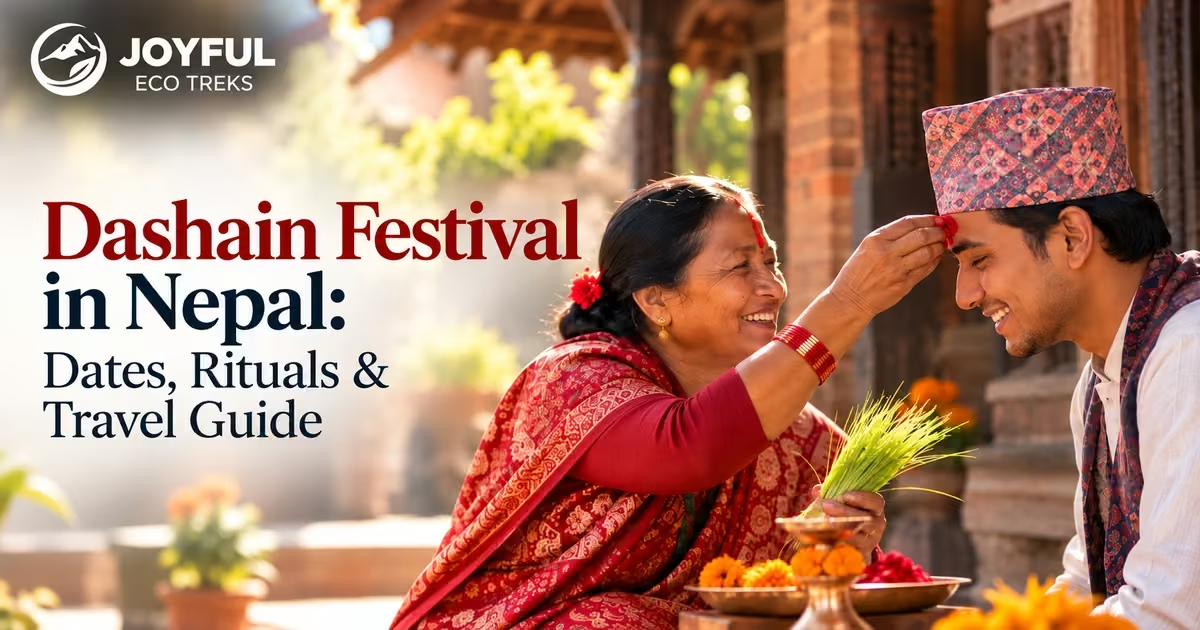
The tenth day, 21 October, is the one to build a Kathmandu stay around. The auspicious tika time in 2026 is 10:26 AM. In the late morning, elders press the red tika onto the forehead of younger relatives and tuck jamara behind the ear, a blessing repeated across families observing Dashain that day. Streets fall near-empty, traffic thins to almost nothing, and the mood turns domestic rather than public.
Ekadashi to Kojagrat Purnima: the slow wind-down
From 22 October (Ekadashi), the tika visits continue as people call on extended family, and the festival closes on Kojagrat Purnima, the full moon of 25 October. Services reopen unevenly across these days, and the highways back into Kathmandu fill as the holiday crowd returns.
What Travelers Can Watch, Join, and Photograph
Look up over Kathmandu in the week before Dashami, and the sky is stitched with paper kites.
Kite flying across the valley rooftops
Kite flying, or changa, peaks during Dashain and is one of the festival’s best-known seasonal traditions. The best vantage points sit high and open. Swayambhunath hill looks down over a valley-wide canopy of them, and the courtyards around Patan Durbar Square fill with competitors trying to cut each other’s lines.
Linge ping: the bamboo swing most guides skip
In village squares and at crossroads, you will find the linge ping, a swing built from four tall bamboo poles lashed together at the top with a jute-rope seat slung between them. They can stand over twenty feet, and they take their name from the Shiva linga shape the poles form. Tradition holds that you should leave the ground at least once during Dashain by riding one. They are vanishing from the cities as open ground disappears, so the intact ones now stand mostly in the mid-hills, with the Palpa area among the documented strongholds.
Receiving tika as a visitor
The tika itself is a paste of rice, yogurt, and red vermilion (abir), applied by the most senior family member, and the jamara is the yellow barley grown since Ghatasthapana. You can receive both if a Nepali family invites you, and many will. Accept the jamara with both hands, let the elder apply the tika to your forehead, and wear it for the rest of the day rather than wiping it off at the door. Our guide to religious-site etiquette in Nepal covers the wider rules on dress and photography.
Paayaa sword processions and Basantapur on Dashami
The Nepal Tourism Board lists the Paayaa sword processions that move through the valley during Dashain, a traditional ceremony almost no guide mentions. Basantapur Durbar Square stays the ceremonial heart of the valley’s Dashain and is worth walking through on Vijaya Dashami, when the old palace complex and its temples draw worshippers through the day.
How Nepal Shuts Down: What Closes, October 17 to 25
Here is the claim to ignore: “all of Nepal shuts down for Dashain.” The closure is partial and category-specific, and knowing which category you depend on is the whole game. The gazetted public holiday runs 17 to 23 October 2026, a seven-day block set by Nepal Gazette notice.
|
Date |
Day |
What closes |
What stays open |
|---|---|---|---|
|
Oct 16 |
Saptami eve |
Nothing yet, last full working day |
Everything |
|
Oct 17 |
Phulpati (7) |
Most banks and government offices, many local shops |
Airlines, tourist hotels, main Thamel restaurants |
|
Oct 18-19 |
Ashtami (8) |
Most offices, banks and local markets; sacrifices begin |
Tourist restaurants, Pashupatinath complex |
|
Oct 20 |
Maha Nawami (9) |
Peak closure; Taleju opens to the Hindu public for one day |
Tourist infrastructure |
|
Oct 21 |
Vijaya Dashami (10) |
Most local businesses close for the main tika day |
Main guesthouses and restaurants |
|
Oct 22-23 |
Ekadashi to Dwadashi |
Most banks and government offices remain on holiday |
Shops begin reopening; some services run limited hours |
|
Oct 24-25 |
to Kojagrat Purnima |
Scattered local closures |
Near-normal in tourist areas |
What closes or runs on reduced hours hits residents and bureaucracy: banks, government offices, some trekking-permit and TIMS services, and most locally owned shops. Immigration and permit services may operate on limited public-holiday schedules rather than normal hours, so anything you need stamped or issued should ideally be done before 16 October. What stays open serves travelers: the airlines, international and tourist-grade hotels, the main Thamel restaurants and guesthouses, and the Pashupatinath temple complex generally keep running. Pharmacies are the trap. Many travelers assume they open like a Western chemist, but small ones can close for the core days, so stock what you need before Phulpati.
Dashain and Trekking: Porters, Tea Houses, Trail Traffic
If your trek overlaps Dashain week, assume your crew would rather be somewhere else.
When porters leave and when they come back
Porters and guides often head home around the core Dashain days, so staffing can thin roughly from 16 to 26 October. A trek starting inside it can launch understaffed, or with a substitute crew you never met. Availability generally improves after the main festival travel period, but the exact return date varies by crew.
Everest-bound? Check whether your Lukla flight departs from Ramechhap
This one blindsides Everest trekkers. For autumn 2026, Tara Air has announced that its Lukla flights will operate from Ramechhap (Manthali) from 25 September to 15 December. The airport is a long road transfer from Kathmandu, and departures often start early. Weather can still create backlogs, so budget spare days on both ends of any Everest Base Camp or Gokyo itinerary in this period and confirm the departure airport shown on your ticket before travel.
Before you pay a deposit, ask the agency three specific things: whether your named guide and porters are confirmed for your exact dates, whether any of them are on Dashain home-leave, and whether a Lukla trek routes through Ramechhap. A vague “yes, no problem” is not confirmation. Our best-time-to-trek Nepal tool helps you see how your dates sit relative to the festival.
How the Dashain Festival Looks Outside Kathmandu
The same festival reads completely differently depending on where you stand for it.
Kathmandu Valley: Hanuman Dhoka and the animal sacrifice
The capital gives you Dashain as public ceremony. Taleju Bhawani temple in Kathmandu Durbar Square opens to the general public for exactly one day a year, on Maha Nawami (Day 9), a point confirmed by the Nepal Tourism Board. Several competing guides wrongly place this opening on Maha Ashtami; it is Nawami. Even on that day, non-Hindu foreigners cannot enter, so plan to observe from the square rather than expecting to go in. Beside it, the Kot courtyard at Hanuman Dhoka holds the state sacrifice, where army and police units offer buffalo and goats to Durga, while across the valley families slaughter goats and ducks for the festival meal. The Nepal Tourism Board notes that a large number of animals are officially sacrificed at Hanuman Dhoka during Nawami. You will see blood on temple steps and butchers working through the morning. This is a devotional offering that becomes the family feast, not a show staged for visitors, so photograph it with restraint and stay clear of the Kot ceremony unless you are invited in.
The mid-hills: Gorkha and Kaski courtyards
Ride a few hours out to a district like Gorkha or Kaski, and the processions disappear. Here Dashain happens in the family courtyard: a goat offered at the household shrine rather than a temple precinct, a linge ping rising from an open field instead of a city crossroads, and an elder blessing three generations who travelled a day by bus to be there. Few travelers stay overnight in a hill village for it. Those who do get the version of Dashain that the Kathmandu crowds are themselves trying to reach.
High trekking regions: small festival, perfect trails
Up in the Khumbu or Manang, Dashain is a minor Hindu note in largely Buddhist country, so it barely interrupts the trail. What you get instead is the reason everyone comes in October: stable, clear post-monsoon weather and the year’s sharpest mountain visibility, paid for with busy lodges and the staffing math above.
Booking Flights, Buses, and Hotels Around Dashain 2026
Booking for the dashain festival in nepal rewards whoever moves first. In typical festival-season booking patterns, the pressure tightens in four stages as Vijaya Dashami approaches.
-
Four weeks out (late September): domestic flights, intercity buses, and hotels all sit at normal autumn rates with open seats.
-
Three weeks out: departures on the peak days, 16 to 18 October, sell through first, and hill-bound buses start to fill.
-
Two weeks out (early October): the 16 to 18 October seats are among the hardest to find.
-
Final week: last-minute seats on the peak departure days are either gone or can cost significantly more than usual, and the 22 to 25 October return legs become the next crunch.
Domestic flights and long-distance buses book out about three to four weeks ahead for the Dashain window, faster than at any other time of year. Kathmandu and Pokhara hotel pricing is the gentler surprise: because the festival drains the cities of their own residents, tourist-district rooms often stay available even at the peak, while guesthouses in family-heavy hill towns tighten instead. The clean strategy is simple. Leave Kathmandu before 15 October, or stay put through 21 October and move from the 22nd, when the return surge builds more gradually than the Phulpati rush out.
Three Things Travelers Get Wrong About Dashain
Three mistakes show up again and again, and each one is avoidable.
First, treating family courtyards as public photo sets. A household mid-tika is not a street scene. Catching the blessing on camera from the gateway without a word is the quickest way to offend. Ask, or wait to be waved in.
Second, underestimating which days actually bite. The shutdown does not begin on Vijaya Dashami; it begins on Phulpati, 17 October, when the offices close and the exodus peaks. That morning and evening, the highways out of the valley clog for hours as a large share of the city heads for ancestral villages at once. Plan your travel around the 17th, not the 21st.
Third, mixing up Dashain and Tihar. Tihar, the festival of lights, follows about three weeks later and is a separate event with its own closures. A trip timed vaguely for “the festival” in early November is timing for Tihar, not Dashain. Read the sequence before you book anything.
Dashain 2026 at a Glance: Dates and When to Move
If you keep one block of this guide, make it this one. The dashain festival in nepal runs 11 to 25 October 2026, but your decisions hang on four dates.
-
16 October: the last full working day before the main Dashain holiday block. Finish routine paperwork by then where possible.
-
17 October (Phulpati): the shutdown and the transport exodus begin. Avoid unnecessary long-distance travel if you can.
-
21 October (Vijaya Dashami): the main tika day, with the auspicious tika time at 10:26 AM, and the single best day to be in Kathmandu for the atmosphere.
-
22 to 25 October: services reopen unevenly and the return crowds build, so move early in the day.
Questions Travelers Ask Before a First Dashain in Nepal
Can a foreign traveler receive tika during Dashain, and is it appropriate to ask a local family?
Yes, a foreign visitor can receive tika, though the grace is to wait for an invitation rather than asking an unfamiliar family outright. Many hosts, guesthouse owners, and guides will offer it gladly. Accept the jamara with both hands, let the senior elder apply the red tika to your forehead, and wear it for the day.
Which Dashain 2026 days should I avoid for domestic flights and long-distance buses?
Avoid 17 October (Phulpati) above all, and the 16 to 18 October window in general. It is the single heaviest departure stretch of the year out of Kathmandu, with highways jammed morning and evening. Either leave before 15 October, or stay through the 21st and travel from the 22nd.
Will my trekking porter and guide team be available if my trek starts or ends during Dashain week?
Not reliably during the core Dashain travel window, roughly 16 to 26 October. Many crews go home around the main festival days, but exact leave and return dates vary. If your trek touches that window, get written confirmation from the agency that your specific guide and porters are booked for your exact dates.
Are restaurants and guesthouses in Thamel open on Vijaya Dashami and the days immediately after?
Many tourist-facing guesthouses and restaurants in Thamel remain open through Dashain, including Vijaya Dashami on 21 October, though often with fewer staff, shorter hours, or a smaller menu. Banks, many local shops, and government offices are the services most likely to close or reduce hours.
What is the practical difference between experiencing Dashain in Kathmandu versus a hill village?
Kathmandu gives you Dashain as public spectacle: the Paayaa sword processions through the valley and the Hanuman Dhoka sacrifices at the Kot courtyard. A hill village gives you the intimate version: a family courtyard, a linge ping in an open field, and three generations gathered for tika, usually without the public processions seen in Kathmandu.
Dashain and the autumn trekking season land directly on top of each other, which is exactly why the timing is worth planning rather than improvising. To map the festival against the rest of the October and November trekking window before you fix your dates, read our best-time-to-visit Nepal guide.

All Categories