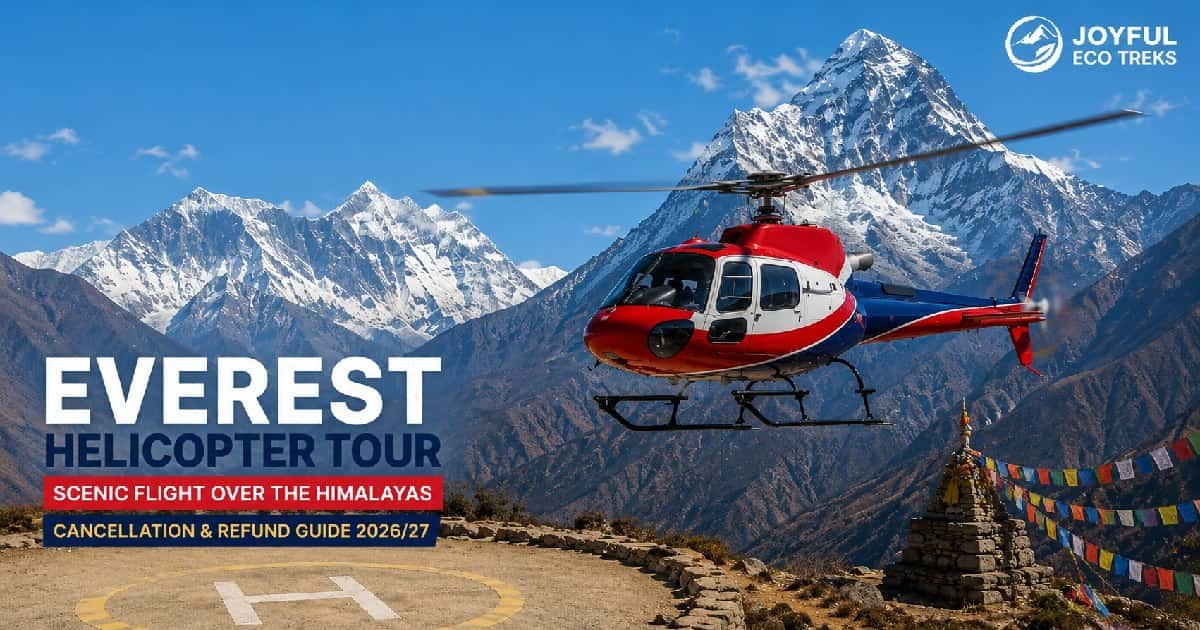
An Everest helicopter tour gives you aerial views of Mount Everest and the Khumbu region within a single morning. However, mountain weather changes quickly, and an Everest helicopter tour cancellation sometimes occurs on the scheduled flight day.
When this happens, you need clear answers. Will the flight remain on standby, move to another date, or receive a full cancellation? Will you receive a refund if the helicopter never departs or completes only part of the route?
This guide explains why Everest helicopter flights get cancelled, what happens on the flight morning, how rescheduling works, and which refund terms you should check before booking. It also explains what happens when the helicopter starts the journey but cannot complete the planned route.
- Everest helicopter tours may be delayed, placed on standby, or cancelled due to poor visibility, strong winds, rain, snow, or unsafe landing conditions.
- If weather cancels the flight before departure, Joyful Eco Treks offers a full refund or free rescheduling.
- A flight that starts but cannot complete the full route may qualify for a partial refund, depending on the distance covered and booking terms.
- Keep one or two buffer days in Nepal so you have enough time to reschedule the flight.
- Spring and autumn usually provide the most reliable flying conditions, but the pilot always makes the final safety decision.
What Weather Conditions Cause Everest Helicopter Tour Cancellations?
Everest helicopter flights operate under Visual Flight Rules in most mountain conditions. This means the pilot needs suitable visibility and must maintain the required distance from clouds while following the approved route. Nepal’s Civil Aviation Authority also requires the pilot in command to confirm that flight conditions are suitable before departure.
Weather is not checked only in Kathmandu. The aviation team reviews conditions across the route, including Lukla, the Everest region, and the planned landing points. Clear skies in Kathmandu do not confirm that the full route is safe.
Below are the main weather factors that lead to a delay or cancellation.
1. Poor Visibility, Clouds, and Fog
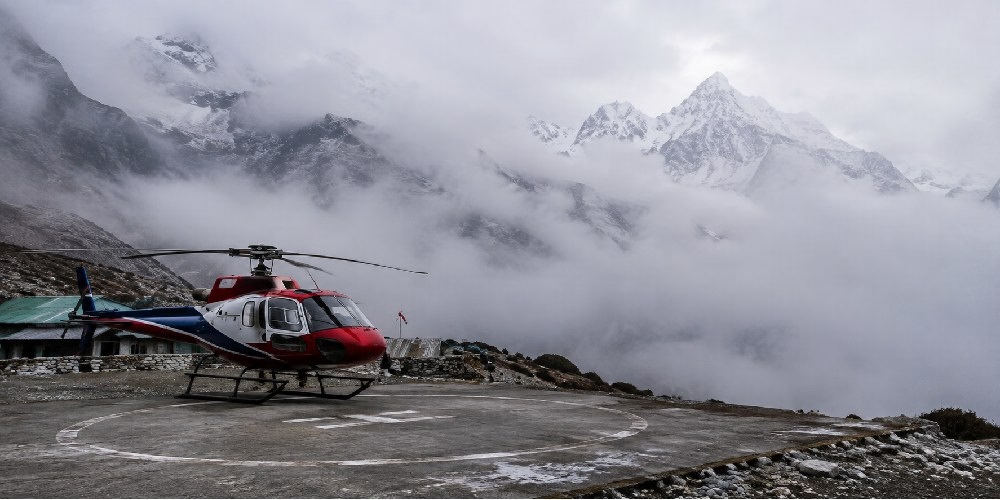
Low clouds, fog, and poor visibility can hide mountains, valleys, flight paths, and landing areas. When the pilot cannot maintain safe visual contact with the route, the flight remains delayed or gets cancelled.
Cloud or fog sometimes clears later in the morning. However, the flight proceeds only when the pilot confirms safe visibility across the required route.
2. Strong Winds and Turbulence
Strong wind affects helicopter control, passenger comfort, and landing safety. Conditions near high-altitude landing areas can differ from those in Kathmandu or Lukla.
Pilots check wind conditions before departure and continue assessing them during the flight. A clear sky does not always mean that the wind is suitable for landing.
3. Rain, Snow, and Unsafe Landing Conditions
Rain and snow reduce visibility and affect landing conditions. Snow cover, changing cloud levels, or poor surface conditions can prevent the helicopter from using a planned landing point.
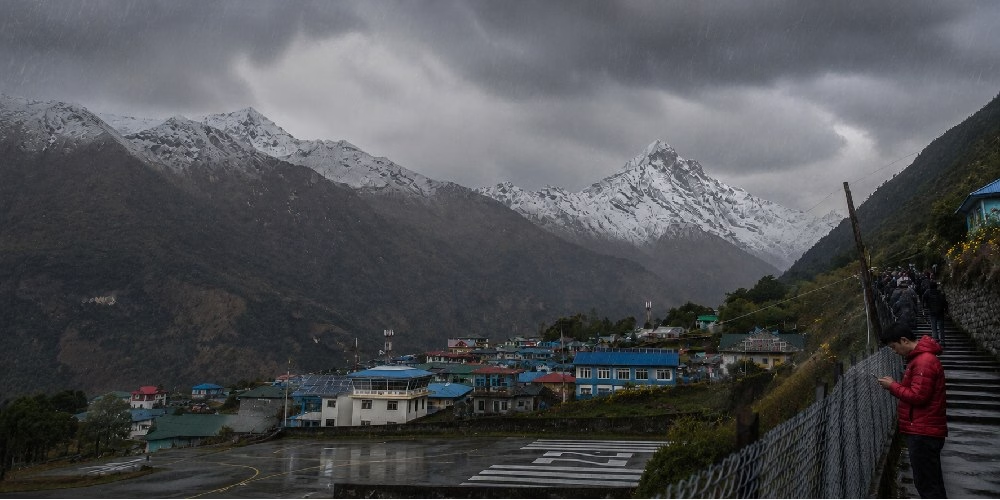
These conditions occur more often during the monsoon and winter periods, but weather disruption remains possible throughout the year. Operators tend to build in extra caution during the monsoon, since rain and reduced visibility add more risk to the flight.
4. Weather Changes Along the Route
Conditions sometimes change after the helicopter leaves Kathmandu. The pilot might continue only to a lower landing point, wait at an approved location, change the planned stop, or return to Kathmandu.
The pilot makes this decision based on current flight conditions. Completing the advertised itinerary never takes priority over passenger and flight safety.
What Happens on the Morning of Your Everest Helicopter Tour?
Weather over Everest can shift quickly, so most decisions about your flight are made on the actual morning of departure, not the night before.
Here’s how the three main outcomes usually play out.
1. Flight Confirmed
If the weather along the route looks stable, your operator will confirm the flight and guide you through the standard airport check-in process. Confirmation usually comes early in the morning because operators review current weather and flight conditions before departure.
Once confirmed, you’ll go through security and boarding as planned, and the helicopter will follow its scheduled route.
2. Flight Delayed or Placed on Weather Standby
If conditions are uncertain, your operator may place the flight on standby rather than cancel it right away. This means you wait at the airport or hotel while the team monitors the weather.
The standby period depends on the weather, airport conditions, and the remaining safe flying window. If conditions improve within the flying window, the flight goes ahead as originally planned.
3. Flight Cancelled for the Day
If the weather doesn’t clear within a safe time frame, the operator will cancel the flight for that day rather than risk further delays. This decision is based on safety, not convenience, so it can happen even if the forecast looked good the previous evening.
At this point, your operator should explain the rescheduling and refund options included in your booking terms.
What Happens If the Helicopter Cannot Complete the Full Route?
Sometimes a flight takes off but cannot finish the entire planned route. Weather can change mid-flight, even after a clear departure from Kathmandu.
Here are the most common ways this plays out.
1. Flight Stops at Lukla or Syangboche
If conditions block the route further ahead, the helicopter may land at Lukla or Syangboche instead of continuing to the higher viewpoints. The flight stops at a lower approved location without completing the full itinerary.
Depending on the conditions, the pilot may wait, continue when safe, use another approved route, or return to Kathmandu.
2. Kala Patthar Landing Is Not Possible
Kala Patthar is a high-altitude and weather-sensitive landing area. Wind, visibility, passenger weight, aircraft performance, and overall flying conditions all affect whether the helicopter can land there.
If the landing is not possible, the pilot may provide an aerial view, use another approved landing point, or continue from a lower location. The final decision depends on the conditions during the flight.
3. Flight Returns Early to Kathmandu
In some situations, the helicopter returns to Kathmandu before completing the planned route. This can happen when visibility, wind, cloud cover, or landing conditions become unsafe during the flight.
If this happens, ask your operator directly how they classify it for refund purposes, since policies vary between an early return and a full cancellation.
Can You Reschedule an Everest Helicopter Tour?
Yes, rescheduling is the most common outcome after a weather cancellation. Most operators would rather move your flight to a new date than cancel it outright, especially if you still have flexible days left in Nepal.
How rescheduling works depends on the type of booking you have.
1. Rescheduling to the Next Safe Date
If the weather cancels the flight, the operator will check the next suitable date based on availability, weather, and your booking terms. This could be the following day or a few days later, depending on the forecast and flight schedule.
Keeping one or two flexible days in your Nepal itinerary gives you more room to reschedule.
2. Shared Flight Rescheduling
If you booked a shared or joining flight, your new date depends on when another group with matching seats is also flying. This can take longer to arrange than a private booking, since the operator needs to fill the remaining seats.
The operator should confirm the available shared-flight dates and seat arrangements after the cancellation.
3. Private Charter Rescheduling
A private charter gives you more control over rescheduling, since the flight isn’t tied to other passengers. Even so, the new date still depends on weather, aircraft availability, permits, and airport conditions.
This flexibility is one of the main reasons some travelers choose a private charter over a shared flight.
Does Everest Helicopter Rescheduling Cost Extra?
In most cases, rescheduling due to weather does not cost extra, since the delay is outside your control and the operator’s control. Reputable operators treat this as a standard part of running weather-dependent flights.
Extra charges are more likely if you request a different route, a different group size, or additional stops that weren’t part of your original booking. Always confirm this directly with your operator before agreeing to a new date, since policies can differ between companies.
Do You Get a Refund After an Everest Helicopter Tour Cancellation?
Refunds depend on why the flight was cancelled and when. Weather-related cancellations are treated differently from cancellations made by the passenger.
Here’s how the main situations usually break down.
1. Weather Cancellation Before Departure
If your flight never takes off because of weather, most operators offer a full refund or a free reschedule. Since the cancellation isn’t caused by anything on your end, this is usually the most straightforward refund situation.
Ask your operator to confirm this in writing, along with the expected refund method, once the flight is officially cancelled.
2. Partial Refund After a Shortened Flight
If your helicopter completes only part of the route, such as reaching Lukla but not Kala Patthar, some operators offer a partial refund based on the portion missed. Others may offer a discount toward a future flight instead.
Since this varies by company, it’s worth checking your operator’s shortened-flight policy before booking, not just their full-cancellation policy.
3. Cancellation by the Passenger
If you cancel the tour yourself, the refund amount typically depends on the cancellation deadline and the charges listed in your booking terms. Cancelling closer to the flight date generally means a smaller refund, or none at all.
Exact cutoff periods and fees differ between operators, so always check this at the time of booking rather than assuming a standard rule applies everywhere.
4. Refund Processing Time
Refunds are rarely instant, since they usually need to be verified against the flight log and payment records first. Processing commonly takes about a week to ten business days, though this can vary by operator and payment method.
If it takes longer than the timeframe your operator quoted, follow up directly with your booking confirmation details on hand.
- Credit Card Fees: Even with a “full refund” due to weather, banks or booking platforms often retain a 3% to 4% non-refundable credit card processing fee.
- Cash Refunds: If you booked locally in Kathmandu and paid in USD or NPR cash, operators can often issue your refund on the spot or within 24 hours.
Which Costs May Not Be Refunded?
Some minor costs stay non-refundable even after a weather cancellation, since they are paid to third parties on the day of travel. Airport transport, if already used to reach the helipad, will be deducted from your total.
Additionally, domestic airport passenger taxes paid at the terminal gate are usually non-refundable once you have entered the airport. It’s worth asking your operator upfront which logistics fees are fixed costs, so there are no surprises later.
What Is the Best Season for an Everest Helicopter Tour?
Choosing the right season lowers your chances of a weather-related cancellation, though no season fully removes the risk in the mountains.
1. Spring and Autumn
Spring (March to May) and autumn (September to November) are generally considered the most reliable months for clear skies and stable flying conditions. Most operators recommend these seasons if your travel dates are flexible.
These months are also the busiest for tourism in Nepal, so booking a little earlier helps secure your preferred date.
2. Monsoon
Monsoon season (June to August) can still offer clear mornings, since Everest flights typically depart early before clouds build up later in the day. That said, sudden rain and low visibility are more common during this period, so delays are more likely.
If you’re travelling during the monsoon, keeping a flexible schedule matters even more than usual.
3. Winter
Winter (December to February) often brings clear skies, sometimes clearer than other seasons, but colder temperatures and occasional snowfall can still ground flights. Wind speeds at high altitude also tend to be stronger during these months.
Flights still operate through winter, but travelers should be prepared for a slightly higher chance of delay.
Note: High-altitude jet streams drop lower over the Himalayas from December to February. This creates high winds over 5,000 meters, which can prevent helicopters from landing at Kala Patthar even if the skies are completely blue.
Does Travel Insurance Cover Everest Helicopter Cancellations?
Travel insurance can help with costs related to trip disruption, but coverage for helicopter tour cancellations depends heavily on your specific policy. Not all standard travel insurance plans cover weather-related activity cancellations the same way.
Before booking, check whether your policy covers trip interruption, missed connections caused by delays, or non-refundable costs like permits. If you’re unsure, contact your insurance provider directly and ask about weather-related cancellations for mountain flights specifically, rather than assuming general coverage applies.
Conclusion
For most travelers, the best way to handle weather-related cancellations is to build in one or two flexible days and confirm rescheduling and refund terms before booking. Since decisions are made on the morning of the flight, safety always comes before the schedule, and most delays end in a reschedule rather than a full cancellation.
Whichever outcome you face, Joyful Eco Treks is here to guide you through it. If your Everest Base Camp Helicopter Tour is cancelled due to weather, we offer a full refund or a free reschedule, with refunds processed within one week to ten business days. Contact us today to plan your flight with confidence.
See more travel stories, destination updates, trekking photos, and trip ideas from Nepal. Follow Joyful Eco Treks on Facebook, Instagram, and TikTok, and stay connected with our latest adventures.
FAQs
What happens if an Everest helicopter tour is cancelled due to bad weather?
If bad weather cancels your Everest helicopter tour, the operator usually reschedules the flight or provides a refund based on the booking policy. The final option depends on your travel dates, flight availability, and the operator’s terms.
Will I get a full refund if my Everest helicopter flight is cancelled?
Yes, you will usually receive a full refund if the helicopter does not depart due to unsafe weather. However, some operators may deduct permit fees, transport costs, bank charges, or other non-refundable expenses.
Can I reschedule my Everest helicopter tour after a weather cancellation?
Yes, you can usually reschedule your Everest helicopter tour after a weather cancellation. The new date depends on suitable weather, aircraft availability, and your remaining travel schedule.
Does weather-related rescheduling cost extra?
No, weather-related rescheduling usually does not cost extra. Extra charges may apply only if you request route changes, added stops, a private charter, or another service outside the original booking.
How long should I wait if the helicopter flight is delayed?
You may need to wait from a short period to several hours if the flight is delayed. The exact wait depends on visibility, wind, cloud cover, airport traffic, and the remaining safe flying window.
Who decides whether the Everest helicopter flight is cancelled?
The pilot makes the final decision to delay, cancel, continue, or change the flight. The decision is based on current weather, visibility, aircraft performance, landing conditions, and aviation safety rules.
What happens if the helicopter cannot land at Kala Patthar?
If the helicopter cannot land at Kala Patthar, the pilot may use another approved landing point, provide an aerial view, or return from a lower location. The decision depends on wind, visibility, passenger weight, and aircraft performance.
How many buffer days should I keep for an Everest helicopter tour?
You should keep one or two buffer days for an Everest helicopter tour. Extra time gives you a better chance to reschedule if weather cancels or delays the original flight.
Which season has the lowest chance of helicopter cancellation?
Spring and autumn generally have the lowest chance of weather-related cancellation. March to May and September to November usually offer better visibility and more suitable mountain flight conditions.
Does travel insurance cover an Everest helicopter tour cancellation?
Travel insurance covers an Everest helicopter tour cancellation, but coverage depends on your policy. Check whether it includes weather-related cancellation, trip interruption, extra accommodation, and missed onward travel.
What happens if I cancel the Everest helicopter tour myself?
If you cancel the tour yourself, the refund depends on how early you cancel. Early cancellations may receive a partial or full refund, while last-minute cancellations may result in higher charges or no refund.
How long does an Everest helicopter tour refund take?
An Everest helicopter tour refund usually takes several business days, but the exact time depends on the operator, bank, payment method, and booking channel.