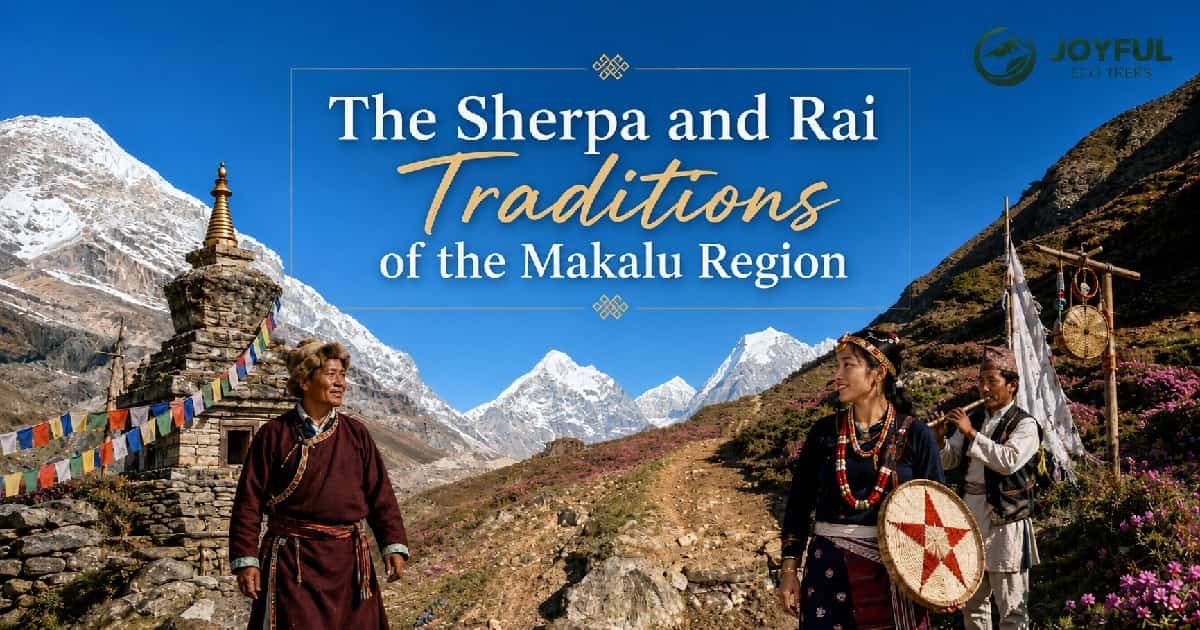
The Makalu region is more than a trekking route beneath Makalu Mountain. As travelers pass through villages and remote settlements, they may see prayer flags, monasteries, local rituals, traditional dress, and community practices that reflect the lives of both Sherpa and Rai people.
The region is also home to Limbu, Tamang, and other communities, but this guide focuses specifically on Sherpa and Rai traditions, the two groups most visible along the main trekking route through the Makalu-Barun area.
Sherpa traditions in the region are closely linked with Tibetan Buddhism, while Rai traditions are shaped by Kirat beliefs, Mundhum, seasonal rituals, music, dance, and respect for ancestors and nature. These customs are not the same in every village, and no two households necessarily observe them the same way.
This guide examines the Sherpa and Rai traditions in the Makalu region, including religion, festivals, food, clothing, family customs, and daily life. It also explains what trekkers may notice along the route and how to behave respectfully when visiting local communities.
- The Makalu region is home to both Sherpa and Rai communities, each with its own traditions, beliefs, and way of life.
- Sherpa traditions are closely linked with Tibetan Buddhism, including monasteries, prayer flags, religious ceremonies, and community festivals.
- Rai traditions are shaped by Kirat beliefs and Mundhum, with strong connections to ancestors, nature, seasonal rituals, music, and dance.
- The mountain environment of Makalu has shaped daily life, influencing local food, farming, livestock, and traditional knowledge.
- Understanding Sherpa and Rai traditions helps trekkers experience Makalu more meaningfully, while also encouraging respectful travel in local communities.
Who Are the Sherpa and Rai People of the Makalu Region?
Sherpa and Rai communities have lived in and around the Makalu-Barun area for generations. Both groups are part of the cultural identity of eastern Nepal, but their religious beliefs and social customs are different. Sherpa people’s culture in this region centers on Tibetan Buddhist practice and mountain livelihoods, while Rai communities carry a distinct Kirat heritage shaped by oral tradition and seasonal ritual.
Sherpa communities are mainly connected with Tibetan Buddhist traditions and high-mountain life. Rai communities belong to the wider Kirat cultural tradition and have their own languages, rituals, oral traditions, and seasonal celebrations.
Sherpa Traditions in the Makalu Region
Sherpa traditions are closely connected with Buddhism, family life, community gatherings, and mountain livelihoods. Religious practices and knowledge passed between generations remain important parts of Sherpa culture.
1. Tibetan Buddhism and Sherpa Religion
Tibetan Buddhism has a strong place in Sherpa religious life. Monasteries, lamas, prayers, religious offerings, and ceremonies are commonly associated with Sherpa communities.
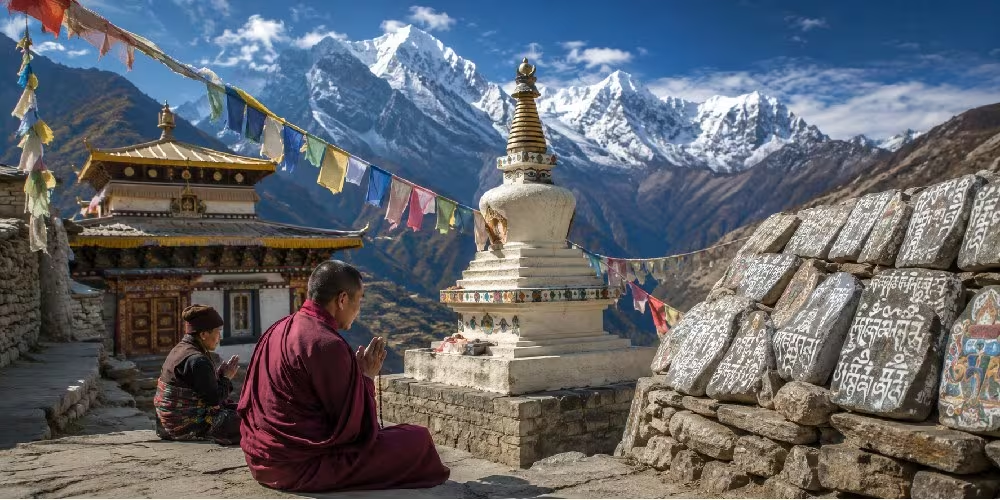
Trekkers may also see prayer flags, mani stones, shrines, and other Buddhist symbols in Sherpa settlements, sacred objects that mark the presence of an active, living faith rather than remnants of the past.
2. Sherpa Festivals and Community Gatherings
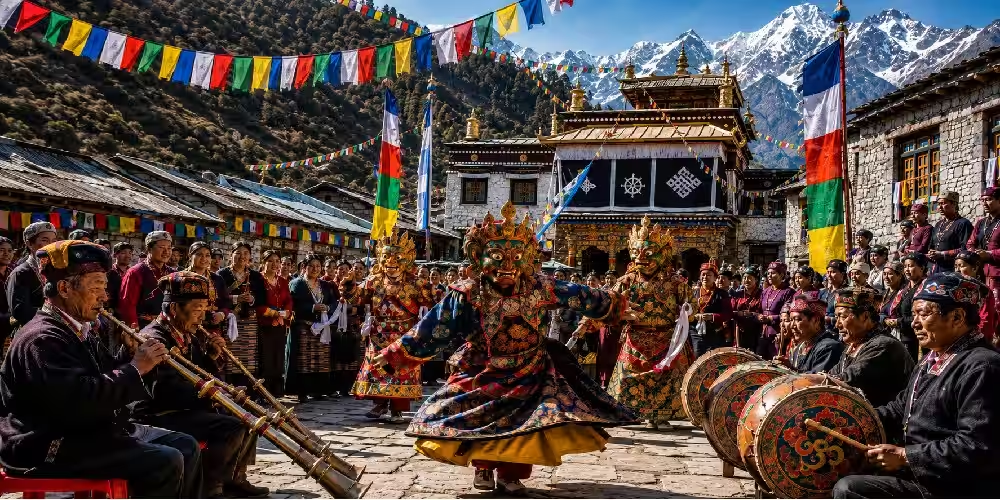
Sherpa communities celebrate Buddhist festivals and seasonal events that bring families and neighbors together. Lhosar, the Tibetan New Year, is one of the best-known celebrations associated with Sherpa culture.
Festival traditions can include prayers, shared meals, family visits, and religious ceremonies. Exact practices may differ from one settlement to another.
3. Sherpa Family and Mountain Life
Family and community support are important parts of Sherpa life. Weddings, funerals, and religious ceremonies often involve relatives and neighbors.
Traditional livelihoods have also included livestock, farming, trade, and the use of high mountain pastures. This connection with the mountain environment has shaped local knowledge and daily routines.
Rai Traditions in the Makalu Region
Rai people’s traditions are connected with Kirat beliefs, ancestors, nature, farming cycles, music, dance, and oral knowledge. The Rai are not one single cultural group, so customs and languages can differ between communities.
1. Mundhum and Rai Beliefs
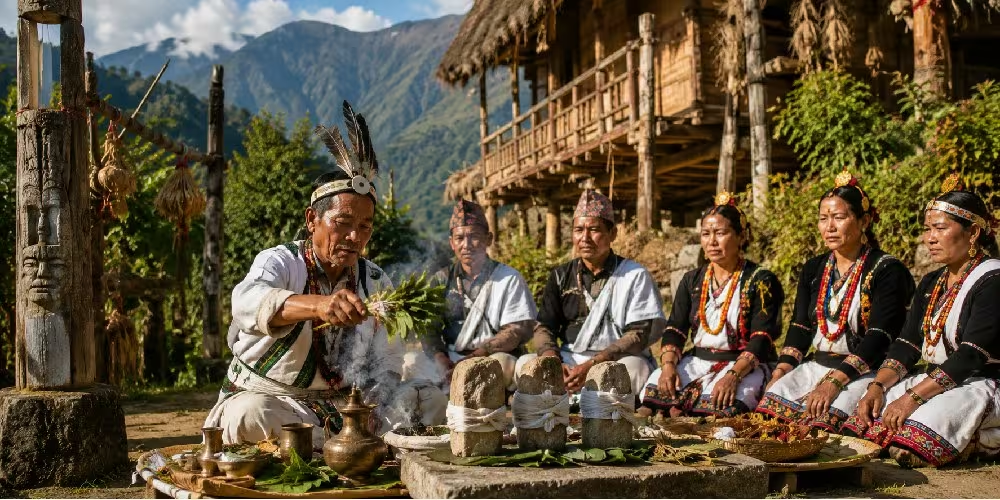
Mundhum is an important oral religious and cultural tradition followed by many Kirat Rai communities. It carries stories, beliefs, ritual instructions, and knowledge that elders share with younger family members.
Ancestor worship and respect for nature are also closely tied to many Rai religious practices.
2. Sakela and Seasonal Traditions
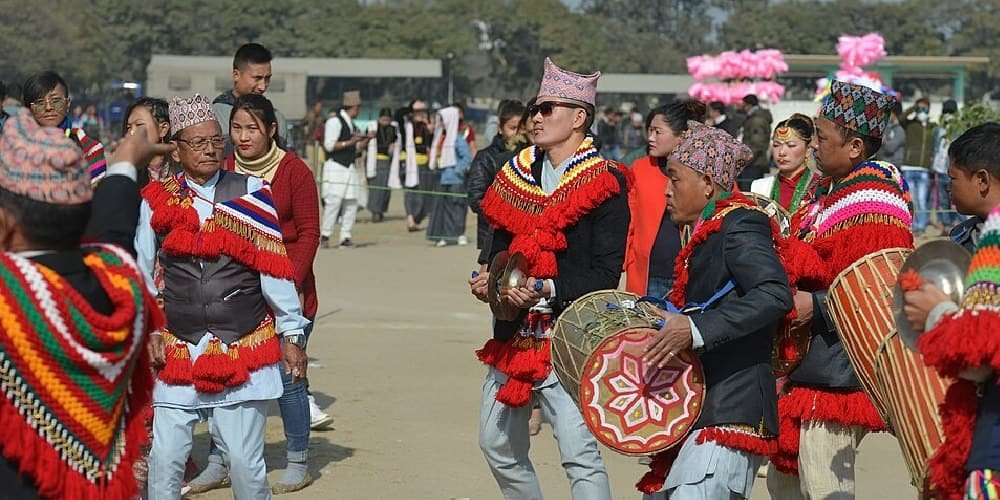
Sakela is one of the best-known Rai traditions. It includes group dancing, music, rituals, and community gatherings.
Sakela Sili movements often represent farming, nature, animals, work, and everyday life. The tradition is connected with two seasonal celebrations: Sakela Ubhauli, held in Baisakh (April–May), which marks the start of the farming year, and Sakela Udhauli, held in Mangsir (November–December), which gives thanks for the harvest.
Source: Wikimedia Commons
3. Rai Music and Oral Traditions
Music and dance are important ways Rai communities pass stories and cultural knowledge to younger generations.
Songs, dances, and spoken traditions may be connected with farming, festivals, family life, ancestors, and Mundhum.
Birth, Marriage, and Death Traditions
Sherpa and Rai communities follow different customs for major life events such as birth, marriage, and death.
Rai ceremonies may be connected with Mundhum and household spiritual practices, while Sherpa ceremonies are more closely linked with Buddhist beliefs. Family and community participation is important in both traditions.
Language, Dress, and Community Identity
Language, clothing, music, and rituals help express Sherpa and Rai identity. Across Nepali Rai culture, this diversity is especially visible: several languages and local customs, with traditional dress, headwear, songs, and dances that set one Rai group apart from another.
Sherpa communities likewise maintain their identity through language, Buddhist customs, clothing, festivals, and family traditions.
Traditional Food and Daily Life in Makalu
Daily life in the Makalu region has long depended on farming, livestock, forests, and locally available resources.
Rai and Sherpa communities have traditionally used local plants for food, medicine, fodder, fuel, household materials, and other everyday needs.
Food and livelihoods also change with altitude. Lower villages depend more on farming, while higher settlements have stronger connections with livestock and mountain pastures.
How Are Sherpa and Rai Traditions Different?
The main difference lies in their religious background.
| Sherpa Traditions | Rai Traditions |
| Mainly Tibetan Buddhist | Mainly Kirat and Mundhum traditions |
| Lamas and monasteries | Ritual specialists and household practices |
| Buddhist prayers and festivals | Ancestor and nature-based rituals |
| Lhosar and Buddhist celebrations | Sakela, Ubhauli, and Udhauli |
| Strong Himalayan Buddhist identity | Strong oral, farming, and seasonal traditions |
These differences are general. Within each community, the specifics can look quite different from one family’s household to the next.
How Has the Makalu Region Shaped Local Traditions?
Beyond religion and festivals, the Makalu landscape itself has shaped how Sherpa and Rai communities understand their place in the world. Sacred sites, pilgrimage routes, and natural landmarks within the wider Makalu-Barun area carry meaning that elders continue to explain to the next generation through story and ritual.
This relationship with the land also shows up in everyday village organization, how communities manage shared resources, mark seasonal transitions, and structure daily routines around the environment. Local traditions are not limited to festivals or religious ceremonies; they are woven into the rhythm of village life itself.
Are Sherpa and Rai Traditions Still Practiced Today?
Yes, many Sherpa and Rai traditions are still practiced today, although they continue to change.
Migration, education, tourism, modern jobs, and younger generations have influenced how some customs are followed. Festivals, religious ceremonies, music, dance, family rituals, and oral traditions remain important parts of community identity.
How Can Trekkers Respect Sherpa and Rai Traditions?
Trekkers should remember that villages in Makalu are living communities, not tourist displays.
Ask before photographing people, ceremonies, homes, or religious activities. Do not touch or move prayer stones, ritual objects, or sacred items.
When visiting monasteries or attending local celebrations, follow the advice of residents or your guide; village-to-village variation means there’s no single rulebook, so local guidance always comes first.
Final Thoughts
The Sherpa and Rai traditions of the Makalu region show two different cultural backgrounds living within the same mountain area. Sherpa communities maintain strong Buddhist traditions, while Rai communities preserve Mundhum, ancestral rituals, seasonal celebrations, music, and dance.
For trekkers, learning about these traditions adds another side to a journey often centered on Makalu Mountain. The people, villages, religious sites, and everyday customs are just as much a part of the region as the trekking trails themselves. If you’re planning a Makalu trek and want help preparing for the journey, contact us, and our team can guide you through the process.
See more travel stories, destination updates, trekking photos, and trip ideas from Nepal. Follow Joyful Eco Treks on Facebook, Instagram, and TikTok, and stay connected with our latest adventures.
FAQs
Who are the Sherpa people?
The Sherpa people are an ethnic community of the high Himalayas, closely connected with Tibetan Buddhism, mountaineering, and mountain livelihoods. In the Makalu region, Sherpa communities maintain monasteries, festivals, and family traditions passed down through generations.
What culture is found in the Makalu region?
The Makalu region is home to several communities, including Sherpa and Rai people. Sherpa traditions are primarily associated with Tibetan Buddhism, while Rai traditions are linked to Kirat beliefs and the Mundhum.
What are the main Sherpa traditions?
Sherpa traditions include Buddhist prayers, religious ceremonies, festivals, family gatherings, mountain livelihoods, and community customs.
What religion do Sherpa people follow?
Sherpa communities mainly follow Tibetan Buddhism.
What are the traditional beliefs of Rai people?
The traditional beliefs of Rai people are rooted in Kirat traditions connected with Mundhum, ancestor worship, and reverence for nature. These beliefs shape household rituals and seasonal ceremonies that continue across many Rai communities today.
What is Mundhum in Rai culture?
Mundhum is an oral body of religious and cultural knowledge passed through generations among many Kirat Rai communities.
What is Sakela in Rai culture?
Sakela is a Rai cultural tradition involving dance, music, rituals, and community participation. It is closely connected with nature, farming, and seasonal celebrations.