Muktinath Hindu Buddhist Sacred Site Explained
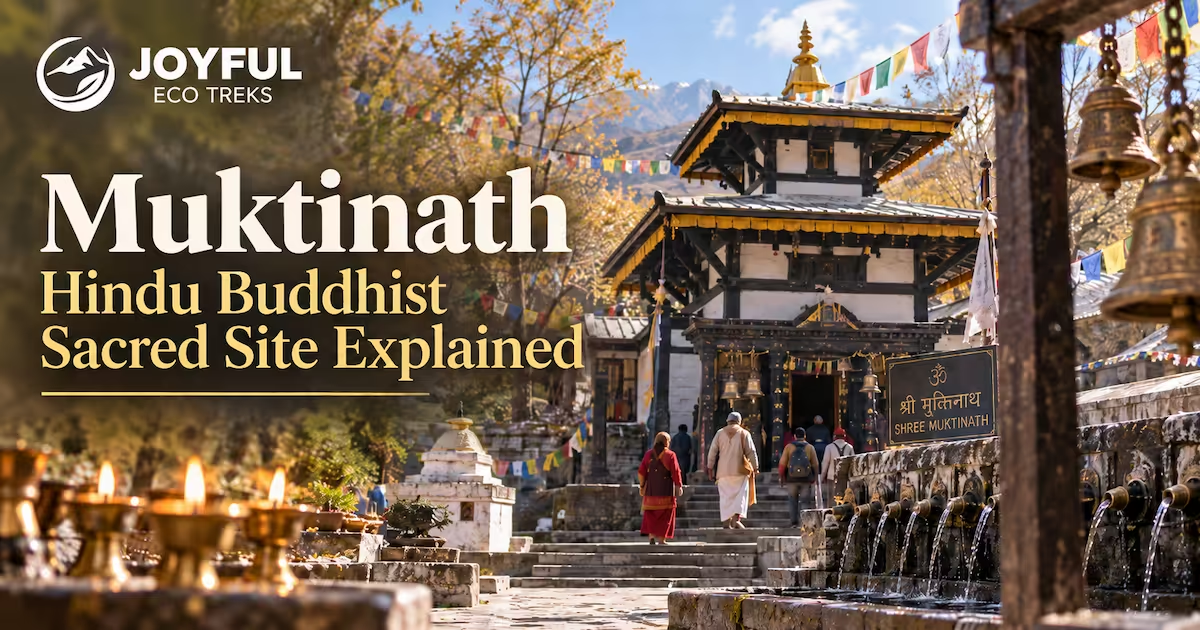
At roughly 3,710 metres in Nepal’s Mustang district, a central temple worshipped as Vishnu by Hindus and Avalokiteshvara by Buddhists stands within a sacred complex containing Buddhist shrine wall of 108 spouts. The muktinath hindu buddhist sacred site is usually explained as one location that two religions happen to share. That framing gets the theology backwards. Each tradition holds an independent religious claim to this ground, anchored in its own scripture, its own presiding figure, and its own idea of what happens to a pilgrim who arrives.
Table of Contents
ToggleWhat You Actually Find at Muktinath at 3,710 Metres
The temple, the gompa, and the waterspouts on one terrace
The complex sits in Gandaki Province, high above the Kali Gandaki gorge at 3,710 m (12,172 ft), though GPS readings vary: Wikipedia’s coordinates place it nearer 3,762 m and the Nepal Tourism Board lists 3,800 m. Whatever the exact elevation, the arrangement on the ground is the striking part. A pagoda-style central temple worshipped as Vishnu by Hindus and as Chenrezig, the Tibetan form of Avalokitesvara, by Buddhists occupies the terrace alongside the Jwala Mai Gompa, which houses the site’s natural flames. Behind the temple runs a semicircular wall of 108 bull-headed water spouts fed by natural springs. Brahmin priests and Buddhist nuns both serve the site. The gompa holds its own canonical standing as a sacred building; it is not an annex to the Hindu temple.
Why the Mustang setting matters to both traditions
Mustang is the old trans-Himalayan corridor between the Tibetan plateau and the Indian plains. Muktinath sits on it like a hinge, which is precisely why a South Indian Tamil devotional canon and a Tibetan Tantric pilgrimage circuit could both reach the same remote shrine. The Kali Gandaki, the river that carved a famously deep gorge beneath the site, supplies the two things each faith prizes here: the mineral water that feeds the spouts and the fossil stones gathered downstream, while natural springs feed the spouts.
Muktinath in Hindu Theology: A Divya Desam in the Himalayas
The only Divya Desam outside India, hymned by the Tamil Alvars
For Vaishnava Hindus, Muktinath is Divya Desam #106, one of 108 Vishnu shrines glorified in the Nalayira Divya Prabandham. That corpus is roughly 4,000 Tamil hymns composed by the twelve Alvar poet-saints between about the seventh and ninth centuries CE, and a site earns Divya Desam status by being sung in those verses. The classification is a formal South Indian canonical designation, not a local honorific. Of the 108, scholars reckon 106 as earthly temples, with two placed in transcendent realms. Of those 106, 105 stand in India. Muktinath is the single earthly Divya Desam outside India.
The human detail deserves a pause. Thirumangai Alvar composed ten pasurams for the Muktinath deity from the nearest point he could reach, unable to complete the Himalayan journey himself. Kulasekhara Alvar praised the shrine in verse, and Periyalvar addressed the deity as Salagramamudaiya Nambi. A remote Himalayan site entered the Tamil canon through poets who, in at least one case, never stood on its terrace.
Muktinath also carries a second, narrower designation: it is counted among the eight Svayam Vyakta Kshetras, sites where Vishnu is believed to have self-manifested rather than been installed by human hands, alongside Srirangam, Tirupati, Badrinath, and others. Self-manifestation is a stronger theological claim than consecration. The deity is not placed there by ritual; the deity is already there.
Mukti Narayana, the liberation-granting form of Vishnu
The name carries the doctrine. Muktinath means “lord of liberation,” and the presiding form is Mukti Narayana, the aspect of Vishnu that grants moksha, release from the cycle of rebirth. Reaching and bathing at this place is framed around a specific promise: that the pilgrimage advances a soul toward final liberation. For that reason, the surrounding basin is also called Mukti Kshetra, the field of salvation.
Shaligram fossils from the Kali Gandaki
Fossils tell a different part of the story. The Kali Gandaki riverbed yields Shaligrams, ammonite fossils of Jurassic age that Vaishnavas regard as direct, natural manifestations of Vishnu rather than carved images. In one traditional classification, color and marking identify the form: white for Vasudeva, black for Vishnu, green for Narayana, blue for Krishna, gold or red for Narasimha or Vamana. Sourced from the Kali Gandaki river system in Nepal, they are widely used as sacred manifestations of Vishnu in temple and household worship. A fossil worn smooth by a Himalayan river becomes, in this reading, an object of worship no sculptor touched.
Muktinath in Buddhist Tradition: What Chumig Gyatsa Means
Hundred Waters and its Dakini associations
Tibetan Buddhists know the site as Chumig Gyatsa, meaning “the Hundred Waters,” and their claim to it is established within their own tradition, not borrowed. Counted among the 24 Tantric pitha within the Chakrasamvara and Heruka Tantra tradition, Chumig Gyatsa is a seat where Dakinis are held to reside. A Dakini, a “sky-dancer,” is a female embodiment of enlightened energy in Tantric Buddhism; a pitha is a concentrated seat of that energy accessible to practitioners. Calling the springs “Hundred Waters” describes the terrain. Placing the site among the 24 pitha gives it independent standing in the Buddhist map of sacred geography.
The Jwala Mai gompa on the Tibetan pilgrimage circuit
The gompa on the terrace anchors Buddhist practice. Tibetan pilgrimage tradition holds that Guru Rinpoche, Padmasambhava, meditated at Muktinath on his way to Tibet, while the central temple deity is worshipped by Buddhists as Chenrezig, the bodhisattva of compassion. For a Tibetan pilgrim, the destination is not Vishnu’s field of liberation but a Dakini seat sanctified by the tantric master traditionally credited with helping establish Buddhism in Tibet. Same terrace, entirely different reason to be standing on it.
The Sacred Features Each Tradition Reads at This Site
108 waterspouts, one count and two cosmologies
The number 108 is sacred in both traditions. One Hindu interpretation reads it as 12 rashis multiplied by 9 grahas, the zodiac signs and planetary bodies whose combinations map the whole sky. One common Buddhist interpretation connects 108 to the klesha, the mental defilements a practitioner works to purify. The number therefore carries distinct religious associations. That is why a wall of exactly 108 spouts resonates for pilgrims of both faiths rather than belonging to one.
The Jwala Mai flame: natural gas and flowing water
Behind the temple, small flames burn near flowing water inside Jwala Mai, sustained by natural gas seeping from the ground. The shrine is also known as Mebar Lhakhang, or the fire temple. The visible conjunction of flame and water contributes to the site’s sacred interpretation. Hindu and Buddhist traditions both associate the phenomenon with elemental symbolism. The geology and the theology are inseparable here.
How Hindu and Buddhist Pilgrims Use the Same Ground Differently
Two pilgrims can perform completely different acts of devotion within a few metres of each other. The table below maps what each tradition brings to the same physical site.
|
Hindu (Vaishnava) tradition |
Buddhist (Tibetan) tradition |
|
|---|---|---|
|
Canonical designation |
Divya Desam #106; also a Svayam Vyakta Kshetra |
One of the 24 Tantric pitha (Chumig Gyatsa) |
|
Canonical basis |
Nalayira Divya Prabandham hymns of the Alvars |
Chakrasamvara / Heruka Tantra lineage |
|
Presiding figure |
Vishnu as Mukti Narayana |
Avalokitesvara (Chenrezig); Padmasambhava is traditionally associated with the site |
|
Sacred objects |
Shaligram fossils, the 108 spouts |
The Dakini seat; the eternal flame is sacred to both traditions |
|
Core ritual |
Bathing through the 108 spouts toward the sanctum |
Circumambulation and butter-lamp offerings |
|
Goal |
Moksha, liberation from rebirth |
Merit and Tantric realization at a power place |
The Hindu sequence through the spouts to the sanctum
The Hindu pilgrimage is a progression. Many devotees pass beneath all 108 spouts in turn, letting the frigid spring water strike them for purification, then bathe in the two kunda pools before entering the inner sanctum to worship Mukti Narayana. The cold is part of the point: the bath is penitential and is traditionally associated with purification and the pursuit of liberation.
Buddhist circumambulation and the work of the gompa
Buddhist practice includes the gompa and the wider sacred complex rather than centering on the spouts alone. Pilgrims circumambulate the shrine clockwise, offer butter lamps, and pay respect at the eternal flame and the central deity worshipped as Chenrezig, treating the visit as an accumulation of merit and a connection to a Dakini seat rather than a single purifying bath. Watching both liturgies unfold on one terrace is the clearest illustration of the dual-faith claim this site makes. A short read on religious-site etiquette in Nepal will help any visitor move respectfully between them.
Frequently Asked Questions About Muktinath
Why do Hindus and Buddhists venerate different deities at the same Muktinath site?
Because each tradition holds an independent religious claim, not a shared one. Hindus venerate Vishnu in his liberation-granting form, Mukti Narayana, on the authority of the Tamil Alvar hymns that make the site Divya Desam #106. Buddhists venerate Avalokitesvara at a Dakini power place, Chumig Gyatsa, counted among the 24 Tantric pitha. The two theological identities were mapped onto one location separately, which is why the deities differ.
What is the significance of exactly 108 waterspouts at Muktinath?
The count is auspicious in both traditions. One Hindu interpretation connects 108 with 12 zodiac signs multiplied by 9 planetary bodies. One common Buddhist interpretation connects it with the 108 klesha, the defilements a practitioner works to overcome. The wall of 108 spouts therefore speaks to pilgrims of both faiths without belonging exclusively to either.
Is the Jwala Mai eternal flame at Muktinath natural or kept burning by priests?
Natural. The flame is sustained by natural gas seeping from the ground near flowing water. Its sacred status is tied to this natural phenomenon: fire joined visibly with water is read by both traditions as evidence of the site’s power.
What does Chumig Gyatsa mean and why do Tibetan Buddhists consider it a power place?
Chumig Gyatsa means “the Hundred Waters” in Tibetan. Counted among the 24 Tantric pitha of the Chakrasamvara tradition, it is regarded as a seat where Dakinis reside. Padmasambhava is also believed to have meditated here, which deepens its standing on the Tibetan pilgrimage circuit independent of its Hindu associations.
Can trekkers who are not Hindu or Buddhist enter the Muktinath temple complex?
Yes, the complex is generally open to visitors of all backgrounds, and many trekkers on the Annapurna Circuit stop here. Access to the innermost sanctum and specific ritual acts may be reserved for devotees, so follow posted guidance and the lead of temple and gompa staff. Dress modestly and remove footwear where required.
Muktinath falls on the Annapurna Circuit route. Read the full Annapurna region guide to see how it fits an itinerary and what the surrounding Mustang landscape adds to the journey.

All Categories