

Nirmal Purja, widely known as Nims Dai, left behind one of the most remarkable climbing records in modern mountaineering history. Following his passing in August 2026, his name is being remembered across the mountaineering world, from Project Possible’s record-breaking 14-peak sequence to the historic first winter ascent of K2.
For background on who Nimsdai was and his early career, see our full profile, [Nirmal Purja Biography: Who Was Nims Dai?]. His achievements were not all the same; however, some focused on speed, while others involved climbing without supplementary oxygen or working alongside Nepali teams on historic firsts. As a result, understanding his record properly means looking at each achievement in its own category rather than treating them as one long list.
In this guide, we look back at Nimsdai’s major mountaineering milestones, including Project Possible, the 14 peaks, winter K2, Kangchenjunga, Everest and Lhotse speed records, the Pakistan Five, and his later no-oxygen achievements. Along the way, we also explain what each record actually meant and why it became important in modern climbing history. (You can also read our tribute to Nims Dai)
- Nimsdai completed the widely reported 14-peak Project Possible sequence in 189 days in 2019, using supplementary oxygen.
- He was one of 10 Nepali climbers who made the first winter ascent of K2 on January 16, 2021.
- Nimsdai later completed all 14 true 8,000-metre summits without supplementary oxygen in 2 years and 150 days.
- In 2022, he climbed Kangchenjunga, Everest, and Lhotse without supplementary oxygen in 8 days, 23 hours, and 11 minutes.
- By September 2025, Guinness had recorded 49 true-summit ascents of 8,000-metre mountains by Nimsdai, including 25 without supplementary oxygen.
What Are Nimsdai’s Biggest Mountaineering Achievements?
Nimsdai’s biggest mountaineering achievements include completing the widely reported 14 peaks sequence in 189 days through Project Possible, joining nine other Nepali climbers for the first winter ascent of K2, and later completing all 14 true 8,000-metre summits without supplementary oxygen. In addition, he set several speed records involving Everest, Lhotse, Kangchenjunga, K2, and other major peaks.
However, these records belong to different climbing categories. Some measured how quickly he could connect several 8,000-metre mountains, while others focused on climbing without bottled oxygen or achieving a historic first as part of a team.
Therefore, the best way to understand Nimsdai’s Complete Himalayan Achievements is to look at each milestone separately, beginning with the expedition that first brought his name to global attention: Project Possible.
1. Project Possible: Completing the 14 Peaks in 189 Days
Nimsdai completed the widely reported sequence of all 14 mountains above 8,000 metres in 189 days during Project Possible in 2019. He started with Annapurna I on April 23 and finished on Shishapangma on October 29, completing the mission in six months and six days.
His 2019 climb later became the subject of the Netflix documentary 14 Peaks: Nothing Is Impossible, which introduced Nimsdai’s record to a global audience beyond the climbing community.
The project connected multiple expeditions into one continuous challenge, combining climbing windows, travel, recovery, logistics, and support from different Nepali teammates. Nims used bottled oxygen on the 2019 climbs, so Project Possible was a speed-focused achievement rather than a no-oxygen record.
Later true-summit reviews changed the formal Guinness classification of the original sequence. Guinness now records his oxygen-assisted completion of all 14 true summits as 2 years and 168 days because later ascents were needed to meet updated true-summit standards. The historic 189-day Project Possible sequence, however, remains the achievement completed and widely reported in 2019.
2. First Winter Ascent of K2
Source: Wikimedia Commons
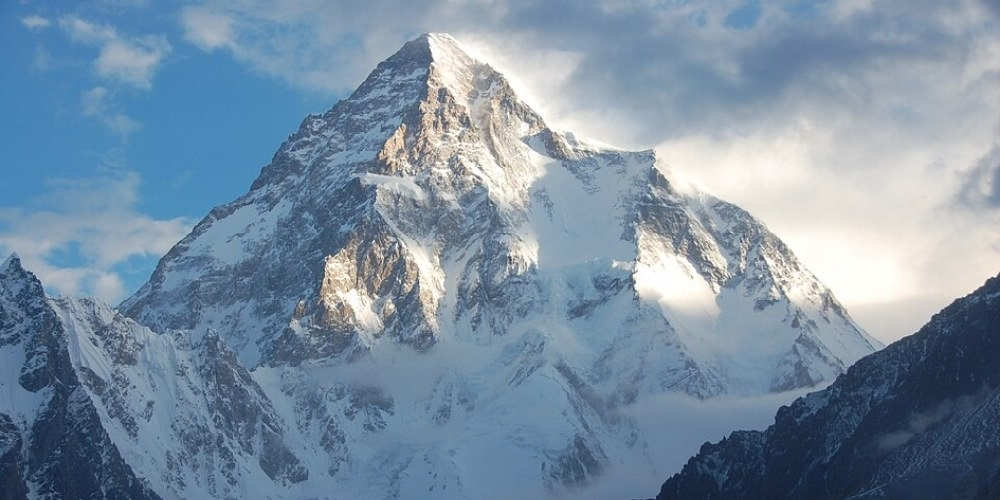
Nims Dai was one of ten Nepali mountaineers who completed the first winter ascent of K2 mountain on January 16, 2021. The climbers stopped roughly 10 metres below the top, regrouped, and then reached the K2 summit together while singing Nepal’s national anthem.
Importantly, this was not a solo Nimsdai achievement. It was a shared historic first by the entire ten-member Nepali team. The 8,611-metre K2 peak lies in the Karakoram and had remained the only 8,000-metre mountain without a winter ascent until that expedition.
3. Everest, Lhotse and Makalu Speed Achievement
Nims Dai completed Everest, Lhotse, and Makalu in 2 days and 30 minutes during Project Possible in 2019. The three peaks are among the world’s five highest mountains, making the rapid sequence one of the major speed achievements of his original campaign.
This was also part of a larger 2019 record involving the world’s five highest mountains. Nims climbed Kangchenjunga, Everest, Lhotse, Makalu, and K2 within 70 days while using supplementary oxygen.
4. Repeated 8,000-Metre True-Summit Ascents
Guinness World Records recorded 49 true-summit ascents of 8,000-metre mountains by Nimsdai as of September 25, 2025. Those ascents stretched from Everest in May 2016 to Manaslu in September 2025.
The number is higher than 14 because Nims returned to several eight-thousanders multiple times. His official achievements page uses a broader total of 52 8,000-metre summits, while Guinness lists 49 under its stricter true-summit category. For accuracy, these figures should not be presented as if they use the same counting method.
5. Guinness World Records
Nimsdai’s official achievements page lists 18 Guinness World Records across high-altitude speed, summit, and mountain-combination categories. These include records connected with the 14 peaks, Everest-Lhotse, the three highest mountains, and repeated 8,000-metre ascents.
However, individual world records can later be broken or reclassified. Therefore, this article focuses on the achievements Nims completed rather than suggesting that every record title necessarily remains unbeaten today.
What Did Nims Dai Achieve Without Supplementary Oxygen?
Without supplementary oxygen, Nims Dai climbed winter K2, completed all 14 true 8,000-metre summits, and set major records involving Kangchenjunga, Everest, Lhotse, K2, and Pakistan’s five eight-thousanders.
These climbs represented a different stage of his career from Project Possible. Instead of repeating the 2019 challenge under the same conditions, Nims returned to many of the world’s highest mountains without bottled oxygen.
1. Winter K2 Without Supplementary Oxygen
Nimsdai reported completing the first winter ascent of K2 without supplementary oxygen on January 16, 2021. His official account states that he made the decision to continue without bottled oxygen despite limited acclimatisation and difficult winter conditions.
The no-oxygen element describes Nimsdai’s individual ascent, while the first winter K2 summit itself remains a shared achievement of the ten Nepali climbers.
2. All 14 True Summits Without Supplementary Oxygen
Nims Dai completed all 14 true 8,000-metre summits without supplementary oxygen in 2 years and 150 days. The Guinness-recorded sequence began on Kangchenjunga on May 7, 2022, and ended on Shishapangma on October 4, 2024.
This achievement should not be confused with Project Possible. The original 2019 campaign used bottled oxygen, whereas this later challenge specifically required true summits without supplementary oxygen.
3. Kangchenjunga, Everest and Lhotse Without Supplementary Oxygen
Nims Dai climbed Kangchenjunga, Everest, and Lhotse without supplementary oxygen in 8 days, 23 hours, and 11 minutes in May 2022. He reached Kangchenjunga on May 7, Everest on May 15, and Lhotse on May 16.
This became a Guinness speed record for a triple-header of the 8,000ers without bottled oxygen. Moreover, the same sequence produced another record between Everest and Lhotse.
4. Everest and Lhotse Without Supplementary Oxygen
Nims Dai climbed Everest and Lhotse without supplementary oxygen in 25 hours and 1 minute. He reached Everest at 9:00 a.m. on May 15, 2022, and Lhotse at 10:01 a.m. the following day.
Although these two mountains formed part of the three-peak sequence above, Guinness recognises the Everest-Lhotse traverse as its own record category. Therefore, the 25-hour figure refers specifically to the time between those two summits.
5. World’s Three Highest Mountains Without Supplementary Oxygen
Nims Dai climbed Kangchenjunga, Everest, and K2 without supplementary oxygen in 75 days, 21 hours, and 45 minutes in 2022. These are the world’s third-highest, highest, and second-highest mountains, respectively.
The challenge began on Kangchenjunga on May 7 and ended on K2 on July 22. Guinness notes that his completion time was the fastest for the three highest mountains even when compared with ascents where bottled oxygen was permitted.
6. Pakistan’s Five 8,000-Metre Peaks Without Supplementary Oxygen
Nims Dai climbed all five of Pakistan’s 8,000-metre mountains without supplementary oxygen in 26 days in 2023. The sequence included Nanga Parbat, Gasherbrum II, Gasherbrum I, Broad Peak, and K2.
He reached Nanga Parbat on July 2, Gasherbrum II on July 17, Gasherbrum I on July 21, Broad Peak on July 25, and finally K2 on July 28. Unlike his Nepal-focused 2022 records, this challenge concentrated entirely on Pakistan’s highest peaks.
7. 25 True-Summit Ascents Without Supplementary Oxygen
Guinness recorded 25 of Nims Dai’s 49 true-summit 8,000-metre ascents as completed without supplementary oxygen by September 25, 2025.
This figure measures individual summit ascents, not unique mountains. In other words, several of the same 8,000-metre peaks were climbed more than once without bottled oxygen.
Nimsdai’s Complete Himalayan Achievements at a Glance
The table below brings together the major milestones in Nimsdai’s Complete Himalayan Achievements while keeping speed, team, and oxygen categories separate.
| Achievement | Year | Result | Category |
| Project Possible | 2019 | 14-peak sequence in 189 days | Speed / supplementary oxygen |
| World’s five highest mountains | 2019 | 70 days | Speed / supplementary oxygen |
| Everest-Lhotse-Makalu | 2019 | 2 days 30 min | Speed / supplementary oxygen |
| First winter ascent of K2 | 2021 | One of 10 Nepali climbers | Historic team achievement |
| Winter K2 | 2021 | Summit without bottled oxygen | No supplementary oxygen |
| Kangchenjunga-Everest-Lhotse | 2022 | 8 days 23 hr 11 min | No supplementary oxygen |
| Everest-Lhotse | 2022 | 25 hr 1 min | No supplementary oxygen |
| World’s three highest mountains | 2022 | 75 days 21 hr 45 min | No supplementary oxygen |
| Pakistan Five | 2023 | 26 days | No supplementary oxygen |
| All 14 true summits | 2024 | 2 years 150 days | No supplementary oxygen |
| True-summit 8,000m ascents | 2025 | 49 total, 25 without O₂ | Repeated ascents |
Why Are Nimsdai’s Achievements Important in Mountaineering?
Nimsdai’s achievements are important because they changed expectations around the speed and organisation of multi-mountain expeditions while also bringing greater international attention to Nepali mountaineers. Project Possible showed how several 8,000-metre expeditions could be linked within one season, while winter K2 highlighted what a united Nepali climbing team could accomplish.
At the same time, his later no-oxygen records added another dimension to his career. Rather than relying only on the achievement that first made him famous, Nims returned to the highest mountains under different conditions and continued building new summit and speed records.
Conclusion
Nimsdai’s Complete Himalayan Achievements cover far more than the famous 14 peaks completed during Project Possible. His record also includes the shared first winter ascent of K2, rapid multi-peak combinations, repeated 8,000-metre summits, and a separate series of demanding climbs without supplementary oxygen.
Together, these achievements show how Nims Dai continued to set different goals throughout his mountaineering career rather than simply repeating the same challenge. His records across the Himalayas and Karakoram remain an important part of the story of modern Nepali mountaineering, and a legacy that will outlast him.
Nimsdai’s climbs remind us how much preparation, patience, and respect for the mountains matter at high altitude, the same principles we build into every trek we lead. If you’re planning your own Himalayan adventure, whether it’s a classic trek or something more ambitious, Joyful Eco Treks is here to help you plan it safely and responsibly. Get in touch with our team to start planning your trip.
See more travel stories, destination updates, trekking photos, and trip ideas from Nepal. Follow Joyful Eco Treks on Facebook, Instagram, and TikTok, and stay connected with our latest adventures.
FAQs
How Many Guinness World Records Did Nims Dai Have?
Nimsdai’s official achievements page lists 18 Guinness World Records. Because record titles can later be broken or reclassified, this figure is best attributed to his official achievements record rather than described as 18 currently unbeaten records.
Why Are 189 Days and 2 Years 168 Days Both Used for Nims Dai’s 14 Peaks?
The 189 days refers to the Project Possible sequence completed in 2019, while 2 years and 168 days is the later Guinness true-summit classification. Updated summit research meant that later ascents were needed for every mountain to meet the accepted true-summit standard.
Was the First Winter K2 Ascent Nims Dai’s Individual Record?
No, the first winter ascent of K2 was achieved jointly by ten Nepali mountaineers on January 16, 2021. Nims personally reported climbing without supplementary oxygen, but the historic first belongs to the full summit team.
Is K2 Part of the Himalayas?
No, K2 belongs to the Karakoram range, not the Himalayas. Therefore, Nimsdai’s complete high-altitude climbing achievements extend across both the Himalayan and Karakoram mountain systems.
What Is the “14 Peaks: Nothing Is Impossible” Documentary About?
14 Peaks: Nothing Is Impossible is a 2021 Netflix documentary chronicling Nimsdai’s 189-day Project Possible expedition to climb all 14 mountains above 8,000 metres. It’s widely credited with bringing his achievements to international attention.
Related article: