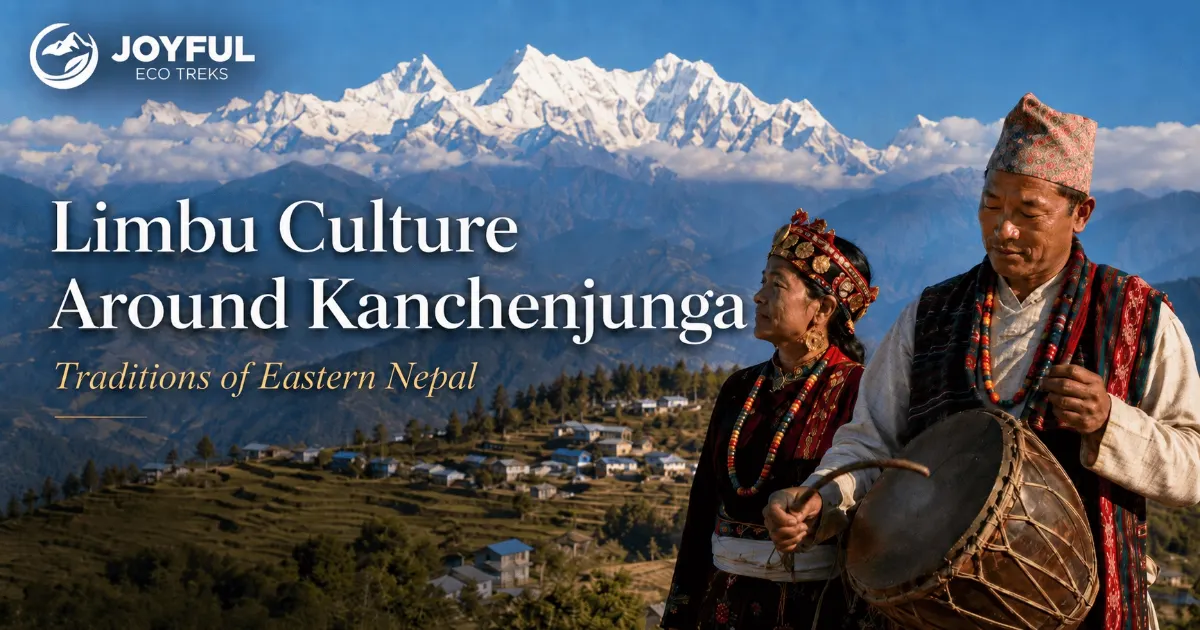
Limbu Culture Around Kanchenjunga :Traditions of Eastern Nepal
Kanchenjunga is usually introduced through its glaciers, high passes, and the immense mountain rising above far eastern Nepal. Yet the lower hills around its trekking routes tell another story. They are part of a living cultural landscape shaped by Indigenous communities whose farms, languages, songs, ceremonies, and family traditions have been part of eastern Nepal for generations.
Among these communities are the Limbu, who also use the name Yakthung. Their historic homeland lies across the eastern hills, including Taplejung, the district through which Nepal’s Kanchenjunga trekking routes pass. For travelers, learning about Limbu culture around Kanchenjunga adds context to the cardamom fields, terraced farms, village homes, local food, music, and seasonal celebrations encountered before the trail climbs into the high Himalayas.
This guide focuses specifically on Limbu culture in the Kanchenjunga region: who the Yakthung people are, the place of Mundhum in cultural life, Chyabrung and Kelang, Yalang and Palam, harvest traditions, food, dress, farming, hospitality, and how trekkers can experience these traditions respectfully.
| Key Highlights • The Limbu, or Yakthung, are an Indigenous nationality with a long cultural connection to Taplejung and the wider eastern hills of Nepal. • Mundhum is central to traditional Limbu religious and cultural life and has been carried largely through oral tradition. • Chyabrung, Kelang, Yalang, and Palam are important forms of Limbu music, dance, and social expression. • Chasok Tangnam is a major harvest tradition centered on gratitude, crops, family, and community. • Cardamom farming, millet, maize, soybean, seasonal vegetables, and fermented foods reflect the agricultural landscape of eastern Nepal. • Nepal Tourism Board has documented a Limbu Cultural Trail in Taplejung connecting toward the wider Kanchenjunga route. |
Table of Contents
ToggleWho Are the Limbu People of Eastern Nepal?
The Limbu are one of Nepal’s officially recognized Indigenous nationalities and commonly refer to themselves as Yakthung. Their ancestral and cultural homeland is associated with the eastern hills historically known as Limbuwan. Taplejung, Panchthar, Sankhuwasabha, Tehrathum, Ilam, and Dhankuta are among the eastern hill districts strongly connected with Limbu settlement and culture.
Taplejung matters especially to trekkers because it is the gateway district for the Nepal side of Kanchenjunga. The journey into the mountains begins in a region where Limbu and Rai communities, hill agriculture, cardamom cultivation, and local market towns shape the landscape long before the trail reaches alpine valleys.
The Limbu language belongs to the Tibeto-Burman language family and is written in the Sirijanga script. Nepali is also widely used, and the language spoken in daily life can vary between households, generations, and settlements.
For visitors, it is useful to understand that the lower Kanchenjunga region is not simply an approach route to a mountain. It is a home, farming area, and cultural landscape in its own right.
Limbu or Yakthung: What Do the Names Mean?
Travelers researching the region will see both “Limbu” and “Yakthung.” Yakthung is a name the community uses for itself, while Limbu remains widely used in Nepal and in English-language travel information. Using both terms respectfully recognizes the community’s own identity while keeping the article clear for travelers searching for Limbu culture.
Local terms such as Yakthung, Mundhum, Chyabrung, Kelang, Yalang, and Palam are worth learning because they carry cultural meanings that do not always fit neatly into a single English translation. They also help avoid flattening the region into a vague idea of “Himalayan culture.”
Mundhum: The Oral Tradition at the Heart of Limbu Life
Mundhum is a central religious, cultural, and literary tradition of the Limbu/Yakthung community. It includes oral narratives, ritual knowledge, teachings, stories about origins and ancestors, and guidance connected with major stages of life. Much of this knowledge has traditionally been passed from one generation to another through recitation and ritual performance.
Traditional ritual specialists can include Phedangma, Samba, Yeba, and Yema. Their roles differ, but they may be involved in ceremonies connected with family life, healing, ancestors, nature, and community traditions.
For a traveler, Mundhum helps explain why land, agriculture, family, ancestors, and nature can be closely connected in Limbu cultural life. A field, forest, household ceremony, or seasonal gathering may carry meaning that is not obvious to someone passing through for a day.
Travelers who want the wider religious picture of the area can also read Joyful Eco Treks’ Sacred Traditions of the Kanchenjunga Region, which covers the mix of Limbu, Rai, Sherpa, Buddhist, and mountain traditions encountered as the trail rises through different cultural zones.
Chyabrung and Kelang: Drum, Dance, and Celebration
Chyabrung is a traditional double-sided drum closely associated with Limbu cultural life, while Kelang is the dance performed with its rhythm. The drum and dance can appear during festivals, weddings, housewarming ceremonies, welcoming events, and other auspicious community occasions.
The drum is carried on the body and played from both sides, creating a strong rhythm that guides the dancers. Some Kelang movements imitate the gait or behavior of birds and animals, reflecting a relationship between performance and the natural world. The exact form can vary by place and occasion.
For trekkers, seeing a Chyabrung or Kelang performance can be memorable, but the setting matters. A village celebration is a community event first. Avoid stepping into the middle of a performance, blocking local participants for photographs, or treating a ceremony as a staged attraction.
Yalang and Palam: Dance, Song, and Social Connection
Yalang, often described as the paddy or rice dance, is commonly performed with Palam, a lyrical form of singing. Palam may be improvised and exchanged between singers, so the performance grows through interaction rather than following only a short fixed verse.
Together, Yalang and Palam create a social space where music, memory, conversation, courtship traditions, and community relationships can meet. That social context is part of what gives the performance its meaning.
Travelers may see Yalang or Palam during festivals and cultural gatherings in eastern Nepal. If you do, watch how local people participate before joining in. If someone invites you, follow their lead rather than assuming that every performance is open to visitors.
Chasok Tangnam: Harvest, Gratitude, and the First Crop
Chasok Tangnam is one of the Limbu community’s best-known harvest traditions. In traditional practice, a portion of the newly harvested crop is offered in gratitude to deities, ancestors, and nature before the new harvest is consumed.
Today, public Chasok Tangnam celebrations may also include family and community gatherings, shared food, Chyabrung or Kelang performances, Yalang, Palam, and traditional games. The festival remains closely tied to agriculture, gratitude, nature, and cultural identity.
Trekkers should avoid planning a trip around a festival date unless the local schedule has been confirmed for that year. Community programs and observance dates can vary. If a trek happens to coincide with Chasok Tangnam, treat the experience as a privilege to observe rather than as an attraction guaranteed by an itinerary.
Farming Life in the Hills Around Kanchenjunga
Some of the clearest signs of Limbu culture around Kanchenjunga are found in ordinary daily life. The lower hills of Taplejung are shaped by terraced farms, village gardens, forest edges, livestock, local paths, and cardamom-growing areas.
Large cardamom is especially associated with eastern Nepal and is visible on parts of the approach to Kanchenjunga. Nepal Tourism Board has also documented cardamom farms along the Limbu Cultural Trail in Taplejung. These farms are more than scenery: they are part of household livelihoods and the wider agricultural economy of the region.
Travelers walking through these areas may see people harvesting, drying crops, carrying fodder, tending livestock, or working on terraces. These everyday scenes can provide a more accurate picture of local culture than a short staged performance.
That is one reason it is worth moving through the lower route with patience. The cultural experience begins well before the high mountains appear close enough to dominate the view.
Food and Drinks You May Encounter in Limbu Areas
Food in the eastern hills reflects what families can grow, preserve, ferment, and source locally. Availability changes by season and village, and many dishes are shared across several communities rather than belonging to only one ethnic group. Trekkers should therefore avoid expecting the same “traditional menu” at every lodge.
Kinema, a fermented soybean food, is strongly associated with eastern Nepal. Dhindo and gundruk are eaten more widely across Nepal, while millet, maize, seasonal vegetables, and locally grown greens also appear in hill diets. Fermentation is especially useful in rural areas because it helps preserve seasonal ingredients and creates distinctive flavors.
Joyful Eco Treks’ Kanchenjunga Circuit Trek also passes through the lower eastern hills before entering the remote high valleys, making the journey a good example of how food, farming landscapes, and culture change with elevation.
What Is Tongba?
Tongba is a traditional alcoholic drink made from fermented millet and is widely associated with Limbu and other communities of the eastern Himalayas. The fermented grain is placed in a vessel, hot water is added, and the liquid is traditionally sipped through a straw.
Visitors may be offered tongba in a home, lodge, or social setting. It is perfectly acceptable to decline politely. If you do try it, remember that it is alcoholic and that drinking traditions can carry social meaning beyond the novelty of tasting something unfamiliar.
Traditional Limbu Dress: What Trekkers May See
Traditional Limbu dress is especially visible during festivals, weddings, dances, and cultural gatherings. Woven fabrics, shawls, headwear, jewelry, and decorative ornaments may form part of ceremonial clothing, while everyday dress in villages is often contemporary.
There is no single outfit worn by every Limbu person. Clothing varies by age, family, place, gender, and occasion, and that variation is part of a living culture rather than a sign that tradition has disappeared.
Photographers should be especially thoughtful during festivals. Traditional dress can be visually striking, but a person wearing ceremonial clothing is still a participant in their own community event. Ask before taking close portraits, especially of children, elders, or people involved in rituals.
Village Hospitality and Everyday Life
Kanchenjunga receives fewer visitors than Nepal’s busiest trekking regions, and many lodges remain small, family-run places. That can make conversations over tea or dinner feel more personal, particularly in the lower villages.
Hospitality should be approached naturally. Follow your host’s lead when entering a home or shared room, ask before stepping into private areas, and show appreciation for food or tea that is offered. Customs can vary from one household to another, so observation is often more useful than memorizing a rigid list of rules.
The Kanchenjunga Conservation Area is also notable for its community-management history. Local participation in conservation links the protection of wildlife and forests with village development and livelihoods. For trekkers, this is another reason to support local lodges, guides, porters, and services while treating the environment carefully.
The Limbu Cultural Trail in Taplejung
Nepal Tourism Board has documented a 4–5 day Limbu Cultural Trail in Taplejung between the Kabeli and Khaksewa river areas. The described route starts at Phungling and passes through Suketar, Lalikharka, Kande Bhanjyang, Simbu, Phungphung, and Phumpe before reaching Mamankhe.
The route is centered on Limbu culture, rural life, farming landscapes, and lower-hill communities rather than on reaching a high mountain viewpoint quickly. The Tourism Board description highlights cardamom farms, local accommodation, meals, and opportunities to spend more time in the villages.
From Mamankhe, the route can connect toward the wider Kanchenjunga trekking trail. Because road access, lodge availability, and local trail conditions can change, confirm the current route before building a standalone trip around the cultural trail.
Where Does Limbu Culture Fit Into a Kanchenjunga Trek?
The cultural landscape changes noticeably as the trail gains elevation. In the lower hills around Taplejung and the approach villages, Limbu and Rai cultural influence is strong. Farming, cardamom cultivation, village homes, and eastern hill food traditions are more visible here.
On the Kanchenjunga South Base Camp Trek, trekkers pass through lower settlements and farming landscapes before climbing toward Yamphuding, Cheram, Ramche, and Oktang on the Yalung Glacier side of Kanchenjunga.
The Kanchenjunga North Base Camp Trek also begins in the eastern hills, but higher in the valley the cultural setting changes. Around places such as Ghunsa, Sherpa and Tibetan Buddhist influences become much more visible through monasteries, prayer flags, chortens, architecture, and high-altitude pastoral life.
The full circuit brings both sides together. That transition is one of the reasons Kanchenjunga feels culturally different from a route that stays within one settlement zone. During a single journey, trekkers move from lower hill agriculture and Indigenous communities into Buddhist-influenced mountain villages, alpine pasture, and glacial terrain.
How to Experience Limbu Culture Respectfully
Respectful cultural travel is usually simple: ask, observe, listen, and avoid treating village life as a tourist display. Remote communities are homes first, even when they also welcome trekkers.
• Ask permission before photographing people, children, homes, rituals, or close-up cultural performances.
• Let your guide or host explain local customs when you are unsure.
• Do not interrupt ceremonies or move religious and cultural objects for a better photograph.
• Accept that some spaces, rituals, or conversations may be private.
• Try local food with curiosity, but do not pressure a host to produce a dish that is unavailable.
• Dress respectfully around ceremonies and community gatherings.
• Support family-run lodges, local guides, porters, and community services when possible.
• Keep waste with you until it can be disposed of properly, especially in remote sections of the conservation area.
Culture also varies between villages and families. A practice described in one source may be observed differently elsewhere. A knowledgeable local guide can help explain the context, but travelers should remain open to differences rather than expecting every settlement to match a fixed description.
Why Limbu Culture Changes the Way You See Kanchenjunga
Kanchenjunga rises to 8,586 m and is the world’s third-highest mountain, so its scale naturally dominates any trek in the region. But height alone does not explain the place. The lower trails cross land where families have farmed, spoken their languages, celebrated harvests, remembered ancestors, and built community life for generations.
Once you understand some of that context, ordinary details begin to mean more. A cardamom plot is part of a household livelihood. A Chyabrung drum carries a cultural rhythm, not just background sound. A fermented dish reflects local crops and preservation methods. A village gathering has meaning that exists whether or not travelers are there to see it.
That is what makes Limbu culture around Kanchenjunga worth learning about. It adds depth to the journey without turning culture into a checklist. The goal is simply to notice more, understand more, and travel with greater respect.
Final Thoughts
Limbu culture is one of the defining cultural threads of eastern Nepal and an important part of the lower Kanchenjunga landscape. Mundhum traditions, Yakthung language and identity, Chyabrung and Kelang, Yalang and Palam, harvest celebrations, farming, local food, and village hospitality all help explain the region beyond its mountains.
You do not need to attend a major festival to experience that culture. Some of the most memorable moments are ordinary ones: a family preparing dinner in a teahouse, cardamom drying beside a home, people returning from the fields, or a conversation with a local guide about the village you have just walked through.
If you want the widest range of landscapes and cultural transitions, the Kanchenjunga Circuit Trek connects the northern and southern valleys. If time is tighter, the South or North Base Camp route can focus the journey on one side of the mountain. Joyful Eco Treks can help match the route to your available days, trekking experience, and cultural interests.
FAQs About Limbu Culture Around Kanchenjunga
Are Limbu and Yakthung the same people?
Yes. Yakthung is a name the Limbu people use for themselves, while Limbu is widely used in Nepal and in English-language travel information. The community has its own language, script, oral traditions, rituals, music, dance, and social customs.
Where do Limbu people live near Kanchenjunga?
Limbu communities are strongly associated with the eastern hills of Nepal, including Taplejung. Trekkers encounter the strongest Limbu and Rai cultural influence in the lower approach areas before the route climbs toward higher Sherpa and Tibetan-influenced settlements.
What is Mundhum in Limbu culture?
Mundhum is a religious, cultural, and oral literary tradition of the Limbu/Yakthung people. It includes narratives, ritual knowledge, teachings, and traditions connected with ancestors, nature, community life, and important stages of life.
What is Chyabrung dance?
Chyabrung is a traditional double-sided Limbu drum. Kelang is the cultural dance performed with its rhythm and can be seen during festivals, weddings, welcomes, housewarming ceremonies, and other important occasions.
What are Yalang and Palam?
Yalang is a traditional Limbu dance often associated with Palam, a lyrical and sometimes improvised form of singing. Together, they create a social performance based on rhythm, song, movement, and interaction.
What is Chasok Tangnam?
Chasok Tangnam is a major Limbu harvest tradition associated with offering part of the new crop in gratitude before it is consumed. Public celebrations may also include family gatherings, food, Chyabrung or Kelang, Yalang, Palam, and traditional games.
Is there a Limbu cultural trek near Kanchenjunga?
Yes. Nepal Tourism Board has documented a 4–5 day Limbu Cultural Trail in Taplejung that starts at Phungling and continues through lower hill settlements toward Mamankhe, from where the route can connect with the wider Kanchenjunga trekking trail. Current access and services should be confirmed before travel.
What traditional foods might trekkers encounter?
Depending on the village and season, trekkers may encounter kinema, dhindo, gundruk, millet, maize, seasonal vegetables, and other locally available foods. Some of these foods are shared across eastern Nepal rather than being exclusively Limbu. Tongba, a fermented millet drink, is also strongly associated with Limbu and wider eastern Himalayan food culture.
Can I experience Limbu culture on a Kanchenjunga Base Camp trek?
Yes. The lower sections of both the North and South Base Camp routes pass through eastern hill communities where Limbu and Rai cultural influence is present. As the route climbs higher, the cultural landscape gradually changes.

All Categories