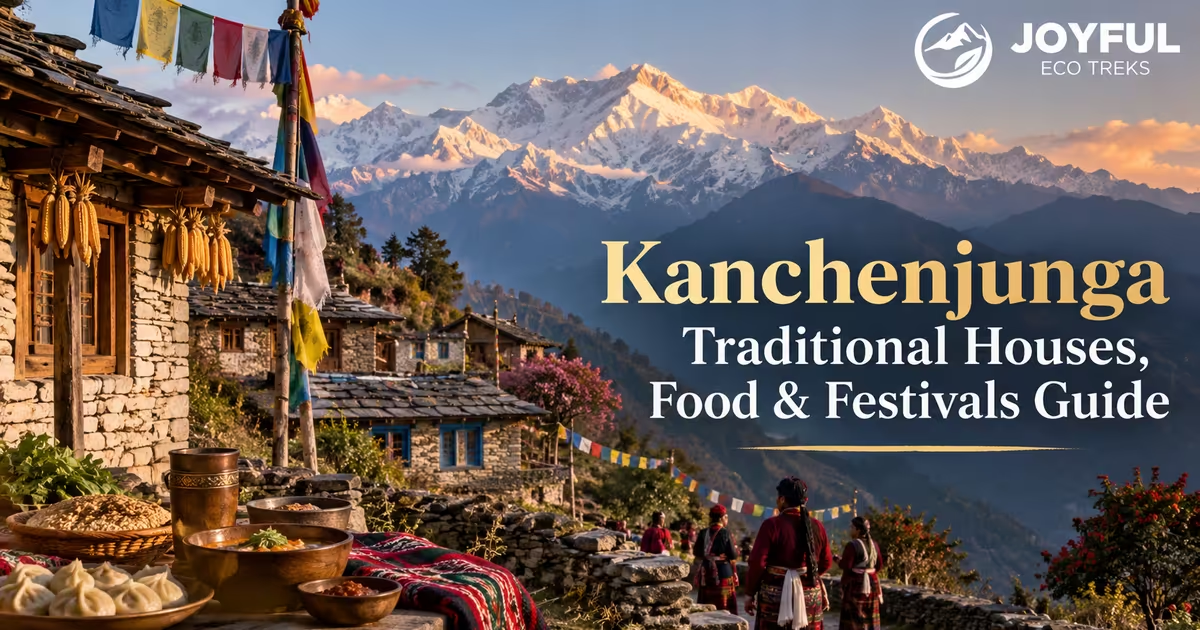
Kanchenjunga Traditional Houses, Food & Festivals Guide
The Kanchenjunga route rises from the lower hills of Taplejung to approximately 5,143 m at Pangpema and passes through several building traditions, kitchens, and festival calendars. These vary by settlement, cultural tradition, season, and access to local materials. This is a field guide to Kanchenjunga traditional houses food festivals: the material culture that logistics blogs skip, mapped to the villages and months you will actually walk through. Far fewer trekkers reach this corner of eastern Nepal than the Everest Base Camp region, so the households you pass are living their own calendar rather than performing anyone’s itinerary.
Table of Contents
ToggleWhy the Kanchenjunga Trail Crosses Three Living Cultures
Elevation influences farming, building materials, and food, but it does not create fixed ethnic boundaries. Limbu communities are prominent across Taplejung’s lower and middle hills, while Rai communities also live within the wider region. Sherpa and other Tibetan-influenced communities are well established in high settlements such as Ghunsa, and the Walung community is centred around Olangchung Gola. The cultural composition varies between valleys and settlements. The distribution matters for a practical reason. The house you sleep beside, the bread on your plate, and any festival you encounter can change as you move between settlements and gain height. These traditions respond to the same practical questions: what grows here, which materials are locally available, and what keeps a household warm at this altitude?
What the buildings and kitchens reveal
The region’s sacred geography sits in a separate article on the mountain’s beliefs, and the deeper genealogy of Limbu identity is covered in our Limbu culture guide. This piece stays on the physical layer: what the houses are made of, what the dishes are and why they exist, and when the festivals fall. Belief accounts tell you what a people hold sacred. The walls and the cooking pots tell you how they actually survive a monsoon and a winter at 3,400 m, which is the part standing in front of you on the trail.
Traditional Houses Built to the Logic of Altitude
Building materials on this trail follow a simple rule: use what the elevation gives you, and defend against what it throws at you. Lower down, that means mud, stone, and heavy monsoon rain. Higher up, it means stone, timber, and sustained cold. The three house types below are the clearest single index of where you are on the circuit.
Limbu mud-and-stone houses below 2,000 m
The standard Limbu house in Taplejung and around Yamphudin is a two-storey rectangle built from stone and mud with carved wooden doorframes. Ground floor: livestock and stored grain. Upper floor: living quarters, warmed slightly by the animals below. Roofs pitch steeply to shed the monsoon that soaks these lower hills.Its defining feature is invisible from the trail. Inside stands the Hang Sitlang, also called the Muring Sitlam, a central wooden pillar with important domestic and ritual meaning. Everyday life, ancestral memory, and ritual are connected with this central part of the house. You may read elsewhere that Limbu houses are stilted timber structures; that describes lower, wetter, bamboo-building pockets, not the mud-and-stone norm the ethnographic record documents for these hills.
Rai bamboo-frame houses in the mid-hills
Rai houses across eastern Nepal vary by settlement, climate, and the materials available locally. Bamboo, timber, stone, mud, slate, and thatch can all appear in traditional construction. Rather than forming one uniform architectural type between fixed elevations, these houses reflect local terrain, rainfall, farming practices, and household needs.
Sherpa stone-and-timber houses above 3,000 m
From Ghunsa (around 3,400 m) up to the high camps toward Pangpema at approximately 5,143 m, cold and wind strongly influence construction. Traditional high-altitude houses commonly use thick stone walls, timber structural elements, relatively small windows, and roofs secured with heavy stones. Their design responds to cold, wind, snowfall, and seasonal rain. Ground floors may serve as storage or livestock space, with living areas above.
The Named Dishes and Trail Food from Taplejung to Pangpema
Tongba and Wachipa: the Limbu table
A host sets down a tall wooden or bamboo canister packed with fermented millet, pours in hot water, and hands you a metal straw (or occasionally a traditional bamboo straw filtered at the base so the seeds stay behind). That is Tongba, and the same word names both the drink and the vessel. You sip, the level drops, and the canister is refilled with hot water from the same grain, each pour milder than the last. Warm, faintly sour, it functions as a hospitality ritual: declining the first pour outright reads as rejecting the welcome, not just the drink.Two things are worth knowing before you drink above the lower villages. Tongba is low in alcohol, roughly 2 to 5 percent by volume, closer to a light beer than a spirit. At altitude, any alcohol dehydrates and can disrupt sleep and impair the judgement you need while acclimatising, so a shared canister at a lower-altitude rest stop is a different proposition from drinking above 4,000 m during an active climb. Treat it as a social pour, not a nightly habit on the high sections.Wachipa is a ceremonial Kirat dish, particularly associated with Rai communities, rather than everyday trail food. Rice cooked with minced chicken, salt, local spices, and a measure of powdered burnt chicken feathers gives it a distinctly bitter edge and a long-standing reputation as restorative. Vegetarian versions replace the meat and feather powder with bitter flowers or leaves. The dish now also appears in ethnic restaurants in cities such as Dharan and Kathmandu.
Sishnu, Phapar ko Roti, and Chhurpi higher up
Three foods are worth recognising as you climb. Sishnu is a soup made from stinging nettles and is eaten by several communities across Nepal’s hills. Phapar ko Roti is a buckwheat flatbread associated with mountain areas, where buckwheat suits short growing seasons and relatively poor soils. Chhurpi, a traditional Himalayan cheese made from yak, chauri, cow, or buffalo milk, comes in soft and hard forms: soft Chhurpi is used in cooked dishes, while hard Chhurpi is slowly softened in the mouth and chewed as a durable snack.
How millet, buckwheat, and potato set the menu
None of this is arbitrary.The menu reflects what households can grow, gather, store, or transport. Millet is important in the lower and middle hills and supports fermented drinks such as Tongba. Buckwheat and potatoes are well suited to colder settlements, while nettles provide a widely gathered seasonal green. Elevation influences the plate, but availability also varies by village, household, and season.
Festivals Mapped to Your Trekking Months
Get the calendar wrong, and you will book a departure that misses the very event you came for. The most common error in trekking blogs drops the main Limbu harvest festival into October. It does not fall in October.Below is the accurate mapping, with 2026 Gregorian dates.
Chasok Tangnam: the Limbu harvest thanksgiving
Chasok Tangnam is the Limbu thanksgiving for the harvest, held on the full moon of Mangsir. In the Gregorian calendar, the full moon of Mangsir lands in late November to December, not October, and in Nepal the 2026 observance falls on 24 December, although local community programmes may be held on nearby dates. Trekkers on an October departure will not see it; a late-November or December trek can. The heart of the festival is the Nwagi offering, in which the first of the newly harvested crops, including rice, is presented to Tagera Ningwaphuma, to ancestors, and to nature spirits. Shamans lead the invocation with Tangsing sacred drums and chants drawn from the Mundhum, the Limbu oral scripture, while households honour Yuma Sammang and exchange visits, with Kelang song cycles running through the celebration. This is a working religious event, not a display, and being present at one without intruding is a genuine piece of luck.
Sakela Ubhauli and Udhauli: the Rai year
The Rai mark two poles of the farming year, and both feature the same dance. Sakela Ubhauli, tied to the spring movement of livestock up to high pasture, opens the planting season on the full moon of Baisakh, which in 2026 fell on 1 May. Sakela Udhauli closes the harvest season around the Mangsir full moon. In Nepal, the 2026 observance falls on 24 December, the same date as Chasok Tangnam, although local programmes may be scheduled on nearby dates. Celebrations may continue for about 15 days and centre on respect for nature, ancestors, and the farming cycle within Kirat traditions.The centrepiece is the Sili, a circle dance choreographed by a named male leader, the Silimangpa, and a female leader, the Silimangma, with the community following their steps in wide rings that echo the movements of birds and the rhythm of farm work. Those roles are specific and named; a guide who can point out the Silimangpa is telling you the dance is the real thing, not a staged version.
Futuk and the high Sherpa and Walung calendar
At Olangchung Gola, the Walung community follows a Tibetan Buddhist lunar calendar. Futuk, also written Phutuk, is documented at this settlement, where masked performances associated with Deki Chholing Monastery reenact a remembered conflict involving rulers linked with Maksum and Thudam. Knowing that narrative is the difference between watching colourful costumes and understanding a re-enacted conflict. Olangchung Gola has approximately 50 to 60 traditional houses and also observes Lhosar and other Buddhist occasions. Futuk generally occurs around October or November, but its exact date follows the local lunar calendar and should be confirmed each year. Olangchung Gola is not included in every standard Kanchenjunga circuit itinerary.
Altitude-Zone Matrix: Kanchenjunga Traditional Houses, Food, and Festivals at Each Elevation
Joyful Eco Treks compiled the table below from published ethnographic accounts and altitude-survey data. The table offers a practical overview of the communities, building materials, foods, and festivals trekkers may encounter, while recognising that these traditions overlap between elevations and settlements.
|
Elevation |
Communities commonly encountered |
Common building materials |
Foods associated with the wider region |
Key festival |
|---|---|---|---|---|
|
Below 2,000 m, including lower Taplejung and Yamphudin |
Limbu and other mixed hill communities |
Stone, mud, timber, and pitched roofs |
Tongba, Sishnu, millet dishes, and dal bhat |
Chasok Tangnam, usually November or December |
|
1,500 to 2,500 m, across the mid-hills |
Limbu, Rai, and other communities depending on the valley |
Bamboo, timber, stone, mud, slate, or thatch depending on the settlement |
Sishnu, Phapar ko Roti, Chhurpi, and dal bhat |
Sakela Ubhauli and Udhauli in communities that observe them |
|
Above 3,000 m, including Ghunsa, Kambachen, and the route toward Pangpema |
Sherpa and other Tibetan-influenced communities |
Thick stone walls, timber elements, small windows, and roofs secured against wind |
Potato, buckwheat dishes, Chhurpi, and dal bhat |
Tibetan Buddhist observances vary by settlement |
|
Olangchung Gola, approximately 3,200 m, on a separate route variant |
Walung |
Traditional stone-and-timber Himalayan houses |
Local highland staples and dairy foods |
Futuk or Phutuk, generally around October or November |
Read it as a practical guide rather than a fixed cultural boundary: elevation influences construction and agriculture, while communities, foods, and festivals overlap between settlements.
Entering Homes, Accepting Meals, and Watching Ceremonies
A few concrete habits carry you through twenty days of village hospitality without a misstep. Remove your boots before stepping onto the raised living floor of any home. Do not step over the hearth or the central pillar; in a Limbu house, the Hang Sitlang is sacred, and treading across it or pointing your feet toward it gives real offence. Receive offers of food and drink warmly, but accept them only if you are comfortable doing so. If you do not drink alcohol or cannot eat something, thank your host and decline politely. At a festival, keep to the edge of the circle unless you are clearly waved in. Sili and Futuk dances can carry ritual and community significance, depending on the setting. Photography that would be fine on a street can be intrusive inside a ceremony, so ask first and accept a no. Etiquette specific to monasteries and temples, where the rules are stricter, sits in our guide to religious-site etiquette in Nepal. The general principle holds everywhere: you are a guest inside a working household and a living faith, not a spectator at an exhibit, and the households of the Kanchenjunga region will meet that respect generously.
FAQs
What traditional foods will I eat in Kanchenjunga villages during the trek?
You may encounter Tongba (warm millet beer), Sishnu (nettle soup), Phapar ko Roti (buckwheat flatbread), and Chhurpi (soft or hard Himalayan cheese), alongside standard dal bhat. Wachipa is a ceremonial Kirat dish, particularly associated with Rai communities, but it should not be expected as everyday teahouse food. What is available varies by settlement, household, and season.
When does Chasok Tangnam happen and can trekkers witness it?
Chasok Tangnam falls on the full moon of Mangsir, which in the Gregorian calendar means late November to December, not October, as many blogs claim. In Nepal, the 2026 observance falls on 24 December, although local programmes may be held on nearby dates. A trek departing in late November or December can realistically coincide with it in Limbu villages below 2,000 m; an October departure will miss it entirely.
How do Limbu mud-stone houses differ from Sherpa stone-timber lodges at higher elevations?
Limbu houses below 2,000 m are two-storey mud-and-stone structures with carved wooden doorframes and steep roofs built to shed monsoon rain, centred on the Hang Sitlang pillar inside. High-altitude houses around Ghunsa use stone and timber to respond to cold, wind, snowfall, and seasonal rain, commonly combining thick walls, relatively small windows, and roofs secured with heavy stones.
Is Tongba millet beer safe to drink at high altitude on the Kanchenjunga trail?
Tongba is often estimated at roughly 2 to 5 percent alcohol by volume, although homemade strength varies. At altitude, alcohol can impair judgement and worsen sleep and breathing during acclimatisation. The CDC recommends avoiding alcohol during the first 48 hours at high altitude, so treat Tongba as an optional social drink rather than a nightly habit on the high sections.
Which trekking months overlap with Sakela or Futuk festivals in the Kanchenjunga region?
Sakela Ubhauli falls on the Baisakh full moon in April or May (1 May in 2026), aligning with a spring trek. Sakela Udhauli falls around the Mangsir full moon, with Nepal’s 2026 observance on 24 December. Futuk at Olangchung Gola generally occurs around October or November according to the local lunar calendar. Because community programmes and lunar dates vary, confirm the schedule locally before planning a trek around either festival. To line a departure up with a real event rather than a vague season, browse the Kanchenjunga circuit trek itinerary to see exactly which Limbu, Rai, and Sherpa villages you pass and which weeks fall inside festival season. If you are weighing the two approaches, the north base camp and south base camp routes pass through different village clusters and, with them, different tables and calendars.

All Categories