Himalayan Festivals Nepal: Month-by-Month Calendar
Search “himalayan festivals nepal” and you get a dozen chronological lists, none of which answer the question a trekker actually has: can I reach this celebration, and what does timing my route around it cost me? A festival in Kathmandu’s Durbar Square and a masked dance at a Khumbu monastery days from the nearest road are not the same planning problem. This calendar maps each major observance to the trail corridor where you can witness it, explains the permit requirements and seasonal access conditions that decide whether attendance is realistic, and closes with a route-by-route timing matrix. Every date below is approximate: Nepal’s festivals shift each year, so treat these as planning anchors and confirm the exact days against current government holiday notices and the relevant monastery or local organizer before you book flights.
Table of Contents
ToggleWhy Nepal’s Festival Dates Move Every Year
Nepal uses the solar Bikram Sambat calendar for civil dates, which sits roughly 56 years and 8 months ahead of the Gregorian calendar. Many Hindu festivals, however, are fixed according to lunar months and tithis recorded in the Nepali patro, so their Gregorian dates change from year to year. That shift is why a date that worked for a friend’s trip two years ago may not line up with yours.
Two Calendars, Two Kinds of New Year
Many Hindu festivals follow lunar months and tithis recorded in the Nepali patro. Tibetan Buddhist observances like Losar and Mani Rimdu follow the Tibetan lunar calendar, which keeps its own month count and intercalation rules. The practical upshot: a single autumn trip can catch a Hindu harvest festival and a Buddhist monastery ceremony governed by two distinct calendrical traditions, and neither will necessarily fall on the date you would guess from last year. Cross-check national holidays against current government notices and monastery festivals against the relevant monastery or local organizer.
How Altitude Decides Which Festivals You Can Reach
Timing is only half the problem. At around 1,300 meters in the Kathmandu Valley, a festival is generally easier to reach; at 4,380 meters on a monsoon trail, the commitment is entirely different. Winter snow can make some high passes unsafe or temporarily impassable, while monsoon rain can disrupt lower trails and road access. Restricted areas require permits arranged through authorized agencies before entry. Before you commit to a festival, check whether its altitude, weather and access conditions make the route realistic.
January and February: Losar in the High Himalaya
Losar is the rare major festival concentrated in the high Himalaya rather than the valley floor, which makes it a genuine reason to trek in winter. “Losar” names at least three separate new years, though, and confusing them will send you to the wrong valley in the wrong week.
Sonam Losar and Gyalpo Losar: Same Name, Different Communities
Sonam Losar, the Tamang new year, falls around January 19 in 2026. Gyalpo Losar, the Sherpa and Tibetan new year, follows about a month later, around February 18. That gap matters because the two communities live on different trails. A late-January route through the Langtang Valley reaches Tamang villages during Sonam Losar, when households hang fresh prayer flags and share chhurpi and home-brewed millet drink. Heading into the Khumbu in late February puts you in Sherpa settlements during Gyalpo Losar, when Namche Bazaar, Khumjung, and the monastery at Tengboche mark the turn of the year with family gatherings and monastery visits. For the cultural background on these observances, the Sherpa people of the Everest region guide goes deeper.
Where Losar Is Most Visible on the Trail
Along the Khumbu corridor, Gyalpo Losar reads most clearly. Namche and Tengboche both sit on the standard Everest Base Camp trek, and winter leaves the lower and middle sections walkable if you are prepared for cold and short days. Sonam Losar concentrates in the Tamang heartland of Langtang and Helambu, a shorter and lower trek that suits a February visitor who wants culture over altitude. Neither is a spectacle staged for visitors. Both are family festivals, and the etiquette section below applies in full.
March to May: Valley Rituals and the Tiji Window in Upper Mustang
Spring is when the valley festivals cluster and the trekking calendar reopens, and it holds the single hardest festival in Nepal to plan around: Tiji, walled off behind a restricted-area permit in Upper Mustang.
Shivaratri and Holi Before the Trails Fill
Maha Shivaratri draws tens of thousands of pilgrims and sadhus to the Pashupatinath temple in Kathmandu, usually in late February or early March. Holi follows a couple of weeks later and runs a day earlier in the hills than on the Terai plains. Both are valley events you would catch before or after a trek rather than on the trail, so slot them into your Kathmandu buffer days rather than building a route around them.
Buddha Jayanti and the May Full Moon
Buddha Jayanti, marking the Buddha’s birth, falls on May 1 in 2026 on the full-moon day of the lunar month. Lumbini, his birthplace in the Terai, and the Swayambhunath and Boudhanath stupas in Kathmandu are major observance sites, where monks and pilgrims circle the domes through the day. This is a valley-and-plains observance rather than a high-trail one, but it lands squarely in the spring trekking season and is worth a day if your itinerary passes through.
Tiji in Lo Manthang: The Ritual and the New Permit Cost
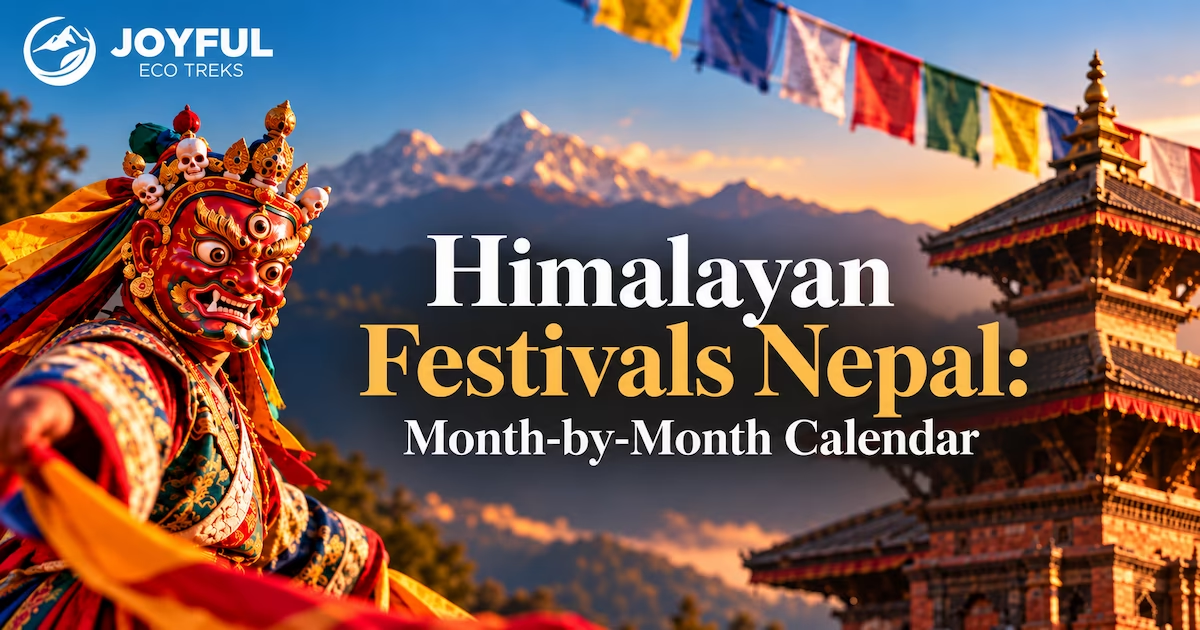
Tiji is a three-day monastic drama staged in the walled city of Lo Manthang. Published 2026 schedules place it in mid-May, but travelers should confirm the final dates with the local monastery or their registered trekking agency before booking. Monks of Lo Manthang perform a named sequence of masked dances: Tsa Chaam on day one, Nga Chham on day two, and Rha Chham on day three, enacting the defeat of a demon and the restoration of order for the coming season. A five-to-six-day visit may be possible by road, but trekking to Lo Manthang and back normally requires a longer itinerary.
Current Department of Immigration information lists the Upper Mustang restricted-area fee as 50 US dollars per person per day. Because some official pages still display the former 500-dollar minimum for the first ten days, travelers should confirm the applicable fee with the Department of Immigration or their registered trekking agency before applying. The permit must be arranged through a registered trekking agency, and you will also need the Annapurna Conservation Area permit to reach the trailhead.
Recent reports indicate that individual foreign travelers may now obtain permits for restricted areas, but the current solo-permit procedure should be reconfirmed with the Department of Immigration or a registered trekking agency. A licensed guide and agency arrangements remain required, so traveling individually does not mean trekking without authorized support. For travelers who prefer two wheels, the Upper Mustang motorbike tour reaches Lo Manthang inside the Tiji window as well.
June to August: Monsoon Festivals and Which Trails Stay Open
Monsoon is low season for good reason: leeches, cloud-blanked views, and slick trails on the popular circuits. Two festivals still make a case for going anyway, and one of them happens directly on a walkable high trail.
Janai Purnima at Gosaikunda: A Festival at 4,380 Meters
Gosaikunda is where a major Nepali festival takes place on an active high-altitude trekking trail rather than in a town. On Janai Purnima, August 28 in 2026, pilgrims climb to the sacred lake at 4,380 meters within Langtang National Park, where Brahmin and Chhetri men traditionally replace the sacred janai worn across the body, while many participants receive a protective thread around the wrist. The route climbs from Dhunche, at around 2,000 meters, to the lake at 4,380 meters.
That altitude gain is the catch. Pilgrims routinely push from Dhunche to the lake in two to three days, a pace that would worry any acclimatization-conscious trekker, and the ascent happens during the wettest month of the year. Lodges fill well in advance, the trail turns into a moving crowd, and the atmosphere is unlike anything on a quiet October route. Build in an extra night to climb slower than the pilgrim stream around you, and expect monsoon cloud rather than the clear ridgelines of autumn. Higher in Mustang and Manang, different communities celebrate Yartung on locally determined dates, with horse racing and other regional traditions in valleys that sit in the rain shadow and stay considerably drier.
Gai Jatra in Bhaktapur and Kathmandu
Gai Jatra, the cow procession, falls in August and reaches its most elaborate form in Bhaktapur, where families who lost a member in the past year lead a cow or a costumed child through the streets in a public, oddly light-hearted reckoning with grief. It is a valley festival, and a strong reason to spend a monsoon day in Bhaktapur while you wait out the weather before an autumn trek.
September and October: Nepal’s Festival Peak Meets Trekking Season
This is the collision that makes autumn Nepal’s busiest window. The two largest festivals of the year run back to back exactly as the post-monsoon skies clear and the trekking season peaks, which is both the appeal and the logistical trap.
Indra Jatra: Eight Days in Kathmandu Before the Trails Fill
Opening the sequence on September 25 in 2026, Indra Jatra runs eight days of masked dances and chariot processions around Kathmandu’s Durbar Square. The living goddess Kumari is pulled through the old city on a wooden chariot, the single most attended event on the valley’s festival calendar. Because it falls before most people start walking, the festival fits naturally into the days you spend in Kathmandu arranging permits and waiting for a flight to the hills.
Dashain: Which Services Close, and What Trekkers Gain
Nepal’s longest festival, Dashain runs fifteen days beginning with Ghatasthapana on October 11 in 2026 and peaking at Vijaya Dashami on October 21. For a trekker, the important fact is not its length but its shutdown. During the main public-holiday period, approximately October 17 to 23 in 2026, government offices and banks close, while transport and tourism services may operate on reduced or heavily booked schedules. A restricted-area permit that needs issuing, a domestic flight that needs rebooking, currency that needs exchanging: any of these tasks will stall if you leave them for that window.
The move is straightforward: front-load anything that depends on an open office. Get permits issued, flights confirmed, and cash drawn before Dashami. Once you are on the trail, Dashain can add meaningful cultural experiences, although some guides, transport services and family-run lodges may have limited availability. Villages you pass are mid-celebration, families invite trekkers to share the feast, and the trail carries a warmth the shoulder weeks lack. The disruption is a booking problem, not a walking one.
Tihar’s Five Nights of Light in the Villages
Tihar, the festival of lights, runs approximately November 7 to 11 in 2026. Laxmi Puja on November 8 is the brightest single night of the Nepali year, when homes and lodges line their walls and windows with oil lamps and marigold strings to welcome the goddess of wealth. On the Annapurna Circuit and through the Langtang villages, lower and middle settlements glow after dark, and Bhai Tika on November 11 closes the festival with sisters blessing brothers. Tihar generally causes less prolonged disruption than Dashain, but public holidays can still affect banks, offices, transport and staffing.
November and December: Mani Rimdu and Late-Season Ceremonies
By November the crowds thin and the monastery festivals of the high Buddhist Himalaya take over, led by the one ceremony a standard trek can catch without a detour.
Mani Rimdu at Tengboche: A Festival on the Descent
Mani Rimdu runs as an extended cycle of private monastic preparation followed by public ceremonies. Multiple 2026 schedules list October 26 to 28 for the three main public days at Tengboche, but travelers should confirm the final monastery schedule before fixing their trek dates.
Tengboche sits three to four days below Everest Base Camp on the standard return to Lukla, so attending requires no detour at all. A normal 14 to 16 day EBC itinerary can be reverse-calculated from the festival date so you pass through Tengboche on the descent around October 26 to 28. Mani Rimdu becomes a route optimization rather than a separate trip. Because the exact date is set by the Tibetan lunar calendar and at least one operator has cited mid-November instead, confirm the year’s public days against the monastery’s own schedule before you fix your start date.
Yomari Punhi and the Late Newari Harvest
Deeper into December, the Newar community marks Yomari Punhi on the December full moon, steaming yomari, a sweet rice-flour dumpling filled with molasses and sesame, to celebrate the rice harvest. By this point, colder conditions, snow and reduced lodge operations make many high trails less accessible, although they are not universally closed. This makes Yomari Punhi a reward for late-season visitors still based in Kathmandu or the valley towns within a day’s travel of the capital. No permit or route planning is needed; a bus to Bhaktapur or Patan puts you at the center of it.
Six Trek Routes Mapped to Himalayan Festivals in Nepal
The table below is the synthesis no chronological list provides: six major corridors set against the eight festival windows above, showing where a festival lands directly on your route, where it is a nearby side trip, and where seasonal conditions make access difficult. The table draws on current government holiday notices, published monastery schedules and standard trek itineraries; every date should still be reverified before booking.
|
Festival window |
Everest Base Camp |
Upper Mustang |
Langtang Valley |
Manaslu Circuit |
Kanchenjunga Circuit |
|
|---|---|---|---|---|---|---|
|
Sonam Losar (mid-Jan) |
Off-season cold |
No |
No |
On-trail, Tamang villages |
Partial, Tamang-Gurung villages |
Off-season cold |
|
Gyalpo Losar (mid-Feb) |
On-trail, Namche and Tengboche |
No |
No |
No |
No |
Cold and potentially snow-affected |
|
Tiji (mid-May) |
No |
Nearby via Jomsom |
On-trail, Lo Manthang |
No |
No |
No |
|
Janai Purnima (late Aug) |
Monsoon-limited |
Yartung nearby, Manang |
Yartung, rain shadow |
On-trail, Gosaikunda |
Difficult during monsoon |
Difficult during monsoon |
|
Indra Jatra (late Sep) |
Kathmandu, pre-trek |
Kathmandu, pre-trek |
Kathmandu, pre-trek |
Kathmandu, pre-trek |
Kathmandu, pre-trek |
Kathmandu, pre-trek |
|
Dashain (mid-Oct) |
On-trail, book permits early |
On-trail immersion |
Permit office closures |
On-trail immersion |
Permit office closures |
Permit office closures |
|
Tihar (early Nov) |
Lower villages lit |
On-trail immersion |
Limited settlements |
On-trail immersion |
On-trail immersion |
Lower villages lit |
|
Mani Rimdu (late Oct) |
On-trail, Tengboche on descent |
No |
No |
No |
No |
No |
Two patterns fall out of the grid. The Khumbu and Langtang corridors are the festival-rich routes: between Losar, the autumn peak, Mani Rimdu, and Gosaikunda, they intersect more festival windows than any other trails. The restricted-area routes, including Upper Mustang and Manaslu, require additional permits and agency arrangements, so a Tiji or Yartung visit should be organized before entry according to the current rules. Kanchenjunga’s own community festivals sit outside this national calendar; the Kanchenjunga food and festival guide covers that region’s distinct observances.
How to Attend a Himalayan Festival Without Getting in the Way
A monastery festival is a religious event that happens to admit visitors, not a performance staged for them, and that difference should govern how you behave.
Photography and Offerings at Monastery Ceremonies
During cham dances, stay at the edge of the courtyard where residents and monks have priority, and never block a doorway or an altar. Ask before photographing monks or interiors, silence your shutter during chanting and the fire puja, and skip flash entirely inside a shrine. Small cash offerings in the donation box are welcome; handing money directly to a dancing monk is not. The guide to religious-site etiquette in Nepal goes into the specifics for temples and gompas alike.
Why Arriving Early and Staying Late Changes the Visit
Public festival days are the visible tip of a much longer observance. Arriving a day early lets you watch the monastery prepare, secure lodging before the festival crowd arrives, and acclimatize if the site is high. Staying through the closing ritual, the fire puja at Mani Rimdu or the final dance at Tiji, is where the meaning resolves, and the crowds have usually thinned by then. Rushing in for the headline dance and leaving the same afternoon is how you see the least.
Questions Trekkers Ask When Planning Around Nepal’s Festivals
Which month has the highest concentration of major festivals in Nepal?
October. Dashain peaks in mid-October, Tihar follows in early November, Indra Jatra runs from late September, and Mani Rimdu at Tengboche falls in late October, all inside the prime autumn trekking window. It is the densest and also the busiest time to plan a festival-timed trek.
Can you attend Mani Rimdu while already on the Everest Base Camp trek?
Yes, and it needs no geographical detour. Tengboche Monastery sits three to four days below base camp on the standard descent to Lukla, so a normal 14 to 16 day EBC itinerary can be timed so you pass through on the expected public festival days, around October 26 to 28 in 2026, after confirming the monastery’s final schedule. Reverse-calculate your Kathmandu departure from the festival date rather than treating Mani Rimdu as a separate trek.
Does Dashain disrupt trekking logistics, or can you still trek during it?
Both are true. Already on the trail, Dashain may affect you less directly and can add village celebrations to the walk, although local services vary. The disruption is administrative: during the main public-holiday period, approximately October 17 to 23 in 2026, government offices and banks close, while transport services may operate on reduced or heavily booked schedules, which can stall permit issuance, flight changes, and currency exchange. Complete every office-dependent task before Vijaya Dashami.
What permits do you need for the Tiji Festival in Upper Mustang?
Two permits are required: the Upper Mustang restricted-area permit and the Annapurna Conservation Area permit. Current Department of Immigration information lists the restricted-area fee as 50 US dollars per person per day, but travelers should confirm the applicable fee because some official pages still show the former 500-dollar minimum. The permit must be arranged through a registered trekking agency. Recent reports indicate that individual foreign travelers may now apply, but the current procedure and guide requirements should be reconfirmed before travel.
How do Sherpa Losar celebrations in the Khumbu differ from Kathmandu?
Gyalpo Losar in the Khumbu is monastery- and family-centered: gatherings in Namche Bazaar, Khumjung, and Tengboche, monastery visits, and home feasts, set against the high mountains around February 18 in 2026. Kathmandu’s Tibetan-community celebrations, concentrated around Boudhanath, are larger and more public. The Khumbu version is quieter, higher, and woven into village life rather than staged for crowds.
Are Nepal’s Himalayan festivals accessible without a guided tour?
Access depends on the route. Valley festivals like Indra Jatra and Gai Jatra need no trekking guide. For trekking routes, check the current Nepal Tourism Board TIMS list before traveling; NTB presently lists Everest Base Camp, Langtang, Gosaikunda and several other routes under licensed-guide and agency-issued TIMS requirements. Restricted areas such as Upper Mustang have additional permit and agency rules. Match the festival to the route’s current requirements before assuming you can trek independently.
To line your chosen festival window up with the right weather and route, read the Joyful Eco Treks best-time-to-visit guide, or use the itinerary builder to sketch a route before you book.

All Categories