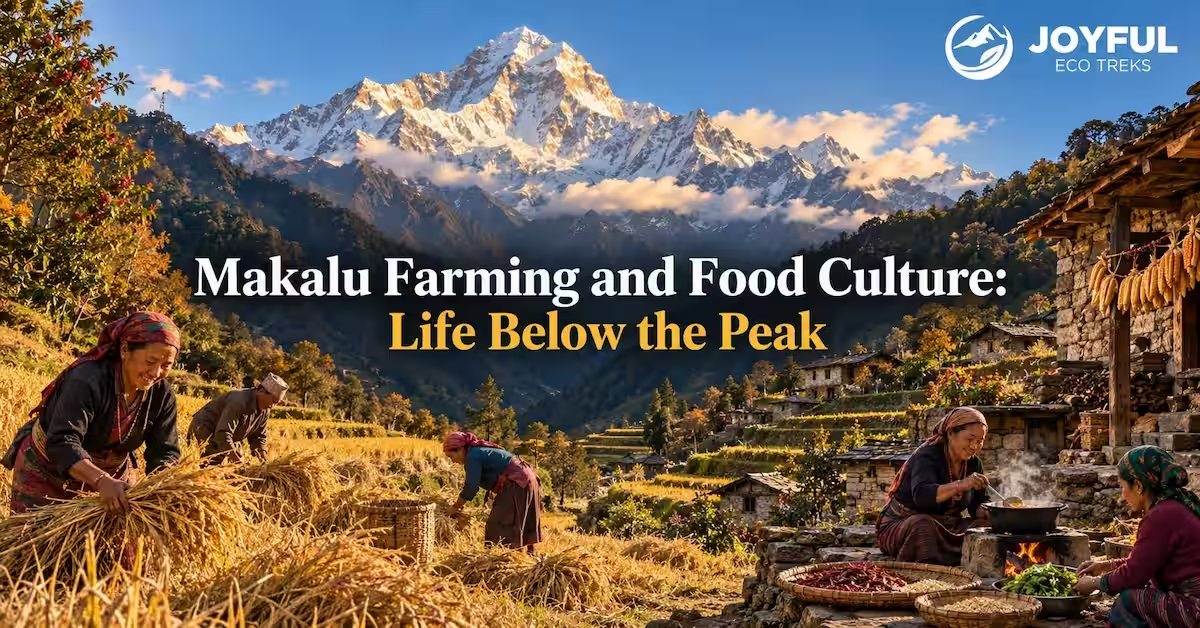
Makalu Farming and Food Culture: Life Below the Peak
Walk from Num to Khongma La and you climb through more than 3,000 metres of cumulative ascent in a few days. Your legs feel it. So does the farming. The dal bhat set down in front of you at a Seduwa teahouse looks almost nothing like the plate two days higher, and altitude explains much of that gap. Makalu farming and food culture reorganises itself around elevation bands, and once you learn to read those bands, the whole corridor makes sense: rice and millet terraces give way to potatoes and hardy grains, then to high pasture where reliable crop cultivation becomes increasingly difficult.
Table of Contents
ToggleThree Elevation Bands Set the Farming Rules
Published forest-ecology research on Makalu-Barun notes that forests below 2,000 metres are strongly affected by subsistence agriculture. That line marks an important divide on the trail. Below it, people farm intensively, terracing workable slopes. Above it, cooler and more humid conditions suppress agricultural activity, and reliable cultivation becomes increasingly limited with elevation while grazing and pasture become more important.
|
Elevation band |
Trail villages |
Main crops |
Who farms |
|---|---|---|---|
|
Below 2,000m |
Num, Seduwa (1,530m) |
Rice, maize, finger millet |
Rai, Yakkha, Limbu |
|
2,000–3,500m |
Tashigaon (about 2,170m) |
Potatoes and hardy grains; cardamom only in suitable lower, shaded sites |
Rai, Sherpa and other local communities |
|
Above 3,500m |
Khongma and Langmale |
Cultivation highly limited; seasonal grazing and transported food become more important |
Seasonal herders and trekking-lodge households |
Timing follows the same general logic. On the valley floor, rice is commonly transplanted into flooded terraces with the summer monsoon and harvested through autumn. In the middle elevations, hardy crops such as buckwheat may be sown after the hardest frosts and harvested before winter returns. Large cardamom can grow in suitable sheltered, shaded and humid lower or middle-elevation sites, although its presence around individual trail villages should be confirmed locally. Above Khongma, cultivation is highly limited and seasonal grazing becomes more important: herders move animals toward summer pasture as snow retreats and bring them down before winter closes in again.
Altitude writes the menu first; community writes it second. Tradition decides how a grain is milled, fermented, or brewed, but whether that grain grows at all is settled by the frost line. In a single day’s climb, you cross what would take hundreds of kilometres to the north on flat ground, a compressed lesson in agronomy stacked into one hillside.
Rai and Yakkha Terrace Farming in the Arun Valley
Hedangna, described as the largest settlement in the Makalu-Barun area, keeps 22 rice species and six millet varieties growing in the fields around it, according to Cultural Survival’s fieldwork there. The women who hold the seed stock track which variety thrives in which microhabitat, a wet corner here, a dry terrace there, and adjust each season’s planting based on what the last one showed them.
Around Num, the roadhead above the Arun, and down at Seduwa, farmers cut narrow steps into slopes far too steep to plough flat, working them by hand and with an ox behind a wooden plough. Maize and finger millet climb the drier terraces; rice takes the wet ones. Large cardamom can grow in suitable shaded, humid sites and is an important cash crop where it is cultivated, sold on rather than eaten.
The valley below Num is not Rai ground alone. The Yakkha are among the diverse communities historically recorded in the wider Makalu-Barun area and farm the lower-Arun slopes, yet they rarely get a mention in writing about Makalu food. Yakkha, Rai, Limbu, and Sunuwar are commonly grouped among Kirati peoples, but farming and drinking practices vary between households and places. Their traditions also overlap and interact with those of Sherpa communities higher up (Sherpa and Rai traditions).
Farm work here has never been only farm work. Households split their labour between the terraces and the forest, gathering fodder and firewood and foraging wild lapsi fruit that gets pounded into a sharp chutney. Winter, once the harvest is in, was traditionally the season for trading trips down to the towns for salt and cooking oil. Older Rai land rights ran through the Kipat system, a communal tenure that once gave cultivators tax-free hold over defined stretches of land, forest, and stream, though land reform dismantled most of that generations ago.
Sherpa Agriculture Above Seduwa and Tashigaon
As you climb toward the upper settlements, grain cultivation becomes less reliable rather than stopping at one fixed elevation. Sherpa farmers in high Himalayan areas often rely heavily on potatoes because they store through winter and tolerate colder conditions than rice. The exact upper limit of cultivation varies with slope, aspect, water, soil and local microclimate.
Locally cultivated grain becomes less dependable as the season shortens and nights grow colder, while transported rice and flour may still appear in household and teahouse meals. Livestock therefore becomes increasingly important. In the warm months, herds move toward high pasture for milk; that milk is processed into butter and churpi, the hard cheese commonly dried for long storage.
Those grazing rotations are not open-ended. Access to forest and pasture can be shaped by park and buffer-zone rules as well as customary, leased or negotiated local grazing rights. The applicable arrangement varies by location, so it should not be described as a single Community Forest User Group system across the entire corridor. At higher elevations around Khongma and beyond, grazing becomes increasingly seasonal toward the exposed basins below Base Camp.
Everyday Food Across the Makalu Corridor
The staples of Makalu farming and food culture repeat all along the corridor, but each community shapes them differently, and altitude determines which version lands on the table.
Dhido, and Why the Grain Changes With Height
Dhido is the workhorse meal: a stiff porridge of flour and hot water, worked into a dough and eaten by the pinch with a dip, not a spoon. Which flour is used depends on household preference, availability and elevation. In the lower Arun, finger millet may produce a dark, faintly bitter meal dense enough to carry you all day. Where buckwheat is available, the same dish turns greyer and earthier. One dish can therefore reflect different grains across the corridor.
Sinki and Gundruk: Refrigeration Without Electricity
Sinki is the more remarkable of the region’s two great ferments. In one documented traditional method, radish taproots are prepared and pressed into a lined pit, then covered to ferment in a low-oxygen environment. Lactic-acid fermentation develops the sour flavour before the radish is removed and sun-dried for extended storage. The preparation method and fermentation time can vary by household and locality.
Gundruk uses similar lactic-acid fermentation above ground. A commonly documented method wilts surplus mustard, radish, or cauliflower leaves, packs them into a container, ferments them for about a week, and then sun-dries them. Pediococcus and Lactobacillus species have been associated with the process, and a final pH around 4.0 has been reported. Dried gundruk becomes a sour winter store when fresh vegetables are less available, and it is often prepared at household level.
Both foods are, in effect, preservation systems that run on bacteria rather than electricity, useful where winter greatly limits fresh vegetable production.
Tongba, Chhang, and Raksi by Community
Tongba is where community, not just altitude, shows on the table. The traditional associated with the Limbu, it is also consumed among Rai and Yakkha communities: fermented millet is packed into a vessel, topped with hot water, and drunk through a filtered bamboo straw, with the grain refilled several times. Chhang is a broader Himalayan fermented-grain drink whose grain, preparation time and serving style vary by household and locality. Because grain and prepared alcohol can be traded or transported, the drink map does not perfectly match the crop map. Raksi, the clear distilled spirit, is found across multiple communities.
Ceremonial Food in Kirant and Sherpa Communities
Festival food is where a year of farming turns into meaning. Kirati communities connect seasonal observances such as Sakela with planting, harvest and thanksgiving, but specific offerings vary between communities and places. Limbu households celebrate Chasok Tangnam as a harvest thanksgiving associated with offering the season’s first produce.
Sherpa ceremonies may feature butter tea, butter lamps, grains and breads, although practices vary by family, monastery and occasion. These traditions should not be reduced to a fixed contrast between lowland grain, poultry and spirits and highland dairy, because communities and ritual practices overlap across the corridor.
What Trekkers Actually Eat From Num to Khongma La
Makalu farming and food culture reaches most trekkers first at the dinner table, and the menu can reflect the fields outside. In Seduwa, dal bhat may include rice and greens produced in the lower valley, while other ingredients are purchased or transported. Prices vary by lodge, season and supply conditions, so trekkers should confirm current menus locally. This lower stretch generally offers a stronger possibility of locally grown ingredients. For how these villages string together into a full itinerary, the Makalu region overview lays out the corridor.
Climb past Tashigaon and the menu narrows fast. By Langmale Kharka at about 4,450 metres, even a simple plate of potatoes reflects the difficulty of supplying high camps. The presence of potatoes on the menu does not prove they were grown at Langmale; ingredients at this elevation are commonly carried from lower settlements by porter or pack animal. A thinning menu and increasingly limited cultivation are closely connected, but they are not exactly the same thing.
How Makalu Farming and Food Culture Is Changing
Demographic change may be placing pressure on farming, as younger people seek education and wage work elsewhere. However, hard Makalu-specific figures are scarce. Research from other parts of Nepal can illustrate how migration may affect agricultural labour, but it cannot establish the scale of farm exit or terrace abandonment around Tashigaon. Those local claims require Makalu-specific census data, field observation or interviews.
Trekking has also influenced the food supply. Teahouses create demand for eggs, vegetables, potatoes and transported staples, while generating cash income for households along the route. The balance between trekking work, farming labour and imported food varies between villages, but the higher camps generally depend more heavily on supplies carried from lower elevations.
Frequently Asked Questions
What crops actually grow above 3,000 meters in the Makalu region?
Annual cropping becomes increasingly limited above 3,000 metres, but there is no single universal cutoff. Potatoes and hardy grains may grow in suitable sheltered sites, depending on aspect, soil, water and local microclimate. Above roughly 3,500 metres, seasonal grazing generally becomes more important, and claims of crops grown at specific high camps such as Langmale require local confirmation.
Can trekkers eat locally grown food on the Makalu Base Camp trail?
Yes, especially in the lower villages. From Num through Seduwa and toward Tashigaon, some teahouse meals may draw on locally produced rice, millet, potatoes or greens, depending on the season and household. Above Tashigaon the local supply becomes more limited, and high camps rely increasingly on ingredients carried by porter or pack animal.
How does Rai fermented food like gundruk differ from Sherpa preparation?
The difference is better described as one of available ingredients and household tradition rather than a strict ethnic divide. Gundruk and sinki are fermented vegetable foods found widely in Nepal, while dairy preservation through products such as butter and churpi becomes more important in many livestock-keeping highland households. Practices overlap, and ingredients may also be traded between elevations.
What is tongba and which communities in the Makalu area drink it?
Tongba is a warm millet-based alcoholic drink: fermented grain is packed into a vessel, topped with hot water, and sipped through a filtered bamboo straw. It is traditionally associated with the Limbu and is also consumed among Rai and Yakkha communities. Chhang is another Himalayan fermented-grain drink, but preparation and serving practices vary, and community drinking traditions should not be treated as completely separate.
How has out-migration from Makalu villages affected local farming over the past decade?
Out-migration may reduce the agricultural workforce and contribute to fallow land, but no Makalu-specific evidence cited here establishes the scale around Tashigaon. Research from other parts of Nepal can suggest a possible mechanism, not prove a local outcome. Makalu-specific census data, land-use analysis or household interviews are needed before quantifying the effect on farming and trail food supplies.
Read the full Makalu Base Camp trek overview to see how farming villages like Num, Seduwa, and Tashigaon fit into the route day by day.

All Categories